
What Cleans Floors Better Than a Mop?

Quick Answer
A steam mop can clean stuck-on grime better than a traditional string or sponge mop on suitable sealed floors because heat helps loosen residue while a microfiber pad lifts it away. However, a powered floor scrubber or wet-dry floor cleaner may work even better on heavy messes, while a microfiber flat mop is safer for moisture-sensitive floors. Steam mop guidance from Consumer Reports also highlights the advantage of using less water than traditional bucket mopping.
Best alternatives to a traditional mop
- Steam mop: Strong choice for loosening dried spills and greasy residue on compatible sealed surfaces.
- Electric scrubber: Powered pads reduce manual scrubbing when dirt is firmly stuck to the floor.
- Wet-dry cleaner: Vacuums loose debris while washing the floor, making it useful for busy homes.
- Microfiber flat mop: Uses controlled moisture and is often the safer approach for wood and laminate.
- Robot mop: Best for maintaining lightly soiled floors automatically rather than deep-cleaning heavy grime.
The key rule
- Choose the cleaning method for your floor material first. More heat, water, or scrubbing power does not automatically mean better cleaning.
If your regular mop seems to push dirty water around instead of leaving the floor clean, you have several better options. Steam mops are especially useful for certain sealed hard floors, but they are not safe for every surface.
This guide explains what works better, where steam cleaning makes sense, and when a simple microfiber mop remains the smarter choice.
In This Guide
- What cleans floors better than a traditional mop?
- Why can a steam mop clean better?
- Which floors can you safely clean with steam?
- Steam mop vs electric mop vs wet-dry cleaner
- What works best for different floor messes?
- How can you get floors cleaner without damaging them?
- When is a regular mop still better?
- Frequently asked questions
- Final takeaway
What Cleans Floors Better Than a Traditional Mop?
For many sealed hard floors, a steam mop, electric scrubber, or wet-dry floor cleaner can outperform a basic string or sponge mop. Each improves cleaning in a different way.
A traditional mop depends heavily on water, cleaner, and manual pressure. Once the mop head becomes dirty, it can start moving contaminated water from one area to another.
- Steam mops use heated vapor to loosen grime before a microfiber pad picks it up.
- Electric mops use rotating or vibrating pads to provide mechanical scrubbing.
- Wet-dry floor cleaners collect loose debris and dirty liquid instead of leaving both on the floor.
- Microfiber flat mops trap fine dust while using much less moisture than many traditional mops.
- Robot mops maintain lightly dirty floors with frequent automated passes.
That does not make one system universally best. Tile can tolerate cleaning methods that would be risky on hardwood or some laminate floors.
What does “clean better” actually mean?
I look at more than whether the floor appears shiny. Effective floor cleaning should remove loose grit, oily film, dried spills, and cleaner residue without damaging the surface.
A method also works better when it avoids leaving dirty water behind. Fast drying and controlled moisture matter on many modern floors.
Section Takeaway: A powered cleaner may remove stubborn soil faster, but floor compatibility matters more than raw cleaning power.
Why Can a Steam Mop Clean Better?
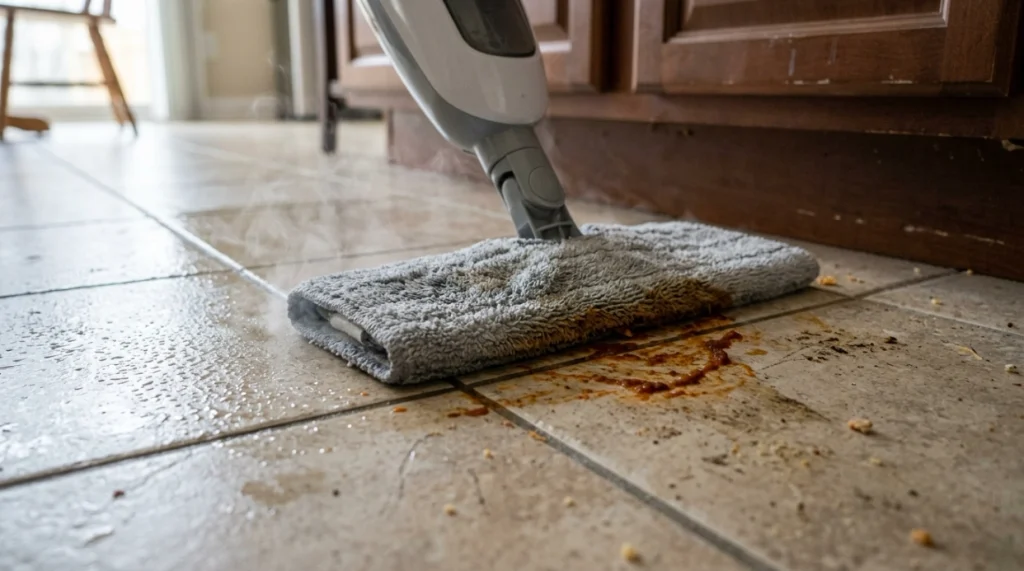
A steam mop can be more effective because heat softens some dried-on residue while the pad supplies physical wiping. You also avoid repeatedly dipping the cleaning surface into a bucket of increasingly dirty water.
A steam mop is an electric floor-cleaning appliance that heats water in an internal tank and releases steam through a washable or disposable floor pad.
Steam loosens stubborn residue
Sticky kitchen splashes and dried footprints can require repeated passes with a cool damp mop. Steam can loosen that film so the pad removes it with less aggressive scrubbing.
This is particularly useful on compatible tile and other sealed surfaces. Two slow passes often work better than racing repeatedly across the same spot.
It uses relatively little water
Steam mops do not flood a floor with a bucket of cleaning solution. Consumer Reports notes that their lower water use can also help floors dry faster than conventional bucket mopping.
Less surface water can make the cleaning process more convenient. It does not, however, make steam safe for moisture-sensitive materials.
Fresh pads help prevent soil redistribution
A microfiber pad captures loosened grime. The advantage disappears once the pad becomes saturated with dirt.
Keep a second clean pad nearby when cleaning a large kitchen or several rooms. Change the pad when it becomes visibly soiled rather than finishing the entire house with one pad.
Steam is not automatically a disinfecting shortcut
Steam can expose surfaces to high temperatures, but sanitation claims depend on temperature, exposure time, and the specific machine. Do not assume a quick pass has disinfected the floor.
The CDC distinguishes routine cleaning from disinfection and notes that normal cleaning is sufficient in many household situations.
Safety note: Follow your steam mop instructions and the floor manufacturer’s care guide before applying heat or moisture.
Which Floors Can You Safely Clean With Steam?
Steam works best only when both the flooring manufacturer and the steam-mop manufacturer allow it. Never choose steam simply because a floor looks waterproof.
Tile
Many sealed ceramic and porcelain tile floors are good candidates for steam cleaning. The combination of heat and microfiber wiping works well around kitchens, entryways, and bathrooms.
Pay attention to grout condition. Cracked grout or failing seals can let unwanted moisture travel below the surface.
Vinyl and LVP
Luxury vinyl plank and sheet vinyl are water-resistant, but steam compatibility varies. High heat can affect adhesives, seams, or layers in products not designed for steam cleaning.
Check the exact care instructions first. A damp microfiber mop is the safer fallback when the manufacturer does not clearly permit steam.
Hardwood and engineered wood
I would not treat steam as the default choice for wood flooring. The National Wood Flooring Association recommends avoiding wet mops and steam mops on wood floors.
The NWFA instead recommends routine sweeping, dust mopping, or vacuuming and using a cleaner suited to the floor finish.
Laminate
Laminate can look waterproof while still having vulnerable joints and a fiber-based core. Moisture or heat reaching those joints can cause swelling or edge damage.
A lightly damp microfiber flat mop with a laminate-approved cleaner usually gives better control.
Natural stone
Natural stone requires care because finishes, sealers, and stone types differ. Use a stone-compatible, preferably pH-neutral product unless the flooring supplier specifies another method.
Safety note: Always test an unfamiliar cleaning method in a small hidden area and follow the manufacturer’s care instructions.
Steam Mop vs Electric Mop vs Wet-Dry Cleaner
The best alternative depends on the kind of dirt you deal with most often. This comparison shows where each method has an advantage.
| Cleaning method | Best use | Main advantage | Main limitation |
|---|---|---|---|
| Steam mop | Sticky residue on compatible sealed floors | Heat loosens grime with little added cleaner | Not suitable for many wood and laminate floors |
| Electric spin mop | Dull film and stubborn surface dirt | Powered scrubbing reduces hand effort | Does not usually vacuum debris first |
| Wet-dry floor cleaner | Crumbs, hair, spills, and daily grime | Vacuums and washes in one routine | More parts require cleaning after use |
| Microfiber flat mop | Wood, laminate, and routine maintenance | Excellent moisture control | Requires more manual work on dried grime |
| Robot mop | Frequent light maintenance | Automates routine cleaning | Limited power on stubborn buildup |
Which one gives the deepest clean?
For stuck-on dirt on a steam-safe surface, a good steam mop or powered scrubber usually has the edge over basic manual mopping. Mechanical action matters when residue has bonded to the floor.
For a house full of crumbs, pet hair, and wet footprints, a wet-dry cleaner can be more efficient because it removes dry and wet debris in one workflow.
Which one is safest?
A well-wrung microfiber flat mop offers the most control over moisture. That makes it my preferred general method when floor compatibility is uncertain.
Simple can be better. A sophisticated machine is only useful when the floor can safely handle it.
What Works Best for Different Floor Messes?
No cleaner wins every mess. Match the tool to the soil before reaching for more chemicals.
- Dry dust and grit: Vacuum or dry microfiber mop first. Wet cleaning dry grit can turn it into muddy residue.
- Sticky food spills: A steam mop can work well on approved sealed surfaces because heat helps soften dried residue.
- Greasy kitchen film: Use a floor-compatible cleaner that can break up oily residue, followed by a clean pad.
- Pet hair: Vacuuming first is more effective than trying to collect large amounts of hair with a wet mop.
- Pet accidents: Remove the mess promptly and use a floor-compatible cleaner designed for the affected surface.
- Muddy footprints: Let heavy mud dry, remove loose material, then damp-clean what remains.
- Cleaner buildup: Reduce product concentration and rinse only when the cleaner’s directions call for it.
What about disinfecting a floor?
Most household floors do not need constant disinfection. The CDC says routine cleaning with an appropriate cleaner is enough in many everyday situations.
If disinfection is needed, use a product labeled for the surface and follow its required contact time. Cleaning and disinfecting are different jobs.
The EPA explains the difference between cleaning, sanitizing, and disinfecting and recommends following product-label directions.
Safety note: Never mix cleaning or disinfecting chemicals. Check both the product label and your flooring manufacturer’s instructions.
How Can You Get Floors Cleaner Without Damaging Them?
Better technique often improves results more than buying a stronger chemical. The biggest mistake is trying to wet-clean everything in one step.
- Remove loose debris first. Vacuum, sweep, or dry-mop dust, sand, crumbs, and hair.
- Identify the flooring. Confirm whether you have hardwood, laminate, vinyl/LVP, tile, stone, or another material.
- Choose a compatible method. Use steam only when the flooring guidance permits it.
- Use the correct amount of cleaner. Extra solution can leave sticky residue and attract more dirt.
- Work in small sections. A roughly 3-by-3-foot area makes it easier to control moisture and inspect the result.
- Change dirty pads or water. Do not keep spreading visibly dirty solution across the room.
- Let the floor dry. Keep foot traffic low until the surface is dry to reduce footprints and slip risk.
Why does too much cleaner make floors look worse?
Many floor cleaners are concentrates or carefully balanced formulas. Using more than directed can leave surfactant residue that makes a floor feel tacky or look streaky.
Measure the product according to its label. More chemical does not mean more cleaning power.
What if you want a gentler cleaner?
Look for a product made specifically for your floor type. The EPA Safer Choice program can also help consumers identify cleaning products whose ingredients meet its safety criteria.
Avoid assuming homemade vinegar mixtures are universal floor cleaners. Acids can be inappropriate for some stone surfaces and certain finishes.
Section Takeaway: Vacuum first, use controlled moisture, and follow your flooring care guide. Those three habits solve more cleaning problems than aggressive scrubbing does.
When Is a Regular Mop Still Better?
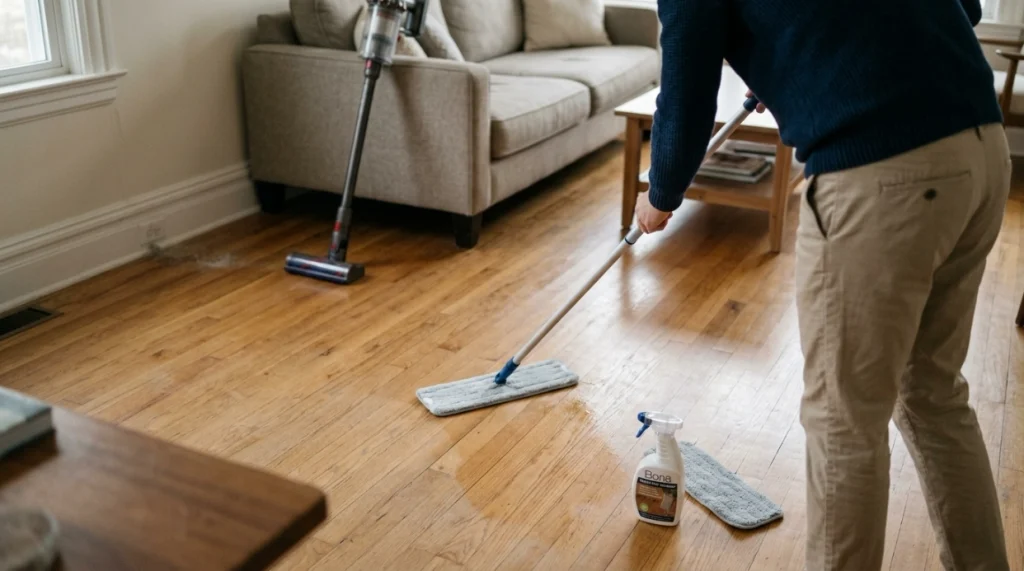
A traditional mop is still useful when you need an inexpensive, simple tool for a large washable surface. It also gives you complete control over the cleaning solution.
A microfiber flat mop is particularly hard to beat for routine maintenance because it is light, inexpensive, and easy to rinse.
Choose a manual mop when:
- You have moisture-sensitive flooring that should not be exposed to steam.
- You only need to remove light surface dirt.
- You want minimal equipment maintenance.
- You need precise control over how much cleaning solution reaches the floor.
- You are cleaning a small area where setting up an electric machine would take longer than the job itself.
A good manual mop also costs less to maintain. There are no pumps, batteries, heating elements, dirty-water tanks, or powered brush heads to clean.
The key is using it correctly. Start with vacuuming, use clean water or properly diluted cleaner, and replace dirty mop water before it turns gray.
Frequently Asked Questions
Is a steam mop better than a normal mop?
A steam mop can clean dried-on grime more effectively on steam-safe sealed floors because heat helps loosen residue. A normal damp microfiber mop is safer for many hardwood and laminate floors, so the better choice depends on the flooring material.
What cleans floors better than mopping?
A wet-dry floor cleaner can outperform ordinary mopping when the floor has hair, crumbs, spills, and surface grime because it removes debris while washing. For stuck-on residue, a compatible steam mop or powered scrubber may provide stronger cleaning action.
Does a steam mop remove sticky floors?
Steam can help loosen sticky residue on compatible sealed surfaces. If the stickiness comes from excessive cleaning product, however, you also need to correct the product concentration and remove the existing residue.
What is the best way to deep-clean tile floors?
Vacuum loose grit first, then use a tile-compatible cleaner or an approved steam mop. Focus on high-traffic sections and dirty grout rather than repeatedly soaking the entire floor.
Can I use a steam mop on hardwood?
The National Wood Flooring Association advises against wet mops and steam mops on wood flooring. Use a dry or slightly damp cleaning method and a cleaner recommended for your specific wood-floor finish.
Is an electric mop better than a steam mop?
An electric mop can be better when mechanical scrubbing is the priority and steam is unsuitable. A steam mop has an advantage on compatible surfaces where heat can help soften dried-on residue.
Do you still need to vacuum before steam mopping?
Yes. Removing hair, crumbs, sand, and dust before wet cleaning prevents loose debris from collecting around the steam pad and reduces the chance of dragging abrasive grit across the floor.
What Should You Use Instead of a Traditional Mop?
If you have compatible sealed tile or another steam-approved surface, a steam mop is one of the strongest upgrades for tackling dried spills and sticky grime without carrying a bucket around.
For daily mixed messes, consider a wet-dry floor cleaner. For stubborn film, a powered electric mop can provide more scrubbing action.
For hardwood, laminate, or any floor where moisture is a concern, stay with a microfiber flat mop and a manufacturer-approved cleaner. The best floor cleaner is not the most powerful machine; it is the method that removes dirt without shortening the life of your floor.
