
What Floors Can You Use Steam Mops On?

Quick Answer
You can usually use a steam mop on sealed ceramic tile, porcelain tile, and some sealed concrete floors. Avoid steam on hardwood, engineered wood, laminate, LVP, sheet vinyl, linoleum, cork, and most natural stone unless the flooring manufacturer explicitly approves it. Even on tile, follow the manufacturer’s care instructions, such as this tile and stone floor-care guidance.
Steam mop compatibility by floor type
- Ceramic and porcelain tile: Usually safe when the tiles and grout are sealed and undamaged.
- Sealed concrete: Often suitable, but avoid steaming cracked, painted, waxed, or poorly sealed concrete.
- Hardwood and engineered wood: Usually unsafe because heat and moisture can affect boards, seams, adhesive, and finish.
- Laminate and vinyl: Avoid steam unless the exact flooring manufacturer gives written approval.
- Natural stone: Use a pH-neutral cleaner instead because steam may affect sealers, fillers, and existing cracks.
- Unknown flooring: Do not steam it until you identify the material and read its care guide.
Before you start
- Check the floor warranty, test a hidden area, and use the lowest effective steam setting.
A steam mop can lift grime quickly, but it is not a universal floor-cleaning tool. I have tested steam mops across several hard surfaces, and the floor’s construction matters more than how durable it looks.
This guide explains which floors can handle steam, which ones cannot, and what to use instead. It also covers safe technique, warning signs, and common mistakes.
In This Guide
- How Does a Steam Mop Affect Flooring?
- Steam Mop Floor Compatibility Chart
- Which Floors Are Usually Safe for Steam Mops?
- Which Floors Should You Not Steam Mop?
- Why Does Manufacturer Approval Matter?
- How Do You Use a Steam Mop Safely?
- What Are the Warning Signs of Steam Damage?
- What Can You Use Instead of a Steam Mop?
- Frequently Asked Questions
- Final Takeaway
How Does a Steam Mop Affect Flooring?
A steam mop heats water and pushes hot vapor through a reusable cleaning pad. The heat loosens soil while the pad collects the released dirt.
Unlike a microfiber flat mop, a steam mop combines three forces:
- Heat: Softens greasy or dried-on residue.
- Moisture: Moves into surface texture, grout lines, and open seams.
- Pressure: Directs vapor toward the floor and its joints.
That combination works well on some sealed, heat-resistant materials. It can damage layered, glued, porous, waxed, or moisture-sensitive flooring.
Why “waterproof” does not always mean steam-safe
A waterproof wear layer may resist ordinary spills from above. It does not guarantee that hot vapor cannot enter plank seams or reach the adhesive below.
Steam can also cool and condense into liquid. That moisture may remain beneath a floating plank long after the visible surface looks dry.
Does steam disinfect a floor?
Cleaning and disinfecting are different jobs. Cleaning removes soil, while disinfection requires a compatible product and its stated wet contact time.
The CDC’s home cleaning guidance says regular cleaning is often enough in most homes. Disinfection is more relevant when someone is ill or a high-touch surface needs extra treatment.
Do not assume one quick pass with a steam mop disinfects every floor. Performance depends on temperature, contact time, movement speed, and the machine’s instructions.
Safety note: Check both the flooring care guide and steam mop manual before relying on heat for sanitation.
Steam Mop Floor Compatibility Chart
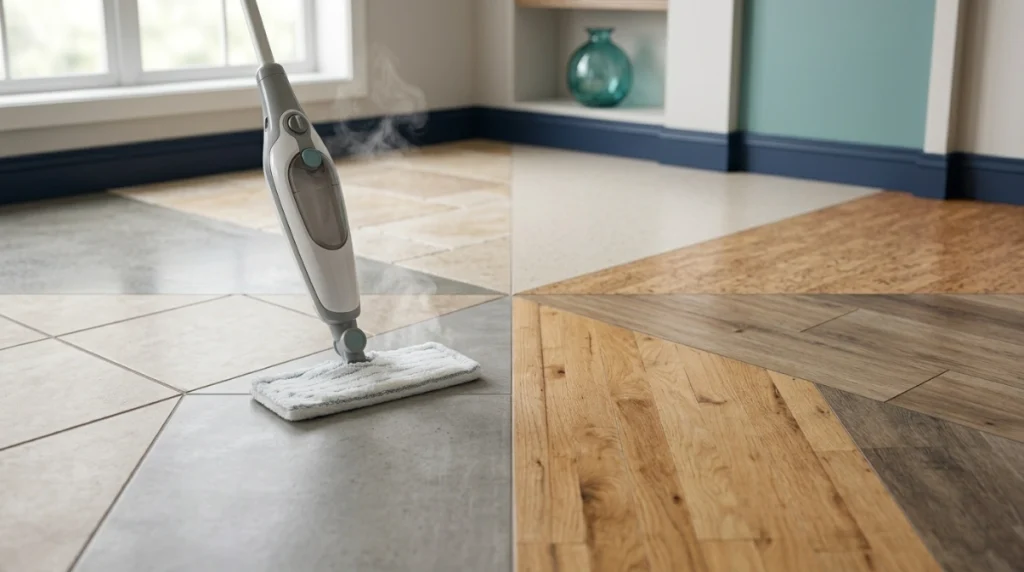
The following chart gives a conservative starting point. The exact manufacturer’s instructions always take priority.
| Floor type | Steam mop? | Main concern | Safer cleaning choice |
|---|---|---|---|
| Sealed ceramic tile | Usually yes | Damaged grout or loose tiles | Low steam setting or damp microfiber mop |
| Sealed porcelain tile | Usually yes | Cracked grout and unsealed joints | Low steam setting or pH-neutral cleaner |
| Sealed concrete | Sometimes | Weak sealer, paint, wax, or cracks | Microfiber mop with neutral cleaner |
| Hardwood | Usually no | Finish damage, cupping, and seam moisture | Barely damp microfiber mop |
| Engineered wood | No unless approved | Layer separation and adhesive damage | Manufacturer-approved wood cleaner |
| Laminate | Usually no | Swollen core and raised edges | Nearly dry microfiber mop |
| LVP or LVT | Usually no | Adhesive, seams, and wear-layer damage | Damp microfiber mop |
| Sheet vinyl | Usually no | Expansion and glue-bond problems | Damp mop with approved cleaner |
| Natural stone | Avoid unless approved | Sealer, fillers, and hidden cracks | Stone-safe pH-neutral cleaner |
| Linoleum or cork | No unless approved | Moisture, seams, finish, and adhesive | Well-wrung microfiber mop |
Safety note: Treat “sometimes” as “no” until the maker of your exact flooring approves steam cleaning.
Which Floors Are Usually Safe for Steam Mops?
Sealed ceramic tile, sealed porcelain tile, and certain sealed concrete floors are the best candidates. They still require inspection and careful technique.
Sealed ceramic and porcelain tile
Glazed ceramic and porcelain tiles resist surface moisture and heat better than wood-based planks. Sound grout and intact sealant are essential.
Before steaming, check for:
- Cracked, missing, or powdery grout
- Loose or hollow-sounding tiles
- Open gaps around walls and fixtures
- Chipped areas exposing a porous tile body
- Recent grout or sealer that has not fully cured
Steam can force moisture into damaged grout. Repeated exposure may worsen an existing weakness rather than create an immediate visible problem.
In my tests, tile cleaned best when I vacuumed first and kept the mop moving. Holding the head over one sticky spot left the grout wetter without improving the result much.
Sealed concrete
A properly sealed concrete floor may tolerate a steam mop. Bare, cracked, painted, polished, waxed, or epoxy-coated concrete needs separate care guidance.
Test a hidden area for dulling, softening, or discoloration. Stop if the pad collects floor color or leaves a different sheen.
Other manufacturer-approved surfaces
Some steam mop makers list additional compatible surfaces. That statement does not automatically override the floor manufacturer’s warranty.
Approval should match all three details:
- The flooring material and product line
- The installation method, such as floating or glued
- The steam setting and cleaning procedure
Section Takeaway: Steam works best on intact, sealed, heat-resistant floors. Tile is the clearest candidate, but inspection and manufacturer approval still matter.
Which Floors Should You Not Steam Mop?
Avoid steam on floors that contain wood fiber, glue, vulnerable seams, wax, or sensitive sealers. Surface toughness can hide a moisture-sensitive structure.
Hardwood and engineered wood
Steam can enter joints, scratches, and worn finish. Moisture may cause swelling, cupping, cloudy finish, or darkened plank edges.
Engineered wood uses multiple bonded layers. Heat and moisture can affect those layers or their adhesive even when the top veneer appears sealed.
The National Wood Flooring Association is a useful starting point for wood-floor care. Your flooring brand’s warranty remains the controlling document.
Laminate flooring
Laminate commonly has a moisture-sensitive fiberboard core. Steam entering an edge can cause swelling, peaking, bubbling, or separation that does not flatten after drying.
Some laminate is marketed as water-resistant. That description normally addresses spills under specified conditions, not repeated exposure to hot vapor.
Luxury vinyl plank, vinyl tile, and sheet vinyl
Vinyl itself may resist water, but the complete floor includes seams, layers, adhesive, and a finish. High heat can stress those parts.
Armstrong Flooring’s flooring FAQs discourage introducing steam heat and moisture to vinyl. The company notes that resulting damage may not receive warranty coverage.
Natural stone
Granite, marble, travertine, limestone, and slate vary in porosity and treatment. Steam may affect sealer, resin filler, repairs, or hidden cracks.
Stone also reacts poorly to some ordinary household cleaners. A pH-neutral product labeled for the exact stone is the safer routine choice.
Linoleum, cork, bamboo, and unsealed floors
Linoleum and cork can have vulnerable seams, coatings, and adhesive. Bamboo flooring shares many moisture concerns with hardwood.
Never steam an unsealed floor. Vapor can enter the material quickly and create swelling, staining, warping, or adhesive failure.
Safety note: Do not test steam on a floor whose material or finish you cannot identify.
Section Takeaway: Waterproof marketing does not prove steam compatibility. Avoid steam when heat or condensed moisture can reach seams, fiber cores, glue, or sensitive finishes.
Why Does Manufacturer Approval Matter?
The floor maker knows the wear layer, core, adhesive, finish, and tested cleaning limits. A general steam mop claim cannot account for every construction method.
As of 2026, product care rules still differ between brands and even between collections from one brand. Check the documents for your exact product name or model number.
Where to find the correct answer
- Look for the original flooring invoice or leftover product box.
- Find the manufacturer and collection name.
- Open the official care-and-maintenance guide.
- Search the document for “steam,” “heat,” and “wet mop.”
- Read both the cleaning and warranty exclusions.
- Ask the manufacturer for written guidance if the wording is unclear.
Terms such as “sealed floor,” “waterproof,” or “hard floor” are too broad by themselves. Written approval for steam cleaning is much stronger evidence.
What if the steam mop manual says it is safe?
Follow the more restrictive instruction. If the mop maker allows steam but the floor maker prohibits it, do not use steam.
This protects both the floor and its warranty. It also prevents damage that may appear gradually after repeated cleaning.
How Do You Use a Steam Mop Safely?
Start with a confirmed steam-safe surface, then minimize heat, moisture, and contact time. More steam does not always produce a cleaner floor.
- Remove loose grit: Vacuum or sweep with a hard-floor-safe tool.
- Inspect the surface: Look for cracks, gaps, loose tiles, or failing grout.
- Fill as directed: Use the water type specified in the mop manual.
- Attach a clean pad: A dirty pad spreads residue and grit.
- Select low steam: Start with the lowest effective setting.
- Test a hidden spot: Check the area after it fully cools and dries.
- Keep moving: Use smooth passes without parking the hot mop head.
- Change dirty pads: Replace the pad when it becomes gray or loaded.
- Let the floor dry: Keep people and pets away until no dampness remains.
Should you add cleaner to a steam mop?
Do not add vinegar, disinfectant, essential oil, or floor cleaner unless the appliance manual permits it. Unapproved liquids can damage the tank, seals, heater, or floor.
If you need a cleaning product, use a separate method approved for the floor. The EPA’s Safer Choice program can help identify products that meet its ingredient and performance criteria.
How often should you steam mop?
Use steam only when the compatible floor needs damp cleaning. Dry soil removal should handle much of the weekly maintenance.
- Busy kitchens: Spot-clean spills promptly and steam only when needed.
- Bathrooms: Clean visible soil regularly and address grout moisture.
- Low-traffic tile: Dry-clean weekly and damp-clean when dull or dirty.
- Entryways: Vacuum grit often to prevent scratching before mopping.
Safety note: Never direct steam toward people, pets, electrical outlets, or floor-level appliance connections.
What Are the Warning Signs of Steam Damage?
Stop using the steam mop if the surface changes color, texture, shape, or sheen. Early action may limit further damage.
- Raised edges: Plank joints begin lifting or feeling sharp.
- Bubbling: A laminate or vinyl layer separates from the material below.
- Cupping: Wood plank edges rise above their centers.
- Cloudy finish: Heat or trapped moisture changes the coating’s appearance.
- Loose tiles: Movement or hollow sounds appear after cleaning.
- Crumbly grout: Grout softens, cracks, or sheds powder.
- Sticky surface: Heat affects an old coating, polish, or residue layer.
- Persistent odor: Dampness may remain beneath the visible surface.
What should you do after suspected damage?
Turn off the mop and blot surface moisture with clean towels. Increase ordinary room ventilation, but do not add more direct heat.
Photograph the area and note when the change appeared. Contact the flooring manufacturer or a qualified flooring professional before applying cleaners, polish, or repair compounds.
Avoid walking on lifted or loose sections. Movement can worsen broken joints or spread separation.
What Can You Use Instead of a Steam Mop?
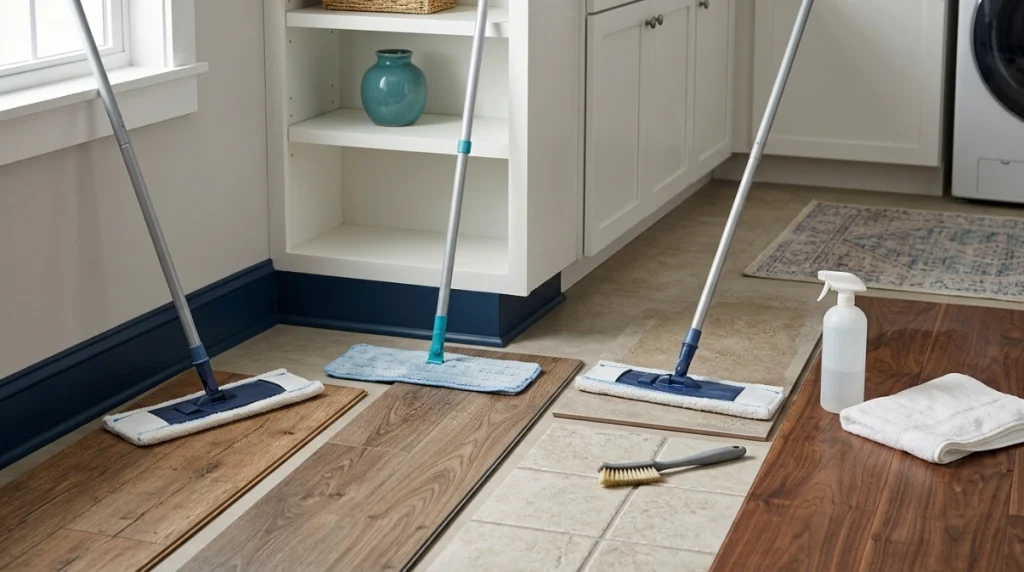
A microfiber flat mop is the safest general alternative for many moisture-sensitive floors. Microfiber uses fine synthetic fibers to collect dust with little water.
Best alternatives by cleaning job
- Routine dust: Use a dry microfiber mop or hard-floor vacuum attachment.
- Light soil: Use a lightly damp microfiber pad.
- Sticky spills: Apply an approved cleaner to the cloth, not across the whole floor.
- Textured tile: Use a soft-bristle brush and tile-safe cleaner.
- Large tile areas: Use a spin mop that can be wrung thoroughly.
- Wood floors: Use a wood-floor cleaner approved by the flooring maker.
- Laminate and LVP: Use minimal liquid and dry remaining moisture promptly.
Can you use vinegar instead?
Vinegar is not a universal floor cleaner. Its acidity may affect stone, grout, finishes, and some manufacturer warranties.
A pH-neutral cleaner is often a safer choice. “pH-neutral” means the formula is neither strongly acidic nor strongly alkaline.
Follow the product’s dilution directions. Extra cleaner can leave streaks, residue, and a slippery surface.
Safety note: Never mix cleaning products, especially bleach with acids or ammonia. Follow every product label and floor-care guide.
Frequently Asked Questions
Can you use a steam mop on hardwood floors?
Usually, no. Steam can enter seams or worn finish and cause swelling, cupping, discoloration, or finish damage. Use a barely damp microfiber mop with a manufacturer-approved hardwood cleaner unless your exact flooring maker explicitly permits steam.
Can you use a steam mop on laminate floors?
Most laminate flooring should not be steam mopped. Hot moisture can penetrate plank joints and swell the fiberboard core, creating raised edges or bubbles. Use a nearly dry microfiber mop and the laminate manufacturer’s recommended cleaner.
Can you use a steam mop on vinyl plank flooring?
Most LVP manufacturers advise against steam. Although the surface may be waterproof, heat and condensed moisture can affect seams, adhesive, wear layers, or the subfloor. Damp microfiber cleaning is the safer option.
Can you steam mop ceramic tile and grout?
Usually, yes, when the ceramic tile is sealed and the grout is intact. Avoid steaming cracked grout, loose tiles, or recently applied sealer. Begin on low steam and keep the mop moving.
Can you use a steam mop on natural stone?
Avoid steam unless the stone supplier explicitly approves it. Natural stone may contain sealer, resin filler, repairs, or small cracks affected by heat and moisture. Use a stone-safe, pH-neutral cleaner instead.
Can you put floor cleaner in a steam mop?
Only add a cleaning solution when the steam mop manufacturer specifically allows it. Many models are designed for water alone. Other liquids may damage internal components, create fumes, leave residue, or harm the floor.
What is the safest floor for a steam mop?
Intact, sealed porcelain or ceramic tile is generally the safest choice. Confirm that the grout and sealant are sound, check the flooring instructions, and test a hidden area before cleaning the full room.
Final Takeaway
Steam mops are best reserved for sealed ceramic tile, porcelain tile, and manufacturer-approved sealed concrete. They are usually unsuitable for hardwood, engineered wood, laminate, vinyl, natural stone, cork, and other moisture-sensitive floors.
When you are uncertain, choose a damp microfiber mop and an approved cleaner. That slower, lower-moisture approach costs far less than repairing warped planks, weakened adhesive, or a damaged finish.
