
What Is a Microfiber Spin Mop? A Complete Guide

Quick Answer
A microfiber spin mop is a floor-cleaning mop with an absorbent microfiber head and a bucket system that spins excess water from the mop. The spinning wringer lets you control how damp the mop stays, which helps reduce puddles and makes routine hard-floor cleaning easier. For general household cleaning, the CDC recommends using cleaning products appropriate for the surface.
What makes a microfiber spin mop different?
- Microfiber head: Fine synthetic fibers collect dust, hair, spills, and loosened grime.
- Spin wringer: The bucket removes excess water without hand-wringing the mop head.
- Moisture control: More spinning leaves the mop drier for moisture-sensitive flooring.
- Reusable design: Many microfiber mop heads can be washed and used repeatedly.
- Flexible cleaning: A rotating head can reach corners, edges, and areas around furniture.
Best quick-use tip
- Spin the mop until it feels damp rather than dripping, especially on wood, laminate, and other moisture-sensitive floors.
If you’ve seen a round microfiber mop sitting beside a bucket with a spinning basket, you’ve probably seen a microfiber spin mop. It’s one of the more practical floor-cleaning tools for people who want the scrubbing ability of a traditional mop without handling a soaking-wet mop head.
I especially like the amount of control the wringer gives you. Below, I’ll explain how the system works, where it performs well, and which floors need extra care.
In This Guide
- What exactly is a microfiber spin mop?
- How does a microfiber spin mop work?
- Why is microfiber used on spin mops?
- How does a microfiber spin mop compare with other mops?
- Which floors can you clean with a microfiber spin mop?
- How do you use a microfiber spin mop correctly?
- What are the advantages and disadvantages?
- How should you clean and maintain the mop?
- Frequently asked questions
What exactly is a microfiber spin mop?
A microfiber spin mop is a reusable wet-mopping system that combines a microfiber mop head with a bucket-mounted spinning wringer. Instead of squeezing the mop by hand, you place it in the wringer and spin away excess water.
Most models use a round mop head made from many microfiber strands. The head attaches to a long handle through a pivoting joint that allows it to move around furniture and along floor edges.
What parts does a spin mop have?
The exact design varies, but most systems contain the same basic components:
- Mop handle: Usually telescoping so you can adjust the working height.
- Pivoting mop plate: Connects the handle to the microfiber head.
- Microfiber refill: The washable part that touches the floor.
- Water bucket: Holds water and any floor-safe cleaning solution.
- Spin basket: Removes water from the mop through centrifugal motion.
- Spin mechanism: Operated by a foot pedal, handle movement, or another mechanical system.
The microfiber portion does most of the actual cleaning. The spinning bucket mainly improves water control and reduces the effort needed to wring the head.
That’s an important distinction. A spin mop isn’t a powered floor scrubber, steam mop, or cordless electric mop.
How does a microfiber spin mop work?
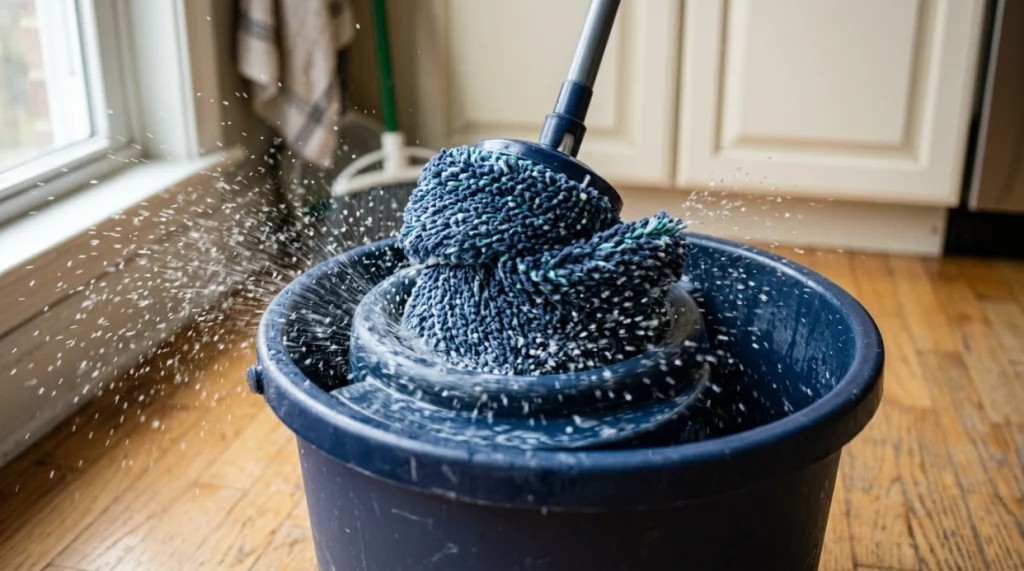
A microfiber spin mop works by wetting the microfiber head, removing excess liquid in the spinning basket, and then wiping the damp fibers across the floor. Dirt and liquid become trapped within the mop’s dense strands.
The wringing stage is what makes the system different from a standard string mop.
Why does the bucket spin?
When the mop head rotates rapidly inside the wringer, centrifugal force pushes water outward. That water drains back into the bucket instead of remaining in the mop.
A short spin leaves more moisture in the fibers. A longer spin usually produces a noticeably drier mop head.
Why does moisture control matter?
Too much water can leave puddles, increase drying time, and create streaks. It can also be a problem for flooring that shouldn’t stay wet.
- Tile: A moderately damp mop usually works well.
- Vinyl/LVP: Use enough moisture to clean without flooding seams.
- Laminate: Keep the mop well wrung and avoid standing water.
- Wood: Use minimal moisture and follow the flooring manufacturer’s instructions.
I usually judge the mop before it touches the floor. If water drips when I lift the head from the bucket, I spin it again.
That simple habit prevents many of the problems associated with overly wet mopping.
Why is microfiber used on spin mops?
Microfiber is a textile made from extremely fine synthetic fibers, commonly polyester and polyamide. The fine fibers create a large cleaning surface that can collect dust, hair, loose debris, and moisture.
Unlike a thick traditional cotton mop, microfiber doesn’t need to be saturated before it becomes useful. That makes it especially suited to controlled damp mopping.
What does microfiber do during floor cleaning?
- Collects fine debris: The fibers can hold dust and hair that a loose string mop may push around.
- Absorbs spills: Microfiber can pick up liquid while remaining manageable when wrung.
- Loosens grime: Moving the fibers across the surface provides mild mechanical scrubbing.
- Supports low-moisture cleaning: A well-wrung microfiber head can remain effective while only damp.
- Can be reused: Washable heads reduce the need for disposable floor-cleaning pads.
Microfiber does have limits. A filthy mop head eventually becomes loaded with soil and may spread dirty water instead of collecting more grime.
For a large room, I rinse or replace the head when it turns visibly dirty. Clean microfiber performs much better than overloaded microfiber.
How does a microfiber spin mop compare with other mops?
A microfiber spin mop sits between a simple manual mop and more specialized floor-cleaning machines. Its strongest advantage is adjustable moisture without requiring disposable pads or electricity.
| Mop type | Water control | Best suited to | Main limitation |
|---|---|---|---|
| Microfiber spin mop | Adjustable through spin wringer | Routine wet cleaning, corners, spills | Requires a bucket |
| Flat microfiber mop | Usually low moisture | Dusting and light floor maintenance | Less convenient for absorbing large spills |
| Traditional string mop | Depends on wringer | Heavy wet cleaning | Can carry substantial water |
| Steam mop | Produces heated vapor | Compatible sealed surfaces | Not suitable for every floor |
| Spray mop | Fine controlled spray | Fast everyday touch-ups | Small onboard cleaner capacity |
If I only need to remove light dust and footprints, a flat microfiber or spray mop feels faster. For dried kitchen messes or several rooms of wet cleaning, I prefer the bucket capacity of a spin mop.
A steam mop is a different tool entirely. Heat and steam introduce compatibility concerns that ordinary damp microfiber mopping doesn’t.
Which floors can you clean with a microfiber spin mop?
A microfiber spin mop can clean many hard floors, but the amount of water and cleaning product must suit the flooring. Always treat the floor manufacturer’s care instructions as the final authority.
Tile and ceramic flooring
Glazed ceramic and porcelain tile are common candidates for spin mopping. The microfiber strands also work around grout lines, although heavily stained grout may require a separate brush.
Vinyl and luxury vinyl plank
A well-wrung microfiber head is useful for vinyl and LVP because it can clean broad areas without leaving large puddles. Don’t deliberately flood plank joints or edges.
Laminate flooring
Laminate calls for tighter water control. Spin the head thoroughly and remove any visible standing water instead of allowing it to sit around seams.
Hardwood and engineered wood
Wood requires the most caution. The National Wood Flooring Association’s maintenance guidance recommends routine sweeping, dust mopping, or vacuuming and warns against wet mops and steam mops on wood floors.
If your floor manufacturer allows damp cleaning, wring the microfiber head aggressively and work in small areas. Bona’s wood-floor care guidance also emphasizes avoiding excess liquid and using a cleaner intended for wood floors.
Safety note: Check the flooring manufacturer’s care guide before using water, vinegar, disinfectants, or any new cleaning solution on wood, laminate, stone, or specialty flooring.
Natural stone
Stone needs a cleaner compatible with the specific material and sealer. Acidic DIY cleaners can be unsuitable for acid-sensitive stones such as marble.
A microfiber spin mop can still be the application tool. The important decision is what liquid you put on the floor.
How do you use a microfiber spin mop correctly?
Good spin-mop technique starts before the mop gets wet. Removing loose grit first prevents the wet mop from turning dry debris into muddy residue.
- Remove loose debris. Sweep, dust mop, or vacuum the floor before wet cleaning.
- Check the floor-care instructions. Confirm which cleaner and moisture level your flooring allows.
- Fill the bucket. Use water at the temperature recommended by your mop and cleaner manufacturers.
- Add cleaner only as directed. More detergent doesn’t automatically produce a cleaner floor.
- Wet the microfiber head. Allow the fibers to become evenly damp.
- Use the spin wringer. Remove enough water for your particular floor type.
- Mop in manageable sections. Rinse the head whenever it becomes visibly dirty.
- Watch the water. Replace dirty bucket water rather than continuing to mop with heavily soiled liquid.
- Let the floor dry. Keep foot traffic away until the surface is no longer slippery.
How much floor cleaner should you use?
Follow the cleaner’s label instead of guessing a stronger concentration. Excess detergent can leave residue that attracts dirt or makes the floor look cloudy.
If you’re choosing household cleaning products, the EPA Safer Choice program provides information about products whose ingredients meet its criteria.
Safety note: Never mix cleaning chemicals unless a product manufacturer specifically directs you to do so. Follow all label directions, ventilation instructions, and floor-care requirements.
Do you need disinfectant every time?
Routine cleaning and disinfecting aren’t the same task. For an ordinary household floor, focus on removing dirt with a floor-compatible cleaning process unless circumstances call for disinfection.
If someone is sick or you need a disinfectant for another reason, use a product approved for that purpose and compatible with the surface. Follow its required contact time and label directions.
What are the advantages and disadvantages of a microfiber spin mop?
A microfiber spin mop is appealing because it solves several problems associated with basic wet mopping. It still isn’t the ideal tool for every cleaning job.
Advantages
- Easy wringing: The bucket does most of the water removal.
- Better moisture control: Extra spinning can produce a drier mop head.
- Reusable microfiber: Washable refills can handle repeated cleaning sessions.
- Good maneuverability: Round pivoting heads work around table legs and edges.
- Useful for spills: Absorbent strands can collect more liquid than many thin disposable pads.
- No power required: Standard spin mops don’t need charging or an electrical outlet.
Disadvantages
- Bucket storage: The system occupies more space than a flat spray mop.
- Water changes: Dirty bucket water must be replaced during larger jobs.
- Mechanical parts: Pedals, bearings, or spinning mechanisms can eventually wear.
- Floor restrictions remain: A spin wringer doesn’t make excessive water safe for moisture-sensitive flooring.
- Head cleaning matters: Neglected microfiber can develop odor and clean poorly.
For my routine cleaning, the biggest benefit is control. I can leave more moisture in the head for durable tile, then wring it much drier before cleaning a more sensitive surface.
How should you clean and maintain a microfiber spin mop?
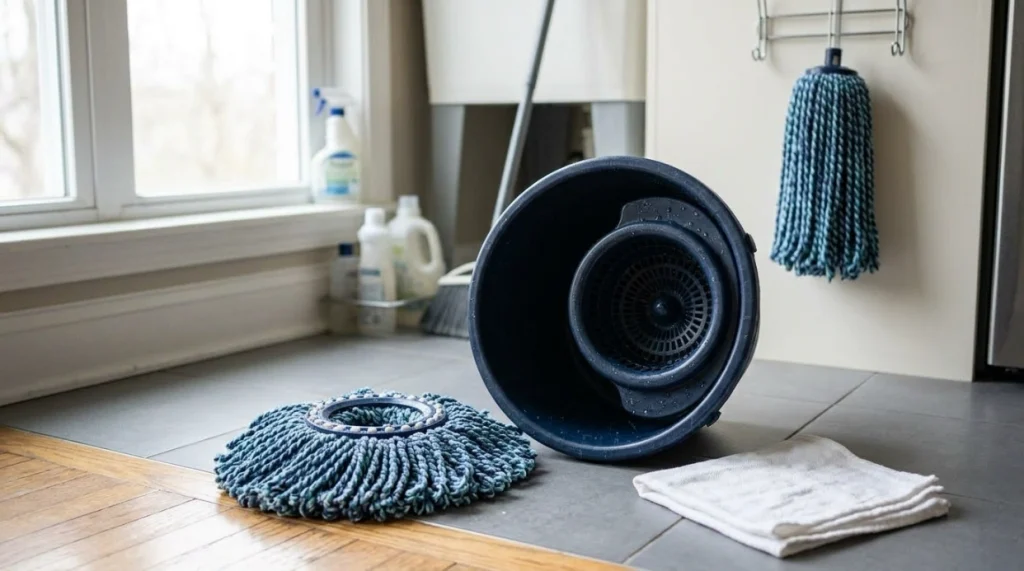
Rinsing the mop after every use keeps old dirt from drying inside the fibers. Don’t store a damp, dirty head inside a closed bucket.
- Rinse after use: Remove visible soil and cleaner residue.
- Wash as directed: Follow the refill manufacturer’s temperature and machine-washing instructions.
- Avoid fabric softener when prohibited: It can coat microfiber and interfere with its cleaning properties.
- Dry completely: Air circulation helps prevent musty smells.
- Rinse the bucket: Remove dirty water and residue after each session.
- Inspect the wringer: Clear tangled hair or debris from moving components.
Bona’s microfiber care instructions, for example, specify washing compatible pads without fabric conditioner. Your particular spin-mop refill may have different requirements, so check its label.
Replace a head when the fibers remain flattened, damaged, stained, or ineffective after proper washing. A fresh refill is cheaper than repeatedly mopping with a head that no longer cleans well.
Frequently asked questions
Is a microfiber spin mop better than a regular mop?
It can be more convenient because the spinning wringer controls moisture without hand-wringing. Microfiber also works well for routine dust, grime, and spills, while a heavy traditional string mop may still be useful for demanding wet-cleaning jobs on suitable surfaces.
Can I use only water in a microfiber spin mop?
Yes, water may be enough for some light routine cleaning if the flooring manufacturer allows damp mopping. Greasy or stubborn soils may need a compatible floor cleaner, so follow both the cleaner label and your flooring care instructions.
Can you use a microfiber spin mop on hardwood floors?
Only when your particular wood floor’s manufacturer permits damp cleaning. Wood should never be flooded, so wring the mop thoroughly and remove spills quickly. The NWFA advises against wet mopping wood floors and recommends products made for the floor’s finish.
Does a microfiber spin mop disinfect floors?
The mop itself is a cleaning tool, not automatically a disinfecting system. Disinfection requires an appropriate disinfectant used according to its label, including any required wet contact time and surface restrictions.
How often should I wash a microfiber spin-mop head?
Rinse it after every cleaning session and wash it whenever it becomes visibly dirty or according to the manufacturer’s instructions. If you clean a heavily soiled area, washing the head immediately afterward helps prevent residue and odor buildup.
Why does my floor look streaky after spin mopping?
Common causes include excessive detergent, dirty water, an overloaded mop head, or too much liquid on the floor. Try fresh water, a clean microfiber head, the correct cleaner dilution, and additional spinning before mopping again.
Is a microfiber spin mop worth using?
For many homes, a microfiber spin mop offers a useful balance between a traditional bucket mop and a lightweight microfiber floor mop. Its main advantage is simple: you decide how wet the mop reaches the floor.
As of 2026, I still consider that mechanical moisture control one of the system’s most useful features. It works especially well when you clean several types of hard flooring and want a reusable mop without batteries, disposable pads, or steam.
Choose the cleaning solution for the floor, wring the microfiber properly, and change dirty water before it becomes murky. Those habits matter more than how fast the bucket can spin.
