
What Is a Spin Mop Bucket? Complete 2026 Guide

Quick Answer
A spin mop bucket is a floor-cleaning bucket with a built-in spinning wringer that removes excess water from a mop head using centrifugal force. It gives you better moisture control than hand-wringing a traditional string mop, which can make routine mopping faster and less messy when used with a floor-safe cleaner and the CDC’s household cleaning guidance.
What a spin mop bucket does
- Holds wash water: The bucket carries water and your floor-compatible cleaning solution.
- Wets the mop: You rinse or saturate the microfiber mop head inside the bucket.
- Spins out water: A basket rotates quickly and throws excess water away from the mop fibers.
- Controls moisture: Extra spins leave the mop drier for surfaces that should not stay wet.
- Reduces hand contact: You usually don’t need to twist or squeeze a wet mop with your hands.
Quick tip
- Spin the mop until it feels damp rather than dripping, especially on moisture-sensitive floors.
A spin mop bucket looks simple, but the wringer changes how much water reaches your floor. I’ve found that moisture control matters as much as the mop itself during everyday floor cleaning.
This guide explains what a spin mop bucket is, how the spinning system works, which floors suit it, and how to use one without leaving puddles or sticky residue.
In This Guide
- What Is a Spin Mop Bucket?
- How Does a Spin Mop Bucket Work?
- Spin Mop Bucket vs. Regular Mop Bucket
- Which Floors Can You Clean With a Spin Mop?
- How Do You Use a Spin Mop Bucket Correctly?
- How Do You Clean and Maintain the Bucket?
- What Features Should You Look For?
- Spin Mop Bucket FAQs
- Is a Spin Mop Bucket Worth It?
What Is a Spin Mop Bucket?
A spin mop bucket is a bucket-and-wringer system designed for a rotating mop head. Instead of squeezing the mop by hand, you place it inside a spinning basket that removes water through rapid rotation.
Definition: A spin mop bucket is a floor-cleaning bucket equipped with a rotating wringer basket that uses centrifugal force to push excess water away from a wet mop head.
The mop head itself is commonly made from microfiber. Microfiber uses fine synthetic fibers that collect dust, hair, and loosened soil while absorbing water.
Why is the spinning basket useful?
Traditional string mops can hold a surprising amount of water. If you don’t wring them thoroughly, that water moves directly onto the floor.
A spinner gives you more control because you can repeat the wringing cycle. I often use several short spins rather than one aggressive spin.
- Fewer spins: Leaves more water in the mop for water-tolerant tile.
- More spins: Produces a lightly damp mop for controlled cleaning.
- Repeated wringing: Helps when moving from a dirty area to a cleaner room.
- Hands-free operation: Keeps dirty mop water away from your hands.
The result should be damp fibers, not a mop head that drips across the room.
Are all spin mop buckets the same?
No. Their basic purpose is similar, but the spinning mechanism and bucket design can differ.
- Foot-pedal systems: A pedal turns the wringer when you press it.
- Handle-activated systems: Pushing the mop handle downward powers the spinning action.
- Separate wash-and-wring designs: One area rinses the mop while another removes water.
- Two-chamber systems: Some designs attempt to separate cleaner water from dirty water.
For everyday use, I care more about stable spinning, easy draining, and moisture control than complicated extras.
How Does a Spin Mop Bucket Work?
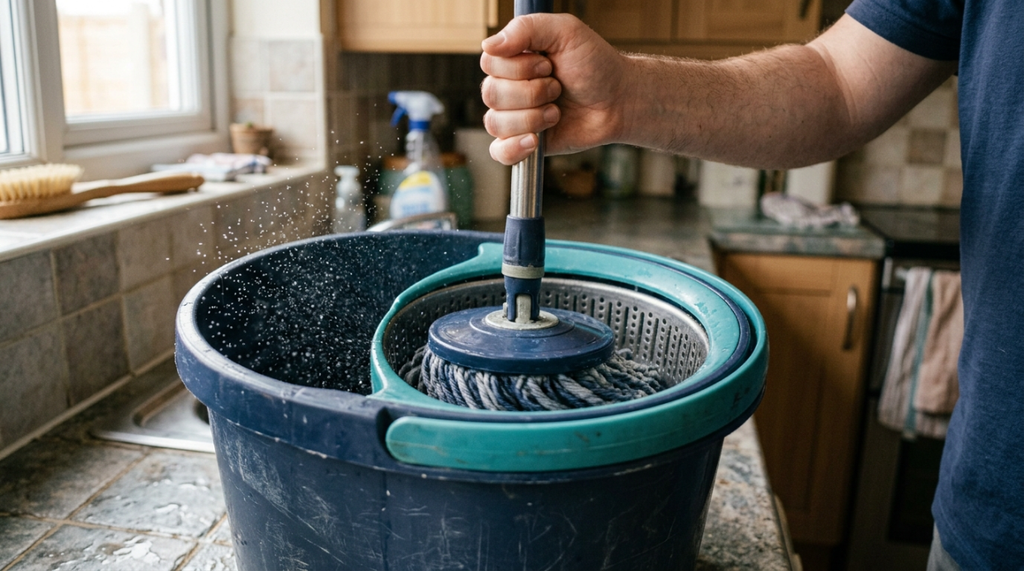
A spin mop bucket works by rotating the wet mop head at speed inside a perforated basket. The rotation creates centrifugal force, moving water outward from the mop fibers.
What happens during the spinning cycle?
The wet mop enters the wringer basket first. You then activate the spinner with a pedal, handle movement, or another mechanical system.
- The mop head begins rotating. The fibers spread outward as rotational speed increases.
- Water moves away from the center. Excess moisture travels toward the outside of the spinning head.
- Water passes through the basket. The perforations allow expelled water to fall back into the bucket.
- The mop becomes progressively drier. Repeating the cycle removes more moisture.
This is why a spin mop gives you more control than simply lifting a wet string mop from a bucket.
What are the main parts of a spin mop bucket?
The exact layout varies, but most systems combine the same basic components.
- Main bucket: Stores water and cleaning solution.
- Wringer basket: Holds and spins the mop head.
- Drive mechanism: Creates rotation using the handle or pedal.
- Mop handle: Connects your movement to the mop head and sometimes the spinner.
- Microfiber head: Loosens and collects dirt from the floor.
- Drain opening: Available on some buckets for easier emptying.
- Carry handle: Helps move the bucket between rooms.
Some systems also include splash guards or separate clean-water chambers. Those features can help, but they also create more parts to rinse after cleaning.
Section Takeaway: A spin mop bucket combines washing and mechanical wringing in one system, giving you direct control over how wet the mop remains.
Spin Mop Bucket vs. Regular Mop Bucket: What’s the Difference?
The main difference is moisture control. A regular bucket only holds water unless you add a separate wringer, while a spin mop bucket actively removes water from the mop head.
| Feature | Spin Mop Bucket | Regular Mop Bucket | Flat Spray Mop |
|---|---|---|---|
| Water removal | Built-in spinning wringer | Usually hand-wrung or separate wringer | No bucket; solution is sprayed directly |
| Moisture control | Adjustable through repeated spinning | Depends heavily on manual wringing | Good for light, controlled damp cleaning |
| Rinsing capacity | Good for repeated wet rinsing | Good | Limited |
| Best use | Whole-room and heavier routine cleaning | Basic wet mopping | Quick daily touch-ups |
| Storage | Requires bucket space | Requires bucket space | Usually compact |
When does a spin mop make more sense?
I prefer a spin mop when I’m cleaning several rooms or dealing with footprints, kitchen soil, or bathroom grime. Being able to rinse the head repeatedly is useful during a larger cleaning session.
A spray mop is faster for a small spill or light maintenance. It also takes less space in an apartment or small utility closet.
Is a spin mop the same as a steam mop?
No. A spin mop uses water, cleaner, and manual movement, while a steam mop heats water into vapor.
A steam mop also introduces heat, which changes floor-safety considerations. A spin mop’s main risk is excessive liquid rather than high temperature.
Which Floors Can You Clean With a Spin Mop?
A spin mop can clean many hard floors, but the amount of water and cleaning product matters. Never assume that a surface is safe simply because the mop itself is gentle.
Tile and sealed concrete
Ceramic and porcelain tile generally tolerate damp mopping well. Spin mops also reach shallow grout lines because the microfiber strands spread as you move the head.
Sealed concrete can also be damp-mopped when its coating permits it. Avoid leaving pools of water around cracks or damaged sealant.
Vinyl and LVP
Vinyl and luxury vinyl plank usually need controlled moisture rather than a soaking mop. Spin the head thoroughly and clean in small sections.
Water should not remain around seams or edges. Follow the flooring manufacturer’s cleaner instructions.
Laminate flooring
Laminate requires extra moisture control. Water that reaches joints or exposed core material can create problems, so the mop should feel barely damp.
Use several wringing cycles before touching the floor. Don’t allow visible puddles to sit between planks.
Hardwood and engineered wood
Wood needs the most caution because standing water and excessive moisture can damage finishes and flooring. The National Wood Flooring Association’s maintenance guidance recommends dry cleaning routinely and warns against wet mops on wood floors.
If your flooring manufacturer allows damp mopping, use a well-wrung microfiber head and minimal liquid. A flat microfiber mop can offer even tighter moisture control.
Natural stone
Natural stone needs a cleaner compatible with that specific material and sealer. Acidic homemade cleaners can harm certain stone surfaces.
Safety note: Always check the flooring manufacturer’s care guide and cleaning-product label before using any solution on wood, laminate, vinyl, or natural stone.
Section Takeaway: The spinner helps control water, but it doesn’t make every floor wet-mop safe. Your flooring manufacturer’s instructions should decide how much moisture and which cleaner you use.
How Do You Use a Spin Mop Bucket Correctly?
The safest approach is to remove loose grit first, use the minimum effective amount of cleaner, and wring the mop until it’s damp. Don’t begin by flooding the floor.
1. Sweep or vacuum first
Remove hair, crumbs, sand, and loose dirt before mopping. Otherwise, the wet mop can push gritty debris across the finish.
2. Fill the bucket correctly
Add water without exceeding the bucket’s fill line. If you’re using floor cleaner, follow its dilution directions rather than adding an extra splash.
More cleaner doesn’t automatically mean a cleaner floor. Excess product can leave residue that makes a surface look dull or feel sticky.
3. Wet the mop head
Place the microfiber head into the wash water and move it gently. Let the fibers become evenly damp.
4. Put the mop into the spinner
Center the mop head inside the wringer basket before activating it. An off-center head may wobble and wring unevenly.
5. Spin until the moisture level fits the floor
I usually start with several short spins and check the head by sight. It should not drip while I’m carrying it from the bucket to the floor.
- Tile: A damp head generally works well.
- Vinyl/LVP: Wring more thoroughly and avoid standing liquid.
- Laminate: Use a lightly damp head only when manufacturer guidance permits it.
- Wood: Use minimal moisture and follow the specific finish manufacturer’s instructions.
6. Mop in manageable sections
Work across a small area, then rinse the head before it becomes heavily loaded with soil. I prefer overlapping passes instead of pressing hard on one spot.
On an ordinary lightly damp floor, I like to see most visible moisture disappear within roughly 5 to 10 minutes. Longer drying often tells me I’m using more water than necessary.
7. Change dirty water
If the water becomes dark or full of debris, replace it. Repeatedly dipping into heavily soiled water can redistribute grime instead of removing it.
Safety note: Follow the product label before mixing any floor cleaner, disinfectant, or homemade solution. Never combine cleaning chemicals unless the manufacturer specifically directs it.
Section Takeaway: Sweep first, dilute cleaner correctly, wring aggressively enough for the floor type, and replace dirty water instead of spreading it through the next room.
How Do You Clean and Maintain a Spin Mop Bucket?
Rinsing the bucket immediately after mopping prevents dirty residue from drying inside it. The microfiber head also needs to dry fully before storage.
After every cleaning session
- Empty the dirty water into an appropriate drain.
- Rinse the bucket with clean water.
- Flush debris from the wringer basket.
- Rinse or wash the microfiber head according to its care label.
- Allow the bucket and mop head to dry before storage.
I don’t store a damp mop head inside a closed bucket. Trapped moisture can create unpleasant odors and makes the next cleaning session less appealing.
How often should you wash the microfiber head?
Wash it whenever it becomes dirty, smells stale, or stops cleaning well. For routine household use, cleaning the pad or mop head after each substantial mopping session is a sensible habit.
Avoid automatically using fabric softener unless its manufacturer allows it. Some softening products can coat microfiber and reduce its ability to absorb and collect soil.
What if the spinner stops working smoothly?
Check for hair, threads, or debris around moving parts. Also make sure the mop head is seated correctly before assuming the drive mechanism has failed.
Don’t force a jammed pedal or handle. Mechanical parts can break when excessive pressure is applied.
What Features Should You Look For in a Spin Mop Bucket?
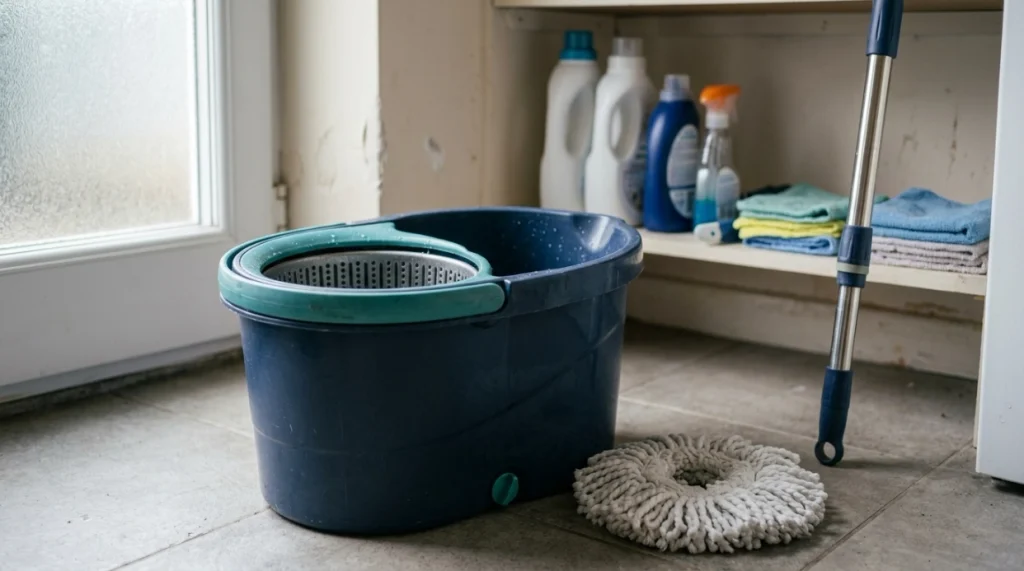
A good spin mop bucket should make water control easier without becoming awkward to carry or clean. I prioritize practical features over complicated mechanisms.
- Stable wringer: The basket should spin without making the bucket jump across the floor.
- Easy activation: The pedal or handle should operate without excessive force.
- Comfortable carry handle: A full bucket becomes heavy quickly.
- Drain plug: Helpful if lifting and tipping a full bucket is difficult.
- Splash control: A well-designed basket keeps dirty water inside the bucket.
- Replaceable mop heads: Replacement microfiber heads should be easy to obtain.
- Compact footprint: Important for apartments and small storage areas.
- Separate water chambers: Useful when you want to reduce contact between cleaner and dirtier water.
Do you need a two-chamber bucket?
Not necessarily. A simple single-bucket system can work well if you change the water when it becomes visibly dirty.
Two-chamber designs may keep the process tidier, but they also add components and cleaning steps. Decide whether that extra complexity solves a real problem in your home.
What about cleaning and disinfecting claims?
A spin mop cleans floors by physically removing soil with water, cleaner, microfiber, and agitation. Cleaning is not automatically the same as disinfecting.
The EPA explains the difference between cleaning, sanitizing, and disinfecting, including the importance of following a registered product’s directions and contact time.
For most routine household situations, you don’t need to treat every mopping session as a disinfection job. Use a disinfectant when appropriate and only on surfaces the label identifies as compatible.
Safety note: If you disinfect a floor, follow the product label for dilution, surface compatibility, ventilation, application, and required wet contact time.
Spin Mop Bucket FAQs
Does a spin mop bucket separate dirty water?
Some do, but many traditional spin mop buckets use the same main reservoir for rinsing. Newer multi-chamber designs may separate clean and dirty water more effectively, so check the specific bucket design before buying.
Can I put floor cleaner in a spin mop bucket?
Yes, if both the flooring manufacturer and cleaner label permit it. Use the recommended dilution because too much concentrate can leave residue, increase slipperiness, or require extra rinsing.
Can I use vinegar in a spin mop bucket?
The bucket can physically hold a vinegar solution, but that doesn’t mean the solution is safe for your floor. Avoid improvised acidic cleaners on surfaces such as natural stone, and follow manufacturer guidance for wood, laminate, and vinyl.
Why is my spin mop still soaking wet?
The head may not be centered in the wringer, the spinner may need more cycles, or debris may be interfering with rotation. Check that the mop and bucket mechanism are assembled correctly before applying extra force.
Can a spin mop bucket be used on hardwood?
Only when your specific wood flooring and finish permit damp mopping. Use a thoroughly wrung microfiber head and minimal moisture, because a spin wringer reduces water but does not eliminate the risks created by excessive moisture.
How often should I change the water?
Change it whenever it becomes visibly cloudy, dark, gritty, or full of debris. A busy kitchen or entryway may require fresh water sooner than a lightly used bedroom.
Is a spin mop better than a flat microfiber mop?
It depends on the job. A spin mop is useful for repeated rinsing and larger wet-cleaning jobs, while a flat microfiber mop gives tighter moisture control and is often more convenient for quick cleaning.
Is a Spin Mop Bucket Worth It?
A spin mop bucket is worth considering if you regularly mop several hard-floor rooms and want easier wringing. Its biggest advantage is simple, repeatable control over the amount of water left in the mop.
I find the system most useful when cleaning kitchens, bathrooms, tiled rooms, and other areas where I want to rinse the mop head several times. The spinner saves me from twisting a dirty mop by hand.
A smaller spray or microfiber flat mop may suit you better if storage space is tight or your floors require extremely low moisture. There isn’t one mop system that fits every surface.
- Choose a spin mop for larger mopping sessions, repeated rinsing, and adjustable wringing.
- Choose a flat microfiber mop when precise moisture control matters most.
- Choose a spray mop for quick everyday touch-ups and small spaces.
- Choose steam only when your flooring manufacturer specifically allows heat and steam.
As of 2026, the basic reason to buy a spin mop hasn’t changed: it combines a washable mop, water bucket, and mechanical wringer in one practical floor-cleaning system.
My final takeaway: Use the spinner to control moisture, not as permission to soak the floor. Match the water level and cleaner to the specific surface, rinse the equipment after use, and your spin mop bucket can handle a large share of routine hard-floor cleaning.