
What Is a Spin Mop Head? A Complete Guide to How It Works

Quick Answer
A spin mop head is the removable cleaning part at the bottom of a spin mop. It usually has absorbent microfiber strands attached to a round plastic hub, and it rotates during rinsing or wringing to remove dirty water. If you use cleaning solution with it, the EPA Safer Choice program is a useful place to check cleaner options.
What a spin mop head does
- Picks up dirt: Microfiber strands grab dust, hair, crumbs, and loose debris from hard flooring.
- Absorbs liquid: The strands hold cleaning water while you mop spills and everyday grime.
- Reaches edges: Flexible strands spread around table legs, corners, and baseboards.
- Spins dry: The head rotates rapidly in the bucket’s wringer to remove excess water.
- Detaches for washing: Most designs let you remove and clean or replace the mop head.
Quick tip
- For moisture-sensitive flooring, spin the mop several times until the strands feel damp rather than dripping wet.
If you’ve seen a round mop disappear into a bucket and come out noticeably drier, the mop head is doing much of the work. Understanding that small component makes choosing, using, and maintaining a spin mop much easier.
In this guide, I’ll explain what a spin mop head is, how the spinning mechanism works, what the head is made from, and when you should replace it.
In This Guide
- What exactly is a spin mop head?
- How does a spin mop head work?
- What is a spin mop head made of?
- Which floors can you clean with a spin mop head?
- Spin mop head vs other mop heads
- How do you use a spin mop head correctly?
- How do you clean and replace a spin mop head?
- Frequently asked questions
- Final takeaway
What Exactly Is a Spin Mop Head?
A spin mop head is the removable floor-cleaning attachment fitted to the lower end of a spin mop handle. Most versions use flexible microfiber strands arranged around a circular center hub.
The name comes from its ability to rotate. Depending on the system, the head can rotate while you clean, while you rinse it, while you wring it, or during several of those steps.
The basic parts of a spin mop head
- Microfiber strands: These flexible fibers contact the floor and collect dirt, dust, hair, and moisture.
- Center hub: A rigid plastic disc holds the strands together and transfers rotation from the handle.
- Connector: This fitting locks the replaceable head onto the mop’s lower plate or handle assembly.
- Pivot point: Many designs allow the head to tilt so it can move around furniture.
Microfiber is a fabric made from extremely fine synthetic fibers. Its structure gives it more contact area than a smooth cloth, which makes it useful for picking up fine debris.
The removable design is important too. Instead of replacing the whole mop when the cleaning fibers wear out, you can usually replace only the head.
Is the mop head the same as the spin basket?
No. The mop head touches the floor, while the spin basket sits inside the bucket and helps remove water from the mop head.
When you place the head into the wringer, centrifugal movement pushes water away from the rotating strands. You control how damp the head becomes by changing the amount of spinning.
How Does a Spin Mop Head Work?
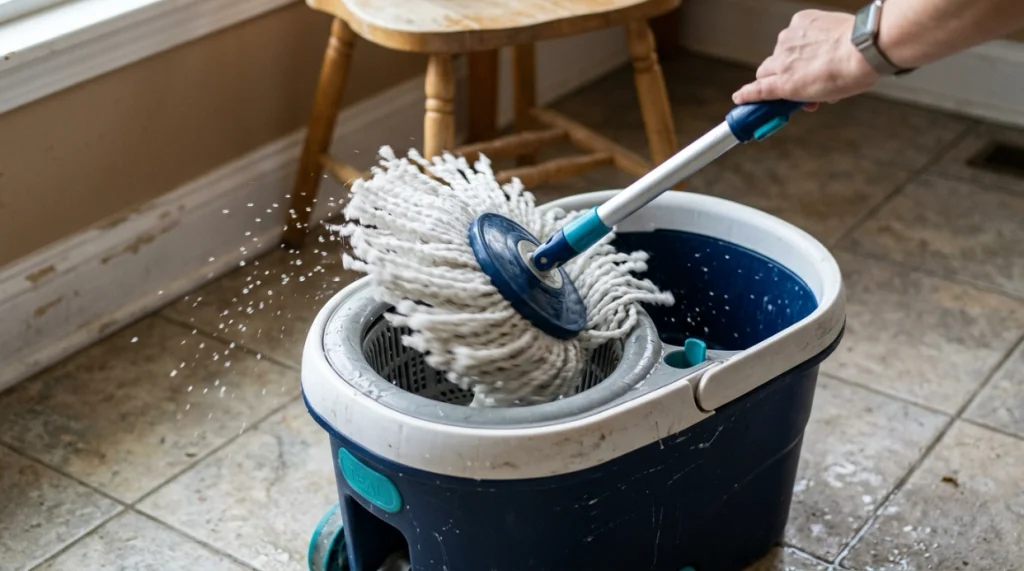
A spin mop head combines absorbent cleaning fibers with a rotating wringing system. The goal is simple: loosen dirt with damp fibers, rinse the fibers, then remove excess water before returning to the floor.
What happens while you’re mopping?
The circular head usually swivels as you move the handle. That lets the strands spread across the floor rather than staying in one fixed direction.
The flexible shape is useful around obstacles. The strands can fan outward beside chair legs, cabinets, toilet bases, and wall edges.
- Push the head forward to cover open areas.
- Rotate the handle slightly to change direction.
- Use the edge of the strands along baseboards.
- Pull the mop toward you to collect loosened debris.
What happens inside the bucket?
Spin mop systems vary, but most use either a pedal, a push-down handle, or another mechanical system to rotate the mop head. That rotation throws moisture outward through the wringer basket.
More spinning generally leaves less water in the fibers. This moisture control is one of the biggest practical differences between a spin mop and a traditional string mop.
My practical benchmark is simple: the mop should feel damp enough to glide, but it shouldn’t leave puddles or a continuous trail of standing water.
Section Takeaway: A spin mop head cleans with flexible absorbent fibers, while the spinning system helps control how much water stays in those fibers.
What Is a Spin Mop Head Made Of?
Most modern spin mop heads rely heavily on microfiber, although the exact fiber blend and strand shape vary by manufacturer. Some replacement heads also use cotton blends or thicker chenille-style fibers.
Microfiber strands
Microfiber is popular because it can handle both dry particles and damp cleaning. A well-maintained microfiber head can collect pet hair, dust, fine grit, and light spills.
It also works without soaking the floor. That matters when you want to clean with controlled moisture instead of flooding the surface.
Cotton and blended fibers
Cotton-rich mop heads can absorb plenty of liquid, but they may hold more water than microfiber. They can also take longer to dry after cleaning.
Blended heads try to balance absorbency, durability, and scrubbing ability. Always check compatibility with your specific spin mop before buying a replacement.
Plastic mounting plate
The center plate is usually rigid plastic. It keeps the strands attached while allowing the head to connect securely to the mop.
Connection systems aren’t universal. Two round heads may look nearly identical yet use different diameters, clips, threads, or locking tabs.
Which Floors Can You Clean With a Spin Mop Head?
A spin mop head can work on many sealed hard floors when you control moisture and use a cleaner suitable for that surface. The correct method changes with the flooring material.
| Floor Type | Spin Mop Suitability | Moisture Level | Main Precaution |
|---|---|---|---|
| Ceramic/porcelain tile | Good | Damp | Avoid leaving dirty water in grout lines. |
| Vinyl/LVP | Good when manufacturer permits | Well wrung | Limit water around seams and edges. |
| Laminate | Use cautiously | Barely damp | Standing moisture can enter joints. |
| Finished hardwood | Only when care guidance allows | Minimal moisture | Follow the flooring manufacturer’s instructions. |
| Sealed concrete | Good | Damp | Use a cleaner suitable for the sealer. |
| Natural stone | Depends on stone and sealer | Controlled | Avoid unsuitable acidic cleaners. |
What about hardwood?
Wood flooring needs extra moisture control. The National Wood Flooring Association is a useful reference for wood-floor care, but your flooring manufacturer’s instructions should come first.
Spin the mop until the head is only slightly damp. Never allow water to pool between boards or remain around floor edges.
Safety note: Check your floor manufacturer’s care guide before introducing water, disinfectants, vinegar solutions, or unfamiliar cleaners.
Spin Mop Head vs Other Mop Heads: What’s Different?
The biggest advantage of a spin mop head is moisture control combined with flexible coverage. It sits between a traditional wet string mop and a low-moisture microfiber flat mop.
| Mop Head Type | Best Trait | Water Control | Typical Use |
|---|---|---|---|
| Spin mop | Flexible head plus mechanical wringing | High | General hard-floor wet cleaning |
| Traditional string mop | Absorbs larger liquid messes | Moderate | Tile, utility areas, larger spills |
| Microfiber flat mop | Low-profile cleaning | High | Light maintenance and dusting |
| Steam mop | Uses heated steam | Machine controlled | Compatible sealed surfaces only |
Spin mop head vs microfiber flat mop
A flat mop usually feels easier under beds and low furniture. Its rectangular pad also follows straight wall edges well.
A spin mop head handles uneven movement differently. Its loose strands wrap around obstacles and can hold more wash water for larger cleaning jobs.
Spin mop head vs traditional string mop
Both designs use hanging fibers, but the wringing system changes the experience. A spin bucket can remove moisture without hand-wringing the head.
That makes it easier to adjust dampness between rooms. You might leave more water in the head for tile, then spin it drier before moving onto a moisture-sensitive surface.
Section Takeaway: Choose a spin mop head when you want flexible reach, reusable fibers, and convenient control over how wet your mop stays.
How Do You Use a Spin Mop Head Correctly?
Good spin-mop technique starts before the mop touches water. Loose grit and hair can turn into muddy residue once wet.
- Sweep or vacuum first. Remove crumbs, pet hair, sand, and visible grit.
- Fill the bucket correctly. Follow the mop and cleaner instructions rather than overfilling.
- Wet the mop head. Submerge the fibers so they become evenly damp.
- Rinse or agitate. Use the bucket system as designed to loosen soil from the strands.
- Spin out excess water. Use more spins when the flooring needs less moisture.
- Mop manageable sections. Work toward an exit so you don’t walk across freshly cleaned flooring.
- Rinse when the head looks dirty. Don’t keep spreading gray cleaning water across the room.
How wet should a spin mop head be?
For routine cleaning, damp is usually better than dripping. If the mop leaves small puddles behind each pass, spin it again before continuing.
For laminate and many wood floors, aim for even less moisture. Your surface manufacturer’s care instructions should always override a general mopping rule.
Do you need disinfectant in a spin mop bucket?
Not for every cleaning job. Routine floor cleaning mainly focuses on removing dirt, residue, spills, and other unwanted material.
The CDC’s household cleaning guidance explains the distinction between ordinary cleaning and disinfecting. Follow the product label whenever you use a disinfectant.
Safety note: Never mix household cleaning chemicals unless their labels specifically say the combination is safe.
How Do You Clean and Replace a Spin Mop Head?
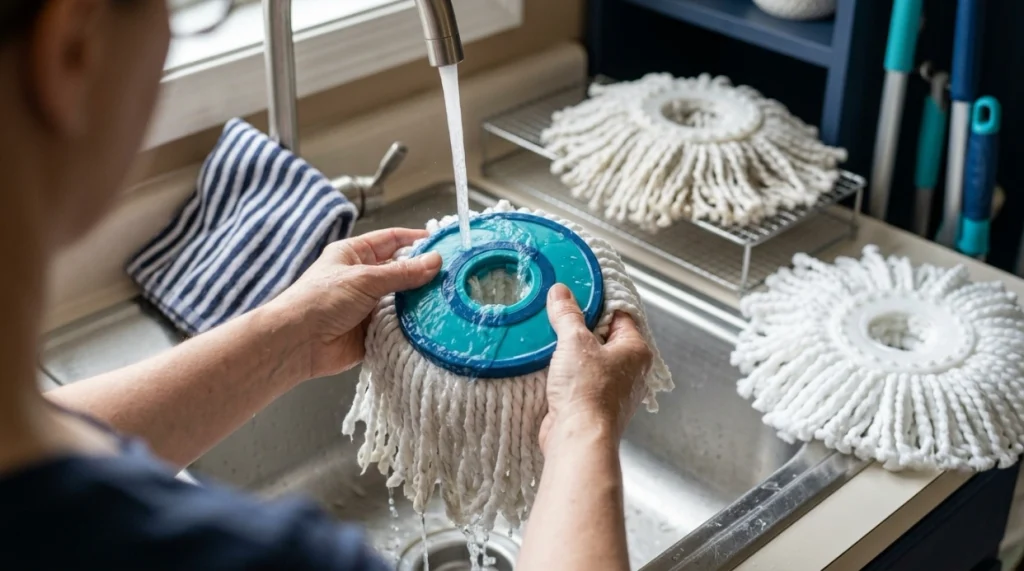
A clean mop head matters because dirty fibers can spread odor and residue instead of removing them. Rinsing immediately after mopping also prevents grime from drying deep inside the strands.
How to clean the head after mopping
- Detach the mop head if the design allows it.
- Rinse away visible dirt with clean water.
- Wash according to the manufacturer’s care instructions.
- Remove as much moisture as possible after rinsing.
- Allow the fibers to dry fully in a ventilated location.
- Store the head dry rather than sealed inside a damp bucket.
Some replacement heads are machine washable, while others aren’t. Check the label before putting the plastic mounting plate into a washer or dryer.
When should you replace a spin mop head?
There’s no useful universal replacement date because usage varies so much. A household that mops daily will wear a head faster than one that mops twice each month.
Look at performance instead of the calendar. Replace the head when cleaning and washing no longer restore it.
- Flattened fibers: The strands remain matted and no longer spread across the floor.
- Persistent odor: The clean, dry head still smells unpleasant.
- Permanent discoloration: Embedded soil remains after proper washing.
- Frayed attachment: Strands are separating from the center plate.
- Poor absorption: The head pushes liquid around instead of picking it up.
- Damaged connector: The head won’t stay securely attached.
How do you choose a replacement mop head?
Start with the mop’s exact brand and model number. Diameter alone isn’t enough to guarantee that a replacement head will fit.
Compare the center connector, locking tabs, mounting plate, and stated model compatibility. Generic replacement heads can work well, but only when the attachment design matches.
Section Takeaway: Rinse and dry a spin mop head after use, and replace it when the fibers or connector can no longer perform properly.
Frequently Asked Questions About Spin Mop Heads
Are all spin mop heads microfiber?
No. Microfiber is common, but some heads use cotton or blended materials. Check the product description because fiber composition affects absorbency, drying time, texture, and washing instructions.
Are spin mop heads universal?
No. Even heads with similar round shapes can use different connectors or mounting diameters. Match a replacement to your exact mop model whenever possible.
Can you wash a spin mop head in a washing machine?
Some microfiber replacement heads are machine washable, but not every design is. Follow the manufacturer’s washing instructions, especially when the head contains a rigid plastic mounting plate.
Why does my spin mop head smell?
Odor usually develops when dirt or moisture remains trapped in the fibers. Rinse the head thoroughly after use and let it dry completely before storage.
Why isn’t my spin mop head spinning?
Check whether the head is fully attached and correctly positioned in the spinner. A jammed connector, damaged handle mechanism, obstructed wringer, or incompatible replacement head can also prevent rotation.
Can a spin mop head scratch flooring?
The fibers themselves are usually soft, but trapped grit can cause problems on sensitive surfaces. Vacuum or sweep first, and rinse the mop head when you notice sand or abrasive debris.
Can I use vinegar with a spin mop head?
The mop head may tolerate diluted vinegar, but the flooring may not. Natural stone, some finishes, and certain manufacturer warranties require specific cleaners, so check the floor-care instructions before using acidic solutions.
Safety note: A cleaning ingredient being common in homes doesn’t mean it’s suitable for every flooring finish.
Final Takeaway: What Should You Know About a Spin Mop Head?
A spin mop head is the removable, rotating cleaning component of a spin mop. Its microfiber or blended strands collect dirt and moisture, while the bucket’s spinning mechanism helps wring those strands without hand-twisting them.
The best results come from simple habits: remove loose grit first, control the amount of water, rinse dirty fibers often, and dry the head fully after cleaning.
Most importantly, match your technique to your floor. A spin mop head that’s ideal for tile may need to be wrung much drier before you use it on laminate or finished wood.
Once you understand how the head works, troubleshooting and replacement become much easier. Check the connector, fiber condition, and floor compatibility whenever your spin mop stops performing as expected.