
What Is a Spin Mop Used For? Complete 2026 Guide

Quick Answer
A spin mop is used for washing hard floors while giving you better control over how wet the mop head stays. It works especially well for tile, vinyl, sealed concrete, and other water-tolerant surfaces, while moisture-sensitive flooring requires more care. For real wood, follow wood-floor maintenance guidance before damp mopping.
Common Spin Mop Uses
- Routine mopping: Clean footprints, dust, crumbs, and light everyday grime from hard floors.
- Sticky messes: Use a damp microfiber head to loosen food spills and dried dirt.
- Large rooms: A bucket holds more cleaning water than most spray-mop bottles.
- Moisture control: The spinning wringer removes excess water before the mop touches the floor.
- Floor rinsing: Rinse the mop head repeatedly when cleaning heavily soiled areas.
- Edge cleaning: Flexible microfiber strands can reach around furniture legs and along baseboards.
Quick Tip
- Spin the mop until it feels damp rather than dripping, especially on laminate or other moisture-sensitive flooring.
If you’re wondering what a spin mop is used for, the short answer is everyday hard-floor cleaning with easier wringing. A spin mop combines a microfiber mop head, bucket, and spinning mechanism that helps remove water without twisting the mop by hand.
In this guide, I’ll explain where a spin mop works well, where it doesn’t, how to use one correctly, and how it compares with other common floor-cleaning tools.
In This Guide
- What Is a Spin Mop and How Does It Work?
- What Is a Spin Mop Used For?
- Which Floors Can You Clean With a Spin Mop?
- How Do You Use a Spin Mop Correctly?
- What Cleaning Solution Should You Use?
- Spin Mop vs. Other Mop Types
- When Should You Not Use a Spin Mop?
- Spin Mop FAQs
- Is a Spin Mop Right for Your Home?
What Is a Spin Mop and How Does It Work?
A spin mop is a floor-cleaning system with a reusable mop head and a bucket that spins the head to remove excess water. Most manual models use either a foot pedal or a push-down handle mechanism.
The mop head is usually microfiber. Microfiber consists of very fine synthetic fibers that collect dust, hair, and loosened grime while holding cleaning liquid.
What does the spinning part actually do?
The spinning mechanism mainly controls moisture. You place the wet mop head inside the wringer, activate the spinner, and centrifugal force throws excess water away from the fibers.
- Shorter wringing: Leaves more moisture for water-safe tile or stubborn dirt.
- Longer wringing: Creates a drier mop for surfaces that need controlled moisture.
- Repeated rinsing: Helps release dirt trapped in the microfiber strands.
- Hands-free operation: Reduces the need to squeeze a dirty mop head manually.
The key benefit isn’t that the mop spins across your floor. With most manual spin mops, the bucket does the spinning while you clean normally with the mop head.
Electric spin mops are different. Their pads rotate on the floor using a motor, so don’t confuse them with bucket-style spin mops.
Section Takeaway: A traditional spin mop is mainly a microfiber mop with a mechanical wringing system, giving you easier rinsing and better control over floor moisture.
What Is a Spin Mop Used For?
A spin mop is most useful for routine wet or damp cleaning across medium and large hard-floor areas. It’s especially practical when a small spray mop cannot hold enough liquid for the job.
Cleaning everyday dirt and footprints
For normal household cleaning, a spin mop can remove footprints, light soil, dried droplets, and fine debris left after sweeping or vacuuming. The microfiber head provides both absorption and mild mechanical scrubbing.
I recommend removing loose debris first. Mopping over crumbs, sand, or pet litter simply moves that material around and can scratch sensitive finishes.
Cleaning kitchens and dining areas
Spin mops are useful in kitchens because you can rinse the head after picking up food residue. That prevents one dirty section of microfiber from traveling across the entire room.
- Food splashes
- Light grease residue
- Muddy footprints
- Drink spills
- Dust along cabinet edges
Dried food may need a short dampening period before it releases. Avoid flooding the spot, especially near flooring seams.
Cleaning bathrooms
A compact spin-mop head can clean around toilets, vanities, and tubs when the head swivels freely. It also works well across sealed ceramic and porcelain tile.
Keep in mind that ordinary cleaning and disinfecting are separate tasks. The CDC’s household cleaning guidance explains that routine cleaning is often enough, while disinfection becomes more relevant when illness is present.
Cleaning larger floor areas
The bucket system becomes useful when you’re cleaning several rooms. You don’t need to stop repeatedly to refill a small onboard bottle.
A spin mop can also hold more loosened soil than a small flat pad. You can rinse and wring the head several times before moving to the next section.
Handling dirtier washable floors
For mudrooms, utility areas, or sealed concrete, a spin mop can handle more water than I would use on laminate or wood. That extra liquid can help loosen soil before the final wringing pass.
Change dirty cleaning water rather than continuing with water that has turned dark or cloudy. A clean mop head dipped into filthy water quickly becomes dirty again.
Section Takeaway: Spin mops are strongest at routine hard-floor washing, bigger cleaning jobs, repeated rinsing, and situations where you need adjustable moisture.
Which Floors Can You Clean With a Spin Mop?
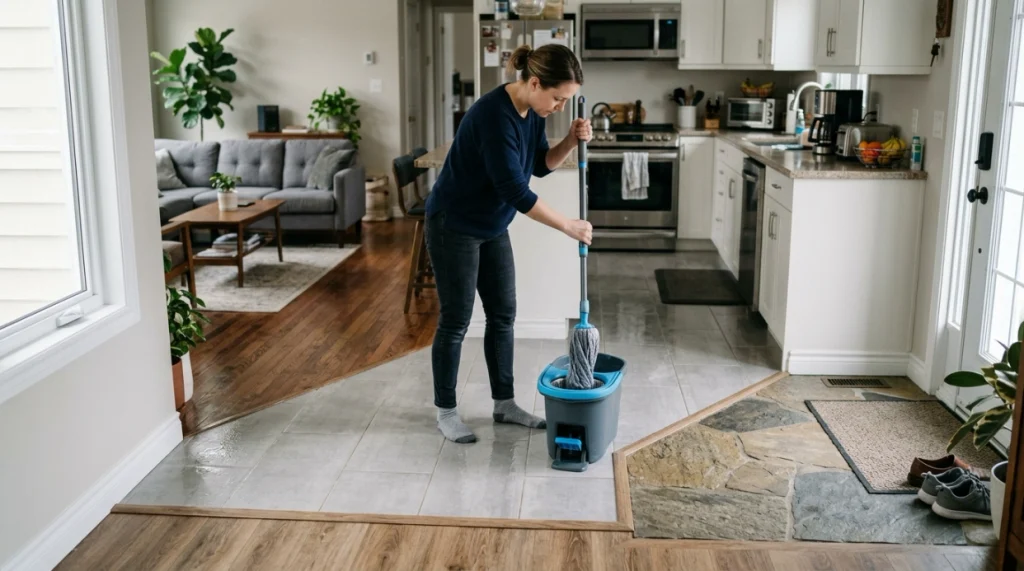
A spin mop isn’t automatically safe for every hard surface. The important question is how much moisture and which cleaner your particular flooring can tolerate.
| Floor Type | Spin Mop Suitability | Moisture Approach | Main Caution |
|---|---|---|---|
| Ceramic/porcelain tile | Good | Damp to moderately wet | Avoid excessive cleaner residue |
| Vinyl/LVP | Good when approved | Well-wrung and damp | Don’t flood seams |
| Laminate | Use cautiously | Lightly damp | Standing water can enter joints |
| Finished hardwood | Only if care guidance allows | Minimal moisture | Wet mopping can damage wood |
| Natural stone | Depends on stone and sealer | Controlled damp cleaning | Cleaner chemistry matters |
| Sealed concrete | Good | Moderate moisture | Match cleaner to coating |
Can you use a spin mop on hardwood?
Real wood requires the most restraint. The National Wood Flooring Association advises against wet mopping and recommends cleaning spills with a dry or slightly damp cloth.
If your flooring manufacturer permits damp cleaning, wring the microfiber head thoroughly and work in small sections. The surface should not remain visibly wet.
Can you use one on laminate?
A spin mop can work on some laminate floors when you wring it almost dry. Water should never pool around seams, edges, or damaged joints.
A microfiber flat mop may give you even tighter moisture control. That can make it the simpler choice for routine laminate maintenance.
Safety note: Always check your flooring manufacturer’s care instructions before introducing water, chemicals, steam, or a new mopping method.
Section Takeaway: Spin mops suit water-tolerant hard floors best. The more moisture-sensitive the surface becomes, the more carefully you need to wring the mop.
How Do You Use a Spin Mop Correctly?
Good spin-mop technique starts before the mop touches the floor. Removing loose grit first improves cleaning and reduces the chance of dragging abrasive particles around.
- Sweep or vacuum first. Remove hair, crumbs, dust, sand, and other loose debris.
- Fill the bucket correctly. Use the water temperature and cleaner recommended for your floor and mop.
- Wet the mop head. Let the microfiber absorb enough solution to loosen soil.
- Wring in the spinner. Remove enough water for your particular flooring.
- Mop a small section. Work from the cleaner side of the room toward the exit.
- Rinse when dirty. Don’t keep spreading the same collected soil across the floor.
- Change dirty water. Replace heavily soiled water rather than trying to finish the entire home with it.
- Allow the floor to dry. Improve airflow and keep people away from slippery wet areas.
- Clean the mop head. Rinse or wash it according to its care label before storage.
How wet should the spin mop be?
For most routine cleaning, the mop should feel damp but shouldn’t leave puddles behind. On laminate or similarly sensitive surfaces, wring it more aggressively.
On sealed tile or concrete, a slightly wetter mop can help with heavier soil. Follow with a cleaner, well-wrung pass so excess liquid doesn’t sit unnecessarily.
How often should you rinse it?
Rinse based on dirt level rather than a fixed number of passes. In a muddy entryway, that may mean after every small section.
For lightly dusty floors, you can usually cover more area between rinses. Once the mop starts leaving visible streaks or dirty water, rinse it.
Section Takeaway: Sweep first, control moisture, rinse before the head becomes overloaded, and never leave puddles behind.
What Cleaning Solution Should You Use in a Spin Mop?
Use a cleaner approved for your floor finish and compatible with the mop system. More cleaner doesn’t mean a cleaner floor.
- Finished hardwood: Use only a cleaner recommended for that wood finish.
- Laminate: Choose a low-residue product approved by the flooring manufacturer.
- Vinyl/LVP: Use a compatible neutral floor cleaner with limited moisture.
- Tile: Use a cleaner suitable for the tile, grout, and surrounding materials.
- Natural stone: Choose a stone-safe product, commonly a suitable pH-neutral formula.
- Sealed concrete: Match the cleaner to the concrete coating or sealer.
If you want to compare household cleaning products, the EPA Safer Choice product search lists products that meet the program’s criteria.
Should you add extra detergent?
Usually, no. Too much detergent can leave residue that makes floors look dull, feel sticky, or attract soil more quickly.
Follow the product’s dilution directions instead. If your floor still looks streaky, using less product may work better than adding more.
Can a spin mop disinfect the floor?
The mop itself doesn’t disinfect anything. Disinfection depends on using an appropriate disinfectant exactly as its label directs, including any required contact time.
For ordinary household conditions, routine cleaning may be enough. Save disinfectants for situations where they are appropriate rather than treating every mopping session as disinfection.
Safety note: Never mix household cleaning chemicals. Follow cleaner labels, provide ventilation when directed, and confirm that the product is compatible with your flooring.
Spin Mop vs. Other Mop Types: Which Is Better?
A spin mop isn’t the best tool for every cleaning job. Its main strengths are rinsing capacity, washable microfiber, and adjustable moisture.
| Mop Type | Best Use | Bucket Needed | Moisture Control | Main Drawback |
|---|---|---|---|---|
| Spin mop | Larger wet-cleaning jobs | Yes | Good | Bucket takes storage space |
| Flat microfiber mop | Controlled routine cleaning | Usually no | Excellent | Small pad gets dirty faster |
| Spray mop | Fast touch-ups | No | Excellent | Limited liquid and pad capacity |
| Steam mop | Approved heat-tolerant floors | No | Varies | Heat and steam limit compatibility |
| Traditional string mop | Heavy-duty wet cleaning | Usually yes | Moderate | Manual wringing can be messy |
Spin mop vs. spray mop
Choose a spray mop when you need fast kitchen touch-ups or small-area cleaning. Choose a spin mop when you expect repeated rinsing or need to cover several rooms.
Spin mop vs. steam mop
A spin mop cleans through moisture, cleaner, microfiber contact, and manual movement. A steam mop adds heat, making surface compatibility more restrictive.
Spin mop vs. flat microfiber mop
A flat microfiber mop gives excellent control on sensitive floors and fits easily under furniture. A spin mop provides easier bucket rinsing when the floor is dirtier.
When I compare these designs, I focus less on whichever tool looks more advanced. The better choice is the one that matches the floor, mess level, and moisture limit.
Section Takeaway: Spin mops excel at larger, dirtier jobs; spray and flat mops are often faster for light maintenance and tighter moisture control.
When Should You Not Use a Spin Mop?
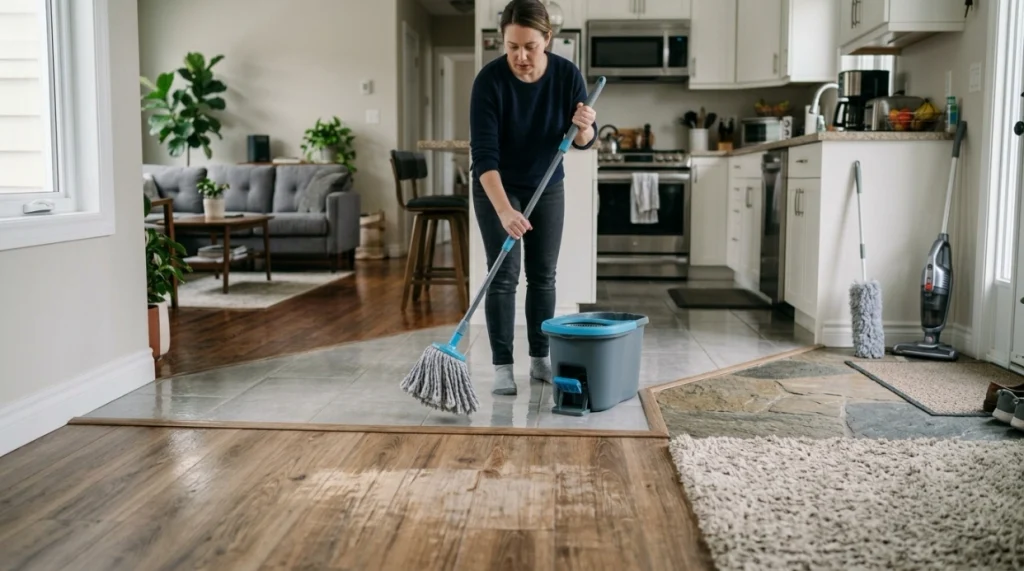
Don’t use a spin mop simply because the floor feels hard. Some hard surfaces can still be damaged by water, unsuitable cleaners, or aggressive scrubbing.
- Unsealed wood: Moisture can penetrate the material quickly.
- Damaged laminate: Water can enter open joints or chipped edges.
- Unknown natural stone: The wrong cleaning chemistry may damage or dull the surface.
- Dry dusting jobs: A vacuum or dry microfiber mop is usually faster.
- Carpet: A conventional spin mop is designed for washable hard floors, not carpet cleaning.
- Manufacturer-restricted flooring: Follow the flooring maker’s cleaning method rather than improvising.
Can too much water damage floors?
Yes, especially where liquid can enter seams, joints, unfinished edges, or wood fibers. The spinning wringer helps, but you still decide how wet the mop remains.
The floor shouldn’t stay covered in visible water after you pass over it. If puddles remain, wring the head again.
Can a dirty mop make floors look worse?
Yes. Dirty water, an overloaded microfiber head, or too much cleaner can leave streaks and residue behind.
Wash reusable mop heads according to their care instructions. Let them dry thoroughly before storage to reduce odor and keep them ready for the next cleaning session.
Safety note: Wet flooring can become slippery. Keep children, pets, and foot traffic away until the surface has dried.
Spin Mop FAQs
What is the main purpose of a spin mop?
The main purpose of a spin mop is to clean hard floors while making it easier to rinse and wring the mop head. Its bucket spinner removes excess water, giving you more control over how much moisture reaches the floor.
Is a spin mop good for everyday cleaning?
Yes, particularly for homes with tile, vinyl, or other compatible hard flooring. For tiny spills or one small room, however, a spray mop or flat microfiber mop may be quicker because there’s no bucket to prepare.
Can a spin mop remove stubborn stains?
A damp microfiber spin mop can loosen many dried spills and patches of grime. For stubborn residue, let an approved cleaning solution work briefly, then gently mop rather than applying excessive force or flooding the area.
Can I use only water in a spin mop?
You can use plain water when your flooring care instructions allow it and the soil is light. Grease or heavier residue may require an approved floor cleaner, while some finishes need a manufacturer-recommended product.
Does a spin mop clean grout?
A spin mop can remove surface dirt from sealed grout, especially with a microfiber head. It won’t always reach deeply embedded grime, so badly stained grout may need a separate grout-safe brush and cleaner.
How often should I use a spin mop?
Mop when the floor is visibly dirty and according to the needs of your household. Busy kitchens and entryways may need cleaning once or twice weekly, while lower-traffic rooms can often go longer between damp cleanings.
Should I vacuum before using a spin mop?
Yes. Vacuuming, sweeping, or dry-mopping first removes grit, hair, crumbs, and dust that wet microfiber would otherwise push around the room.
Is a Spin Mop Right for Your Home?
A spin mop makes the most sense if you have several rooms of compatible hard flooring and want a reusable system for routine washing. It’s particularly useful when easy wringing and repeated rinsing matter more than grab-and-go convenience.
- Choose a spin mop if: You clean medium or large hard-floor areas and want adjustable moisture.
- Consider a spray mop if: Most of your cleaning involves quick spills and small rooms.
- Consider a flat microfiber mop if: Precise moisture control is your top priority.
- Use extra caution if: Your home has hardwood, laminate, natural stone, or another surface with strict care requirements.
As of 2026, the basic reason to choose a spin mop hasn’t changed: it makes traditional bucket mopping cleaner, easier to wring, and more controllable. Match that convenience to the needs of your flooring, and it can become one of the most practical floor-cleaning tools in the home.
Before your next cleaning session, check your floor-care instructions, start with a clean microfiber head, and use less water than you think you need. Good mopping is mostly about controlling moisture, soil, and cleaner residue.