
What Is a Spray Mop? Complete Guide to How Spray Mops Work

Quick Answer
A spray mop is a floor-cleaning mop with a built-in bottle and trigger that sprays a small amount of water or cleaning solution directly in front of the mop head. You then wipe the damp area with a reusable microfiber or disposable pad, giving you more moisture control than a traditional mop and bucket. It is especially useful for quick everyday floor cleaning, a point reflected in Consumer Reports’ mop testing.
What a spray mop does
- Controls moisture: You spray only the amount of liquid needed for the area you’re cleaning.
- Skips the bucket: Cleaner is stored in a bottle attached to the mop.
- Handles quick messes: It works well for footprints, light dirt, small spills, and routine maintenance.
- Uses a flat pad: Most models clean with microfiber or another absorbent pad under a flat mop head.
- Works without steam: A spray mop does not heat water or produce hot vapor.
Quick tip
- Start with less spray than you think you need. The pad should leave the floor lightly damp, not visibly wet.
If you’ve seen a slim mop with a bottle attached to its handle, you’ve probably seen a spray mop. I’ve used this style for everything from kitchen footprints to quick evening touch-ups when pulling out a bucket would be overkill.
This guide explains what a spray mop is, how it works, which floors it suits, and how it compares with steam, spin, and traditional microfiber mops.
In This Guide
What Is a Spray Mop?
A spray mop is a manual floor mop that carries its own cleaning liquid and sprays it onto the floor through a nozzle. You control the spray with a trigger or button on the handle.
The cleaning head then wipes up loosened dirt with a flat pad. Most modern versions use microfiber because it can collect fine dust while absorbing a modest amount of liquid.
A simple spray mop definition
Think of a spray mop as a microfiber flat mop and spray bottle combined into one tool. You don’t need to carry a bucket from room to room.
A typical spray mop contains these parts:
- Handle: Gives you leverage and usually holds the spray trigger.
- Liquid bottle: Stores water, ready-to-use cleaner, or an approved diluted solution.
- Spray nozzle: Sends a fine mist onto the floor ahead of the mop head.
- Flat mop head: Swivels across open areas and around furniture.
- Cleaning pad: Collects moisture, dust, soil, and loosened residue.
Some systems use refillable bottles and washable pads. Others rely on proprietary solution cartridges or disposable pads.
What is a spray mop used for?
Spray mops are best suited to routine maintenance rather than major flood cleanup. I reach for one when a kitchen floor has footprints, a hallway looks dusty, or a small sticky patch needs attention.
- Daily or weekly hard-floor maintenance
- Small food and drink spills
- Dust and light tracked-in soil
- Pet paw prints
- Quick cleaning in apartments or small rooms
- Low-moisture cleaning on compatible floors
They can also be useful between deeper cleaning sessions. Their biggest advantage is convenience.
How Does a Spray Mop Work?
A spray mop works by applying a controlled mist of cleaning liquid ahead of an absorbent pad. The liquid loosens soil, while the mop pad wipes it from the surface.
You provide the scrubbing action by moving the mop. There is usually no motor, heater, pump, or vacuum suction involved.
The spray-and-wipe process
When you squeeze the handle trigger, the system pushes liquid from the bottle toward a nozzle near the mop head. The nozzle spreads the solution over a relatively small section of floor.
You immediately pass the mop pad over that area. This keeps the floor from sitting wet while you clean somewhere else.
- Press or squeeze the spray trigger.
- Apply a light mist in front of the mop.
- Move the mop over the damp area.
- Let the microfiber pad loosen and collect soil.
- Repeat in the next small section.
When I test a new spray mop, I begin with one trigger pull over a small area. I only add another spray if the pad starts dragging or the soil needs more moisture.
Why microfiber matters
Microfiber is made from very fine synthetic fibers. A clean microfiber pad can pick up dust and light grime while using much less liquid than a saturated string mop.
The pad still has limits. Once it looks gray, muddy, or saturated, replacing or rinsing it usually improves the result more than adding extra cleaner.
How Do You Use a Spray Mop Correctly?
Sweep or vacuum first, fill the mop with a floor-safe cleaner, spray lightly, and mop in small sections. The goal is a thin film of moisture that disappears quickly.
Step-by-step method
- Remove loose debris. Sweep or vacuum crumbs, sand, hair, and grit before adding moisture.
- Check the floor instructions. Confirm which cleaner and moisture level the flooring manufacturer allows.
- Fill or install the bottle. Use the cleaner specified for the mop and floor.
- Attach a clean pad. A dirty pad can spread old residue across the room.
- Spray lightly. Work in roughly 3-by-3-foot sections instead of soaking a large area.
- Mop immediately. Use overlapping passes so the pad collects the loosened grime.
- Change the pad when dirty. Large or heavily soiled rooms may need more than one pad.
- Allow the floor to dry. Keep people and pets away until no damp areas remain.
How much cleaner should you spray?
There is no universal number of trigger pulls because nozzle output varies. A good visual target is a light mist rather than beads, puddles, or a continuous wet film.
Too much cleaner can leave residue and lengthen drying time. Too little may cause the pad to drag over sticky soil.
Safety note: Always follow the cleaner label and flooring manufacturer’s care instructions. Never mix bleach, disinfectants, vinegar, ammonia, or other cleaners unless the product directions specifically allow it.
Which Floors Can You Clean With a Spray Mop?
Spray mops can work on many sealed hard floors because they let you control moisture closely. The correct cleaning liquid matters just as much as the mop itself.
Hardwood and engineered wood
Wood needs careful moisture control. The National Wood Flooring Association emphasizes dry cleaning, quick spill removal, and manufacturer-approved care methods for wood floors.
A well-controlled spray mop can leave less moisture than a wet string mop. Use a wood-floor cleaner approved for your finish and avoid flooding seams.
Laminate
Laminate usually responds best to a barely damp cleaning method. Standing water can work into joints and edges.
A spray mop can be useful because you apply cleaner directly to a small section. Keep the spray light and wipe it up promptly.
Vinyl and LVP
Many vinyl and luxury vinyl plank floors tolerate low-moisture microfiber cleaning well. Check the flooring maker’s instructions because recommended cleaners vary.
A spray mop is often a more controllable choice than a wet mop. It also avoids the heat produced by steam cleaning.
Tile
Sealed ceramic and porcelain tile are generally straightforward to clean with a spray mop. The flat pad works well for surface dirt, although deep grout may need a separate brush.
Natural stone
Stone requires more caution because marble, limestone, travertine, and other materials can react to unsuitable cleaners. Use a stone-approved, usually pH-neutral formula.
Safety note: Check both the stone type and sealer instructions before using acidic products such as vinegar. A cleaner that works on ceramic tile may not be suitable for natural stone.
Spray Mop vs. Steam Mop vs. Spin Mop
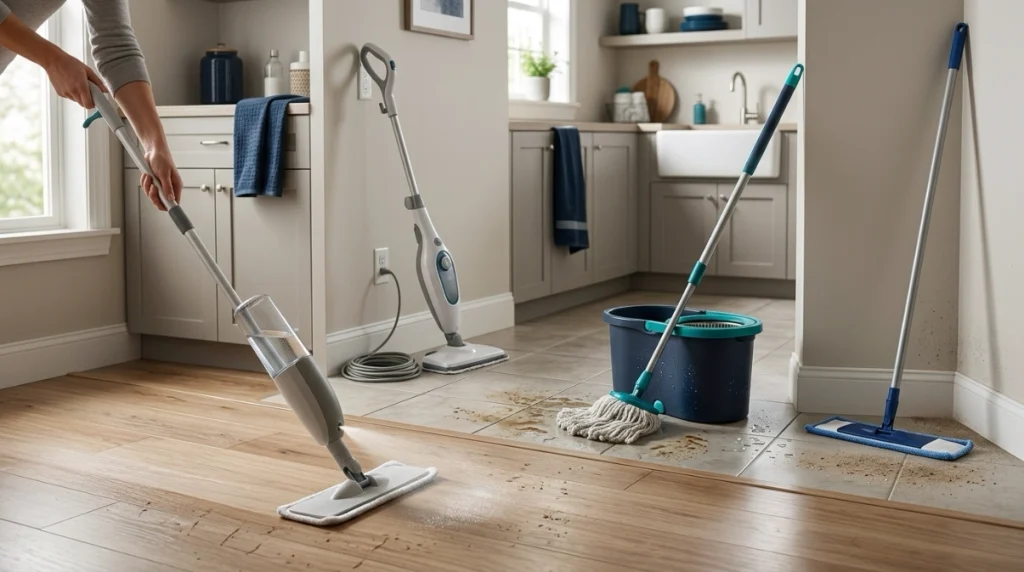
A spray mop prioritizes speed and moisture control, while steam and spin mops are better suited to different cleaning jobs. A basic microfiber flat mop remains the simplest option when you want maximum control over the cleaning liquid.
| Feature | Spray Mop | Steam Mop | Spin Mop | Flat Microfiber Mop |
|---|---|---|---|---|
| Cleaning method | Spray plus wiping | Hot vapor plus wiping | Bucket solution plus wiping | Dry or damp wiping |
| Bucket needed | No | No | Yes | Usually no |
| Electricity needed | Usually no | Yes | No | No |
| Moisture control | High | Moderate; adds heat | Depends on wringing | High |
| Best use | Quick routine cleaning | Sticky soil on steam-approved floors | Larger dirty washable areas | Dust and controlled damp cleaning |
| Main limitation | Small bottle and pad capacity | Heat and floor compatibility | Bucket setup and storage | Cleaner must be applied separately |
Is a spray mop the same as a steam mop?
No. A spray mop applies room-temperature or manufacturer-specified cleaning liquid, while a steam mop heats water and releases vapor.
Steam introduces both heat and moisture. That makes floor compatibility more restrictive than with a conventional spray mop.
Is a spray mop better than a traditional mop?
For small messes and routine cleaning, I usually find the spray mop faster. For a heavily soiled utility floor, a bucket and well-wrung mop can be more practical.
The right choice depends on the mess rather than which tool looks more advanced.
What Are the Benefits and Drawbacks of Spray Mops?
Spray mops are quick, lightweight, and easy to control, but their small pads and liquid bottles make them less suitable for major cleaning jobs.
Main benefits
- Fast setup: There is no bucket to fill, carry, empty, or rinse.
- Controlled moisture: You decide when and where liquid reaches the floor.
- Easy spot cleaning: Small spills can be handled without cleaning the entire room.
- Simple storage: Most models take up about as much space as a standard flat mop.
- Reusable options: Refillable bottles and washable microfiber pads can reduce disposable supplies.
- Good maneuverability: Flat swivel heads usually fit around table legs and under furniture.
Current products such as O-Cedar and Bona spray mops show how common refillable bottles and washable microfiber pads have become.
Common drawbacks
- Limited capacity: Small bottles are less convenient for large, heavily soiled floors.
- Pad saturation: One dirty pad can start spreading grime instead of collecting it.
- Sprayer maintenance: Cleaner residue can clog a nozzle if the system is stored poorly.
- Cleaner restrictions: Some models use proprietary cartridges or specific formulas.
- Limited scrubbing force: Dried grease or textured grout may need a brush or deeper-cleaning method.
Common spray mop mistakes
Using more solution is not the same as cleaning better. Excess liquid can create streaks, sticky residue, and longer drying times.
- Mopping before removing grit
- Over-spraying the floor
- Using one dirty pad for several rooms
- Using the wrong cleaner for the floor
- Leaving cleaning solution in a system that should be rinsed before storage
- Assuming every cleaner also disinfects
The CDC’s cleaning and disinfecting guidance explains that routine cleaning removes dirt and germs, while disinfecting is a separate process used when needed.
How Do You Choose a Spray Mop in 2026?
Choose a spray mop based on your floor type, pad system, bottle design, spray control, and replacement costs. A fancy handle matters less than a reliable nozzle and clean pad.
Look for a controllable spray pattern
The nozzle should create an even mist rather than a narrow stream. Good control makes it easier to avoid puddles near seams and baseboards.
Choose reusable or disposable pads
Washable microfiber pads cost more upfront but can be reused many times. Disposable pads reduce laundry but create recurring cost and waste.
I prefer at least two washable pads. One can be in use while the other is being washed or dried.
Check whether the bottle is refillable
A refillable bottle lets you use an approved cleaner without buying a new cartridge each time. Proprietary systems can be convenient but may limit your formula choices.
Match the mop to the floor
- Hardwood: Prioritize fine spray control and a wood-approved cleaner.
- Laminate: Choose a model that works well with minimal liquid.
- LVP or vinyl: A washable microfiber pad and gentle compatible cleaner are practical choices.
- Tile: Look for a sturdy head and enough pad texture for everyday grime.
- Mixed flooring: Choose a refillable system and use separate approved solutions when needed.
Don’t assume a disinfecting product and a floor cleaner are interchangeable. The EPA explains the difference between cleaning, sanitizing, and disinfecting, and product labels determine proper use.
Safety note: Only put a chemical in the mop bottle if both the mop manufacturer and flooring care instructions allow it. Never create your own chemical mixtures inside the reservoir.
Spray Mop FAQs
Do you put water in a spray mop?
It depends on the model. Some refillable spray mops can use water or a properly diluted floor cleaner, while others use ready-to-use cartridges. Follow the mop instructions and your flooring manufacturer’s care guide instead of assuming every reservoir works the same way.
Can you use any cleaner in a spray mop?
No. Some formulas can clog the sprayer, leave residue, or damage the floor. Use only a cleaner that is compatible with both the mop and the flooring surface.
Does a spray mop sanitize floors?
Not automatically. A spray mop is primarily a cleaning tool. Sanitizing or disinfecting requires an appropriate product, correct concentration, surface compatibility, and the contact time stated on the label.
Can a spray mop replace a regular mop?
For routine cleaning in many homes, yes. A bucket mop may still be more practical for large washable floors, mud, extensive spills, or jobs that require frequent rinsing.
Can you use a spray mop on hardwood floors?
A spray mop can work on many finished hardwood floors when the flooring manufacturer allows damp cleaning. Use minimal moisture and an approved wood-floor cleaner, and never allow liquid to pool around seams.
Why does my spray mop leave streaks?
Common causes include too much cleaner, a dirty pad, residue from an old product, or excessive spraying. Try a clean microfiber pad and use less liquid before switching to a stronger cleaner.
How often should you wash a reusable spray mop pad?
Wash it after a dirty cleaning session and whenever the pad becomes visibly soiled or starts leaving streaks. For larger homes, switching to a fresh pad during cleaning usually works better than continuing with a saturated one.
Is a Spray Mop Right for Your Home?
A spray mop is a strong everyday choice if you want fast cleaning, controlled moisture, and no bucket. It works especially well for apartments, kitchens, hallways, and homes with mostly sealed hard flooring.
It is less useful when you regularly deal with thick mud, large spills, rough utility floors, or grout that needs aggressive scrubbing.
As of 2026, I still consider a refillable spray mop with washable microfiber pads one of the simplest floor-care tools to keep nearby. It bridges the gap between dry dusting and a full deep-cleaning session.
Start by matching the cleaner to your floor. Then use the least amount of moisture that removes the mess.
That simple habit usually produces cleaner floors with less residue, less drying time, and less unnecessary work.
