
What Is the Best Mop for Laminate Floors?

Quick Answer
The best mop for laminate floors is usually a flat microfiber spray mop. It removes dust and grime while letting you control exactly how much moisture reaches the floor. A traditional wet mop can leave too much water behind, while a steam mop on laminate flooring should only be used when your flooring manufacturer specifically allows it.
What to look for
- Microfiber pad: It traps fine dust without aggressive scrubbing.
- Controlled moisture: A fine spray helps prevent water from collecting between plank joints.
- Flat mop head: It reaches under furniture and keeps even contact with the floor.
- Washable pads: Clean pads reduce grit, residue, and streaks during routine mopping.
- Laminate-safe cleaner: Choose a cleaner approved for your particular flooring whenever possible.
If you ask me what mop I reach for first on laminate, it isn’t a bucket mop or high-powered steam cleaner. I normally choose a lightweight microfiber spray mop because moisture control matters more than brute scrubbing power.
Laminate can look like hardwood, but its care requirements are different. In this guide, I’ll explain which mop types work best, when steam becomes risky, and how to clean without streaks or swollen plank edges.
In This Guide
- What type of mop is best for laminate floors?
- Why does microfiber work so well on laminate?
- Can you use a steam mop on laminate floors?
- Which laminate mop type is best?
- How should you mop laminate without streaks?
- What cleaner should you use with a laminate mop?
- How often should you mop laminate floors?
- What mopping mistakes can damage laminate?
- Frequently asked questions
What Type of Mop Is Best for Laminate Floors?
A flat microfiber spray mop is the best general-purpose choice for most laminate flooring. It combines gentle cleaning with precise moisture control.
A spray mop releases a small amount of cleaner directly in front of its pad. That makes it much easier to avoid soaking plank seams.
My first choice: a microfiber spray mop
A microfiber mop uses thousands of fine synthetic fibers to collect dust, hair, and grime. The fibers provide useful cleaning action without needing a rough abrasive surface.
I especially like spray mops for kitchens and hallways. I can treat a dirty section without wetting the entire room.
- Best for: Regular weekly cleaning and quick touch-ups.
- Moisture level: Low and easy to control.
- Cleaning pads: Usually removable and washable.
- Handling: Lightweight and easy around furniture.
- Main advantage: Good cleaning without flooding plank joints.
A plain flat microfiber mop is another strong option
You don’t need an integrated spray bottle to get good results. A basic flat microfiber mop works well when you lightly mist cleaner yourself.
The important part is the word lightly. Laminate generally needs damp cleaning rather than the dripping-wet approach used on some tile floors.
Section Takeaway: For routine laminate cleaning, choose a microfiber mop that lets you use as little liquid as necessary.
Why Does Microfiber Work So Well on Laminate?
Microfiber works well because it cleans with physical contact while requiring little water. That combination suits a floor that can suffer when moisture reaches vulnerable seams or edges.
A good microfiber pad also collects particles instead of pushing them around. That matters because loose grit can become abrasive underneath a dirty mop.
Microfiber helps control three common problems
- Fine dust: Microfiber grabs small particles that a loose string mop may leave behind.
- Streaks: A clean pad absorbs dirty solution rather than redistributing it.
- Excess water: The pad can clean effectively while only slightly damp.
When I’m cleaning a busy laminate kitchen, I often keep two pads nearby. I use the first for the main cleaning pass and switch pads if it becomes visibly dirty.
That small change can make a noticeable difference. Continuing with a filthy pad often spreads grime instead of removing it.
Can You Use a Steam Mop on Laminate Floors?
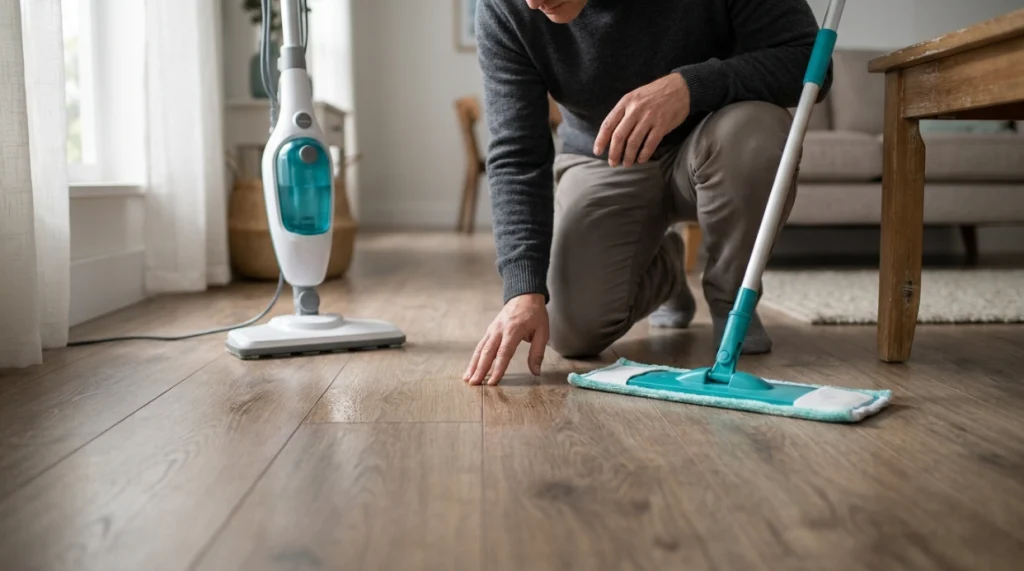
Do not assume a steam mop is safe for laminate. Some laminate manufacturers prohibit steam, while certain water-resistant products may permit carefully controlled steam under specific instructions.
Steam creates heat and moisture at the same time. If moisture penetrates a joint, the laminate core or edges may swell, distort, or separate.
Why manufacturer instructions matter
Laminate products vary widely in construction and water resistance. A cleaning method allowed on one product may void the warranty on another.
For example, some manufacturers explicitly advise against steam cleaning laminate. Others allow low-power steam only on designated wet-resistant flooring and with strict precautions.
- Check your warranty: Look for steam-cleaning restrictions before using the machine.
- Identify the exact floor: Don’t rely on advice written for another laminate collection.
- Watch the joints: Moisture entering plank connections creates the biggest concern.
- Avoid repeated passes: Concentrating heat over one area increases exposure.
- Use microfiber instead: A damp microfiber mop is the safer default when you’re uncertain.
Safety note: Always follow your laminate manufacturer’s care guide before using steam, strong cleaners, disinfectants, or other moisture-heavy cleaning methods.
In my own cleaning routine, steam isn’t my starting point for an unidentified laminate floor. I would rather make two gentle microfiber passes than gamble with a moisture-sensitive joint.
Section Takeaway: Treat steam mops as manufacturer-specific tools, not universal laminate cleaners.
Which Laminate Mop Type Is Best?
The right mop depends on how much control it gives you over moisture, grit, and cleaning pressure. Here’s how the common choices compare.
| Mop Type | Moisture Control | Laminate Suitability | Best Use |
|---|---|---|---|
| Microfiber spray mop | Excellent | Excellent | Routine cleaning |
| Flat microfiber mop | Excellent when well wrung | Excellent | Whole-room cleaning |
| Spin mop | Good if wrung nearly dry | Good with caution | Larger spaces |
| String mop | Poor to moderate | Usually not ideal | Water-tolerant flooring |
| Steam mop | Varies | Manufacturer-dependent | Approved laminate only |
| Robot mop | Usually good | Good when configured correctly | Maintenance cleaning |
What about spin mops?
A spin mop can work on laminate if you wring the head until it’s only slightly damp. The bucket’s spinning mechanism makes moisture control easier than with a traditional string mop.
I still prefer a flat pad for everyday laminate care. A broad microfiber pad gives me more predictable contact and less splashing.
What about cordless electric mops?
Electric mops with rotating pads can be useful when they dispense only a small amount of solution. Check that the model and cleaner are suitable for sealed laminate.
Avoid assuming more power means better cleaning. A gentle method performed regularly usually beats aggressive scrubbing on a finished floor.
How Should You Mop Laminate Without Streaks?
The best technique is to remove dry debris first, use very little cleaner, and work with a clean microfiber pad. Let the surface dry instead of leaving pools behind.
- Vacuum or dust mop first. Remove grit, crumbs, hair, and other loose debris.
- Inspect the mop pad. Start with a clean microfiber pad rather than yesterday’s dirty one.
- Apply a fine mist. Spray a small section instead of soaking the entire floor.
- Mop with the plank direction. This makes it easier to spot residue and clean along joints.
- Work in manageable sections. Clean several feet at a time so liquid doesn’t sit.
- Change dirty pads. A heavily soiled pad will create streaks.
- Remove remaining moisture. Wipe visible wet spots with a dry microfiber cloth.
- Let the floor dry. Keep foot traffic away until the surface is no longer damp.
Why do laminate floors look streaky after mopping?
Streaking often comes from excess cleaner, a dirty pad, or using too much liquid. Hard-water minerals can also contribute to visible film.
More detergent isn’t the solution. If anything, using too much product can make the floor look worse.
- Use less cleaner: Follow the product’s dilution or application directions.
- Refresh the pad: Switch when the microfiber looks gray or heavily soiled.
- Avoid oily products: Products that leave a coating may create haze.
- Don’t re-mop with dirty water: You’re likely to spread dissolved soil again.
Section Takeaway: Streak-free laminate cleaning depends more on clean tools and controlled product use than heavy scrubbing.
What Cleaner Should You Use With a Laminate Mop?
Use a cleaner labeled as compatible with laminate or approved by your flooring manufacturer. A ready-to-use, low-residue formula is usually easier to control than a bucket full of concentrated detergent.
A pH-neutral cleaner is formulated near the middle of the pH scale. These cleaners are commonly chosen for routine hard-floor care because they avoid unnecessarily harsh chemistry.
Products I would avoid unless the flooring manufacturer approves them
- Large amounts of dish or laundry detergent: Concentrated soap can leave sticky film.
- Wax or oil soap: It may create buildup on surfaces that don’t need waxing.
- Strong abrasive cleaners: Abrasion can dull or mark the wear layer.
- Undiluted vinegar: Don’t assume every DIY acidic cleaner suits your finish.
- Bleach mixtures: Disinfectants require surface compatibility and correct label use.
For routine household cleaning, disinfection usually isn’t necessary on every section of flooring. Cleaning away dirt and residue is normally the main goal.
If disinfection is needed because of illness or contamination, use a product appropriate for the surface. Follow its contact-time and safety directions exactly.
Safety note: Never mix cleaning chemicals, and always check both the cleaner label and your flooring manufacturer’s care instructions before applying disinfectants to laminate.
How Often Should You Mop Laminate Floors?
Most laminate floors benefit from regular dry cleaning and damp mopping only when needed. The exact schedule depends on traffic, pets, children, cooking, and outdoor dirt.
I prefer to let visible soil determine frequency rather than repeatedly wet-cleaning an already clean floor. Dry debris removal can happen far more often.
| Area | Dry Cleaning | Damp Mopping |
|---|---|---|
| Busy kitchen | Daily or as needed | About weekly or when visibly dirty |
| Entryway | Several times weekly | As needed |
| Living room | Weekly | Every one to several weeks |
| Low-traffic bedroom | Weekly or as needed | When visibly dirty |
As of 2026, manufacturer recommendations still vary enough that there isn’t one universal wet-cleaning schedule. Follow the care guide supplied with your exact flooring whenever it provides a specific interval.
What Mopping Mistakes Can Damage Laminate?
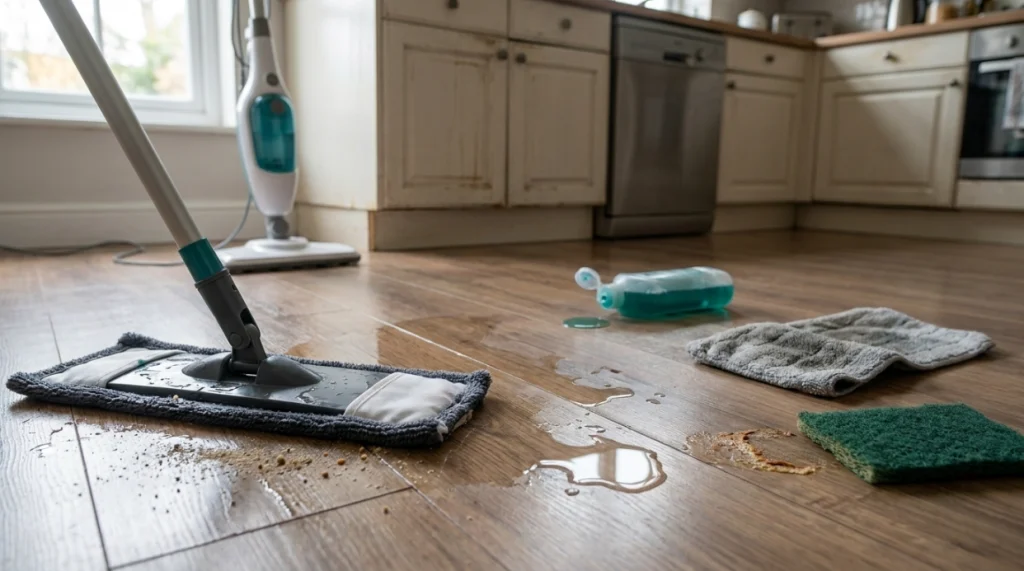
The biggest laminate-cleaning mistakes involve excessive moisture, abrasive debris, and products that aren’t compatible with the floor. Preventing those problems is easier than repairing swollen or separated planks.
1. Starting with a wet mop
A dripping mop can push water toward joints and edges. Laminate should usually be cleaned with controlled moisture instead.
2. Skipping dry debris removal
Sand and grit can become trapped beneath your mop pad. Dragging those particles across the surface can contribute to fine scratching.
3. Leaving spills standing
Clean spills promptly rather than letting them remain near seams. Even water-resistant flooring can have product-specific exposure limits.
4. Using the same dirty pad throughout the house
A dirty microfiber pad eventually stops collecting soil efficiently. Change or rinse it before it becomes overloaded.
5. Assuming steam is safe because the floor is water-resistant
Water resistance doesn’t automatically mean steam resistance. Steam combines moisture, pressure, and heat in a way ordinary damp mopping does not.
6. Using extra cleaner for extra shine
Adding more solution often leaves more residue. A clean laminate floor should not need a thick coating of detergent.
7. Scrubbing stubborn spots aggressively
Spot-clean stains with a floor-compatible method instead of immediately reaching for abrasive pads. Test unfamiliar products in a hidden area first.
Safety note: Stop using any method that causes swelling, raised edges, discoloration, unusual haze, or separation at laminate joints.
Section Takeaway: Protect laminate by controlling moisture first, removing grit before mopping, and following product-specific care instructions.
Frequently Asked Questions
What is the best mop for laminate wood floors?
A flat microfiber spray mop is usually the best choice. It removes dust and grime while releasing only a small amount of cleaning solution, helping you avoid the excess moisture that can reach laminate plank joints.
Is a Swiffer-style mop good for laminate?
A lightweight pad-style mop can work well when its cleaning solution is approved for your floor. The main advantages are moisture control and disposable or washable pads, but always check your laminate manufacturer’s cleaning guidance first.
Can I use a spin mop on laminate flooring?
Yes, a spin mop can be suitable if you wring the head until it is only slightly damp. Avoid leaving puddles or repeatedly flooding seams, and dry any visible moisture promptly.
Can I use a steam mop on waterproof laminate?
Only when the flooring manufacturer explicitly permits steam on your exact product. Some water-resistant laminate collections allow controlled steam, while other manufacturers prohibit it because heat and moisture can damage joints or the laminate core.
Should I mop laminate with hot water?
You normally don’t need very hot water for routine laminate cleaning. Use the temperature and solution recommended by your flooring or cleaner manufacturer, and focus on minimizing the amount of liquid left on the floor.
Why does my laminate floor feel sticky after mopping?
Sticky laminate often comes from using too much detergent, repeatedly mopping with dirty solution, or leaving cleaner residue behind. Switch to a clean microfiber pad and use a smaller amount of laminate-compatible cleaner.
Is microfiber better than a string mop for laminate?
For most homes, yes. A flat microfiber mop gives you better moisture control and collects fine particles effectively, while a saturated string mop can release far more water than laminate needs.
The Best Choice for Most Laminate Floors
If I had to keep only one mop for laminate, I’d choose a flat microfiber spray mop. It’s simple, reusable, easy to control, and suitable for the type of low-moisture cleaning laminate generally needs.
Steam mops are a different story. Use one only when your exact laminate flooring instructions clearly approve steam cleaning.
Start by vacuuming or dust mopping, apply the smallest useful amount of laminate-safe cleaner, and keep your microfiber pads clean. Those simple habits usually matter more than buying the most powerful floor-cleaning machine.
Before your next clean, check your flooring warranty or care guide once. Knowing its moisture and steam restrictions can save you from an expensive cleaning mistake.