
What Is Better Than a Mop? Best Floor-Cleaning Alternatives

Quick Answer
A steam mop can be better than a traditional mop for sticky grime on steam-safe ceramic or porcelain tile. For mixed flooring, a microfiber flat mop or powered floor washer is usually more versatile, while robot mops are better for automated maintenance. Steam mop testing and buying guidance can also help you compare powered options.
Which alternative fits which job?
- Steam mop: Best for loosening sticky residue on flooring specifically approved for steam.
- Powered floor washer: Best when you want to wash the floor and collect dirty liquid in one pass.
- Microfiber flat mop: Best for controlled moisture, everyday cleaning, and sensitive flooring.
- Robot mop: Best for scheduled maintenance between deeper cleaning sessions.
- Spin mop: Best for larger water-safe areas where you want strong manual scrubbing with easier wringing.
My quick recommendation
- Choose by floor type first, then by cleaning power and convenience.
If you’re wondering what is better than a mop, the answer depends on what you’re cleaning. I’ve found that no single floor-cleaning machine wins on tile, hardwood, laminate, vinyl, and every other surface.
In this guide, I’ll compare steam mops, floor washers, microfiber systems, spin mops, and robot mops. You’ll also see where a simple traditional mop still makes more sense.
In This Guide
- What Is Better Than a Traditional Mop?
- What Are the Best Alternatives to a Mop?
- Is a Steam Mop Better Than a Regular Mop?
- Are Floor Washers or Robot Mops Better?
- What Is Best for Each Floor Type?
- Which Floor-Cleaning Tool Should You Choose?
- When Is a Regular Mop Still Better?
- How Do You Clean Floors Safely?
- Frequently Asked Questions
- What Should You Choose in 2026?
What Is Better Than a Traditional Mop?
A powered floor washer is the closest all-in-one upgrade to a traditional mop on compatible sealed hard floors. A steam mop can be better when sticky grime on steam-safe tile is your main problem.
A traditional mop depends on water, cleaning solution, and your physical scrubbing. Depending on the design, dirty water may remain in the bucket and return to the floor.
A modern alternative can improve one or more parts of that process:
- Steam mops use heated vapor to soften grime.
- Wet-dry floor washers apply cleaning liquid and collect dirty water.
- Electric spin mops use powered pads to reduce manual scrubbing.
- Robot mops clean automatically on a schedule.
- Microfiber flat mops use less moisture and offer better control.
A powered floor washer is a machine that applies fresh cleaning liquid while a roller or brush scrubs the floor. Many models then suction the dirty liquid into a separate tank.
That separation is useful in busy kitchens and entryways. You’re not deliberately dipping the cleaning surface back into the same bucket of dirty water.
I still wouldn’t call any powered machine universally better. Floor compatibility matters more than motor power.
What Are the Best Alternatives to a Mop?
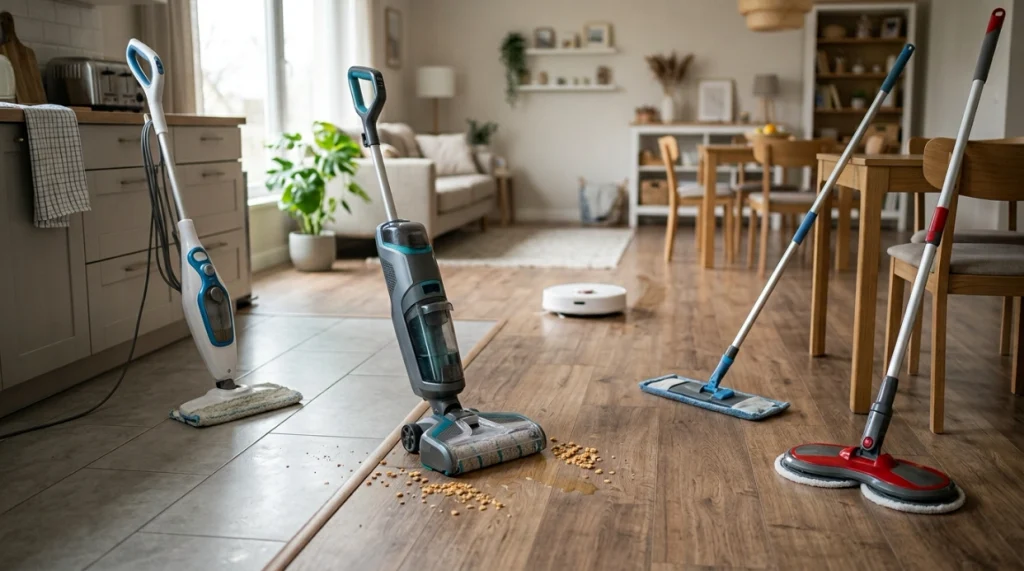
The best alternatives are steam mops, powered floor washers, microfiber flat mops, electric spin mops, and robot mops. Each solves a different weakness of conventional mopping.
Steam mop
A steam mop heats water and directs vapor through a washable pad. Heat can soften dried food, light grease, and sticky residue before the pad lifts it away.
- Best for: Approved ceramic and porcelain tile.
- Main advantage: Strong performance on stuck-on residue without a bucket.
- Main drawback: Heat and moisture restrict where you can safely use it.
Powered wet-dry floor washer
A floor washer combines liquid application, powered agitation, and dirty-water pickup. That makes it attractive for households dealing with muddy footprints, food spills, and pet messes.
- Best for: Frequent cleaning of compatible sealed hard floors.
- Main advantage: Collects dirty liquid instead of leaving most of it behind.
- Main drawback: Costs more and requires tank, roller, and filter maintenance.
Microfiber flat mop
Microfiber consists of extremely fine synthetic fibers that trap dust and soil. A flat microfiber system gives you precise control over how much moisture reaches the floor.
- Best for: Everyday maintenance and moisture-sensitive flooring.
- Main advantage: Lightweight, inexpensive, and easy to control.
- Main drawback: Stubborn dried residue may require extra passes.
Electric spin mop
An electric spin mop uses motor-driven rotating pads. The powered movement reduces how much scrubbing you need to do yourself.
- Best for: People who find repeated manual scrubbing tiring.
- Main advantage: Powered agitation with less heat than steam cleaning.
- Main drawback: Most models don’t collect loose debris or dirty water.
Robot mop
A robot mop is best viewed as a maintenance tool. It can handle light dust, footprints, and routine surface cleaning while you’re doing something else.
- Best for: Frequent automated touch-ups.
- Main advantage: Minimal hands-on cleaning time.
- Main drawback: Corners, dried spills, and heavy soil can still need manual attention.
Is a Steam Mop Better Than a Regular Mop?
A steam mop is better for certain sticky messes on steam-approved surfaces. A regular microfiber mop is better when floor compatibility and moisture control matter most.
Consumer Reports notes that steam mops heat water in an onboard tank and apply steam directly through a cleaning pad. This avoids carrying a bucket and can make stubborn grime easier to remove.
You can review its broader steam mop buying guidance when comparing steam features and cleaning systems.
Where steam has an advantage
- Sticky kitchen residue
- Dried food spills
- Textured steam-safe tile
- Light greasy film
- Situations where you want to avoid a bucket
I’ve found steam most useful when a slightly damp microfiber pad keeps sliding over a dried kitchen spot. Controlled heat often loosens that residue with fewer aggressive passes.
Where a regular mop has an advantage
- Hardwood and engineered wood
- Laminate flooring
- Many LVP and vinyl products
- Natural stone requiring specialized cleaner
- Floors with uncertain steam compatibility
The National Wood Flooring Association emphasizes moisture control and manufacturer-approved maintenance for wood flooring. Its guidance cautions against excessive moisture and steam exposure on wood floors.
Safety note: Check both the flooring manufacturer’s care instructions and the steam mop manual before putting steam on any floor.
Section Takeaway: Steam can outperform a regular mop on compatible tile with stubborn grime. A microfiber mop remains the safer default when you have several sensitive floor types.
Are Floor Washers or Robot Mops Better?
A floor washer is better for active cleaning and dirty-water removal. A robot mop is better for convenient maintenance between deeper cleaning sessions.
Choose a floor washer when messes are heavier
Powered washers can scrub while collecting dirty liquid. That design is especially helpful after cooking, wet weather, or regular pet traffic.
You still need to maintain the machine. Empty dirty water promptly, rinse removable parts, and let rollers dry according to the manual.
Choose a robot mop when consistency matters
A robot can run several times per week without much effort. Frequent light cleaning may stop dust and footprints from building into a larger weekend job.
Don’t expect the robot to replace detailed edge cleaning. You may still need a handheld tool around toilets, corners, stairs, and stubborn spots.
What Is Best for Each Floor Type?
The safest cleaning method depends on the floor material, finish, seams, and manufacturer’s care instructions. A method that’s excellent on porcelain tile can be risky on wood or laminate.
Hardwood and engineered wood
Use a dry dust mop, hard-floor vacuum setting, or barely damp microfiber pad. Keep standing water and uncontrolled steam away unless the flooring manufacturer specifically permits another method.
The goal is moisture control. Wipe spills quickly instead of leaving water on the surface.
Laminate
A microfiber flat mop with minimal liquid is usually the safer approach. Moisture that reaches joints can create swelling or raised edges.
Avoid soaking the floor. Spray the pad lightly rather than flooding a large section.
Vinyl and luxury vinyl plank
Use a damp microfiber mop and a cleaner approved for your specific flooring. Heat, seams, coatings, and adhesives make broad steam recommendations risky.
Check the warranty before using a steam machine. Waterproof marketing does not automatically mean steam-safe.
Ceramic and porcelain tile
Tile is one of the strongest candidates for steam cleaning when the installation is sound. Steam can help soften kitchen residue and dirt sitting in surface texture.
Inspect grout and sealant before starting. Damaged grout can allow unwanted moisture beneath the surface.
Natural stone
Use a stone-approved, usually pH-neutral cleaner. A pH-neutral cleaner sits near the middle of the acid-to-alkaline scale and is less likely to attack sensitive finishes.
Avoid assuming vinegar is safe because it’s natural. Acid can harm certain stone surfaces.
Concrete
Bare or properly sealed concrete can tolerate stronger cleaning than wood. However, coatings, waxes, paint, and decorative finishes may need special treatment.
Safety note: The flooring or finish manufacturer’s instructions should override general cleaning advice whenever chemical, heat, or moisture damage is possible.
Section Takeaway: Choose the method for the floor you own, not the machine with the strongest marketing claim. Microfiber offers broad compatibility, while steam belongs mainly on surfaces explicitly approved for heat and moisture.
Which Floor-Cleaning Tool Should You Choose?
Use this comparison as a starting point. Your flooring manufacturer’s guidance should make the final call on compatible liquids, heat, and moisture.
| Cleaning Tool | Best Job | Pre-Sweep Usually Needed? | Collects Dirty Water? | Main Limitation |
|---|---|---|---|---|
| Steam mop | Sticky grime on approved tile | Yes | No | Restricted floor compatibility |
| Wet-dry floor washer | Frequent whole-floor washing | Often no | Yes | Cost and maintenance |
| Microfiber flat mop | Routine controlled-moisture cleaning | Recommended | No | More manual effort |
| Electric spin mop | Powered scrubbing | Yes | Usually no | Doesn’t vacuum most debris |
| Robot mop | Scheduled light maintenance | Depends on model | Model-dependent | Limited deep cleaning |
| Spin mop and bucket | Large water-safe areas | Yes | No | Bucket handling |
Steam-mopped nonporous floors may feel dry within several minutes when little vapor is used. A heavily soaked traditional mop can take considerably longer, especially in humid rooms with poor airflow.
Those times are not fixed specifications. Ventilation, floor texture, pad saturation, room temperature, and moisture output all change drying speed.
When Is a Regular Mop Still Better?
A regular mop is still better when you need a simple, inexpensive tool with no charging, heating, filters, tanks, or electrical parts. It also gives you direct control over cleaner choice and moisture.
I keep a microfiber mop available even when testing powered cleaners. It handles small spills faster than setting up a larger machine.
A conventional system also makes sense when:
- You have several floor materials in one home.
- Your flooring requires a specific approved cleaner.
- You only clean a small area.
- You need precise edge and corner cleaning.
- You don’t want appliance maintenance.
- You want the lowest equipment cost.
For many homes, the smartest setup isn’t replacing the mop completely. It’s pairing a microfiber mop with a powered tool for the jobs where automation or heat provides a clear benefit.
How Do You Clean Floors Safely?

Start by removing loose dirt before wet cleaning unless your machine is specifically designed to vacuum and wash simultaneously. Hair, sand, crumbs, and grit can interfere with the cleaning pad.
- Check the floor-care guide. Confirm approved cleaners, moisture levels, and whether steam is allowed.
- Remove loose debris. Sweep, dust mop, or vacuum using a suitable hard-floor setting.
- Use the minimum effective moisture. A flooded floor is not automatically a cleaner floor.
- Work in manageable sections. This prevents cleaning solution from sitting too long.
- Change dirty pads. A saturated pad can spread residue instead of collecting it.
- Let the surface dry. Keep people and pets away from slippery wet areas.
- Clean the equipment. Rinse pads, rollers, and dirty-water tanks according to the manufacturer’s directions.
The CDC’s cleaning and disinfecting guidance explains that routine cleaning is enough in many household situations. Disinfection becomes more relevant when illness or another specific need is present.
Cleaning and disinfecting are not identical. Cleaning removes dirt and many germs, while disinfecting uses a validated product or process to kill targeted microorganisms.
The EPA Safer Choice program can also help consumers identify cleaning products evaluated against its ingredient and performance criteria.
Safety note: Never mix cleaning or disinfecting chemicals unless the product labels specifically instruct you to do so. Follow label ventilation, protective-equipment, dilution, and contact-time instructions.
Frequently Asked Questions
What cleans floors better than a mop?
A powered wet-dry floor washer can clean more efficiently than a basic mop on compatible sealed floors because it scrubs and collects dirty liquid. A steam mop may work better for sticky residue on steam-safe tile.
What can I use instead of mopping?
You can use a floor washer, steam mop, electric spin mop, microfiber flat mop, or robot mop. Pick according to your floor material and the type of dirt you’re trying to remove.
Is a steam mop better than mopping?
Steam can be better for stubborn grime on approved ceramic or porcelain tile. Traditional damp microfiber cleaning is safer for many hardwood, laminate, vinyl, and natural-stone floors unless their manufacturers specifically permit steam.
Is a floor washer better than a steam mop?
A floor washer is often more practical when you want debris or dirty-water collection. A steam mop has the advantage when heat helps release stubborn residue on a floor designed to tolerate steam.
Do I still need to vacuum before using a steam mop?
Yes, with most traditional steam mops. Remove hair, grit, crumbs, and loose dust first because a standard steam mop normally lacks vacuum suction.
Is a robot mop better than a normal mop?
A robot mop is better for convenience and frequent light maintenance. A manual mop gives you more control and usually handles edges, spills, and stubborn spots more effectively.
Can I replace all my floor-cleaning tools with one machine?
Usually not. Homes with several floor types often benefit from a microfiber mop for sensitive surfaces plus a powered cleaner for compatible high-traffic areas.
What Should You Choose in 2026?
If most of your home has steam-approved tile, a steam mop is a meaningful upgrade over a traditional bucket mop. It handles sticky residue well and removes the need to carry a bucket from room to room.
If you want washing plus dirty-water collection, consider a powered wet-dry floor washer. For hardwood, laminate, mixed flooring, or maximum moisture control, I would keep a microfiber flat mop in the cleaning cabinet.
Robot mops make sense when your biggest problem is keeping up with daily dust and footprints. Electric spin mops fit households that want powered scrubbing without relying on steam.
The best cleaner isn’t simply the most powerful one. Choose the tool that cleans your floor effectively without creating unnecessary heat, moisture, residue, or maintenance problems.
