
What Is the Best Mop for Tile Floors? 2026 Guide

Quick Answer
For most sealed ceramic and porcelain tile floors, the best mop is a washable microfiber flat mop. It controls moisture, picks up fine dirt, and leaves less dirty water behind than a traditional string mop. A spin mop is better for heavier soil, while a steam mop can work on some sealed tile when the flooring manufacturer permits heat and steam. For surface-specific advice, check hard-surface floor cleaning guidance.
What I Look for in a Tile Mop
- Washable microfiber: It traps dust and grime while staying gentle on glazed tile.
- Controlled moisture: The floor should become damp, not flooded with cleaning solution.
- Easy pad changes: Fresh pads stop you from spreading dirty water across the room.
- Good edge reach: A low-profile head should clean beside cabinets, toilets, and baseboards.
- Tile compatibility: Steam and stronger cleaners need extra caution around natural stone and grout.
Quick Buying Tip
- Choose for your mess: Flat microfiber suits routine cleaning, while a spin mop handles heavier kitchen and entryway soil.
If you are asking what the best mop for tile floors is, I would not pick one tool for every type of tile. Ceramic, porcelain, natural stone, textured tile, and grout can respond differently to water, cleaners, and steam mops.
I have found that choosing the right mop head matters more than choosing the most complicated machine. This guide explains which mop works best, when steam makes sense, and how to avoid streaks or damaged grout.
In This Guide
- What is the best mop for tile floors in 2026?
- Which mop type works best on ceramic and porcelain tile?
- Are steam mops good for tile floors?
- What is the best mop for grout and textured tile?
- Which cleaning solution should you use with a tile mop?
- How do you mop tile floors without streaks?
- What mop should you use on natural stone tile?
- How often should tile floors be mopped?
- Frequently asked questions about tile mops
What Is the Best Mop for Tile Floors in 2026?
A microfiber flat mop is my best overall choice for most tile floors. It combines good dirt pickup with excellent control over how much water reaches the tile and grout.
Microfiber contains many fine synthetic fibers that hold dust, grease, and small particles. A flat head also gives consistent contact across smooth ceramic and porcelain tile.
Definition: A microfiber flat mop is a low-profile mop with a rectangular head and a removable microfiber pad. Most pads can be washed and reused many times.
I especially like this design in kitchens because I can replace the pad as soon as it looks gray. That simple change produces cleaner results than continuing with one increasingly dirty mop head.
However, flat microfiber is not automatically best for every mess. Match the tool to the condition of the floor.
- Routine dust and light soil: Use a microfiber flat mop.
- Sticky kitchen residue: Use a spin mop or microfiber mop with slightly more cleaning solution.
- Large sealed porcelain areas: Choose a wide microfiber mop for faster coverage.
- Deep grout lines: Pair your mop with a grout brush rather than expecting the mop alone to scrub them.
- Heat-safe sealed tile: Consider a steam mop only after checking the flooring guidance.
The key is not maximum water. Tile itself may tolerate moisture well, but grout lines, subflooring, adhesives, and nearby flooring can create limits.
Which Mop Type Works Best on Ceramic and Porcelain Tile?

Microfiber flat mops and spin mops are the two options I would consider first for ceramic or porcelain. Steam mops are more specialized and should not be treated as the default choice.
| Mop Type | Best Use | Moisture Control | Grout Cleaning | My Take |
|---|---|---|---|---|
| Microfiber flat mop | Routine ceramic and porcelain cleaning | Excellent | Fair | Best overall |
| Spin mop | Sticky soil and larger messes | Good when well wrung | Good | Best for deeper wet cleaning |
| Steam mop | Approved sealed tile | Uses steam | Fair to good | Useful but conditional |
| Spray mop | Fast spot cleaning | Excellent | Fair | Good for small homes |
| String mop | Rough or uneven tile | Low to moderate | Good | Effective but holds more water |
For smooth porcelain, the wide contact area of a flat mop saves time. On uneven ceramic tile, a flexible spin-mop head can reach shallow depressions more easily.
A spray mop is handy in apartments and small kitchens because there is no bucket to carry. I still prefer removable washable pads over disposable ones for regular floor cleaning.
Are Steam Mops Good for Tile Floors?
Steam mops can be useful on some sealed ceramic and porcelain tile, but they are not automatically safe for every tiled floor. Always check the tile, grout, sealer, and flooring manufacturer’s instructions first.
Definition: A steam mop heats water and sends hot vapor through a cleaning pad. The combination of heat, moisture, and wiping loosens grime from the floor.
Steam is appealing because you do not need a bucket of cleaning solution. It also loosens many sticky residues that require more physical scrubbing with a standard mop.
The concern is what lies between and beneath the tiles. Cracked grout, damaged sealers, loose tiles, and moisture-sensitive adhesives can make repeated steam exposure a poor choice.
When I would consider a steam mop
- Sealed ceramic tile: Use steam only when the flooring guidance permits it.
- Sealed porcelain tile: It may work well on greasy kitchen soil when approved.
- Sound grout: Check for cracks or loose sections before steaming.
- Controlled cleaning: Keep the mop moving rather than holding steam over one spot.
When I would skip steam
- Natural stone: Follow the stone and sealer supplier’s care instructions instead.
- Damaged grout: Repair cracks before introducing concentrated moisture.
- Mixed flooring: Do not casually run a steam mop from tile onto wood, laminate, or other heat-sensitive flooring.
Safety note: Check your flooring manufacturer’s care guide before using steam, especially when you do not know the condition of the grout, sealer, or adhesive.
What Is the Best Mop for Grout and Textured Tile?
A spin mop with a flexible microfiber head is usually more useful on textured tile than a rigid flat mop. However, no normal mop replaces direct grout scrubbing when the grout is deeply stained.
Grout sits below the tile surface in many installations. A flat pad can glide across the tile while barely touching those recessed lines.
Use a two-tool approach
- Vacuum first: Remove loose grit from tile edges and grout lines.
- Pre-treat dirty grout: Apply an appropriate grout-safe cleaner according to its label.
- Agitate the grout: Use a small nylon grout brush rather than a metal brush.
- Mop the full floor: Pick up loosened soil with a clean microfiber or spin mop.
- Rinse if required: Follow the cleaner label and remove remaining residue.
I find this faster than repeatedly pushing a wet mop over dark grout. The brush handles the narrow lines while the mop removes the soil released onto the tile.
Safety note: Test grout cleaners in a hidden area first and follow the flooring, grout, and sealer manufacturer’s directions.
Which Cleaning Solution Should You Use With a Tile Mop?
For routine tile cleaning, I prefer a correctly diluted, surface-compatible cleaner rather than a strong homemade mixture. More chemical does not mean a cleaner floor.
The CDC’s household cleaning guidance explains that regular cleaning is enough in many home situations. Disinfection becomes more relevant when illness or another specific contamination risk is present.
- Ceramic tile: Use a tile-safe neutral cleaner according to its label.
- Porcelain tile: A mild pH-neutral hard-floor cleaner is usually the simple choice.
- Natural stone: Use a product specifically approved for the stone and sealer.
- Routine cleaning: Avoid overdosing cleaner, which can leave sticky residue and streaks.
- Disinfection: Clean first, then follow the disinfectant’s surface and contact-time directions.
If you want to compare products based on ingredient standards, the EPA Safer Choice program identifies cleaning products that meet its safer-ingredient criteria. That does not mean every Safer Choice cleaner is appropriate for every tile surface.
What about vinegar?
I do not recommend vinegar as a universal tile-floor recipe. Acidic products can create problems for natural stone and may be unsuitable for some grout, sealers, or finishes.
A cleaner matched to the actual floor is simpler than guessing at a DIY dilution. It also makes troubleshooting residue much easier.
Safety note: Never mix household cleaning chemicals unless the product labels specifically direct you to do so.
How Do You Mop Tile Floors Without Streaks?
The best way to prevent streaks is to use less cleaner, clean pads, and controlled moisture. Most streaking I see comes from residue or redistributed dirt rather than a lack of cleaning power.
My practical tile-mopping routine
- Remove dry dirt first: Vacuum or sweep the entire floor before introducing moisture.
- Prepare fresh solution: Follow the cleaner label instead of pouring by eye.
- Start at the far side: Work toward the room exit so you do not cross wet tile.
- Clean small sections: Areas around 5 by 5 feet are easy to control.
- Use overlapping passes: Turn the mop before the pad becomes heavily soiled.
- Change dirty pads: A second clean pad often improves the final appearance dramatically.
- Let the floor dry: Keep foot traffic away until the tile is fully dry.
For most routine cleaning, the floor should look lightly damp rather than covered by standing water. With good airflow and a thin moisture layer, many tile floors can dry within roughly 10 to 20 minutes.
If the surface still looks cloudy after drying, buff a small area with a clean damp microfiber pad. Improvement usually points to cleaner residue rather than permanent tile damage.
Why two buckets can help
For heavily soiled floors, use one bucket for cleaning solution and another for rinsing the mop. This reduces how much dirty water returns to the floor.
With washable flat pads, I often use the same principle without buckets. I simply switch to a fresh pad once the first one becomes visibly dirty.
What Mop Should You Use on Natural Stone Tile?
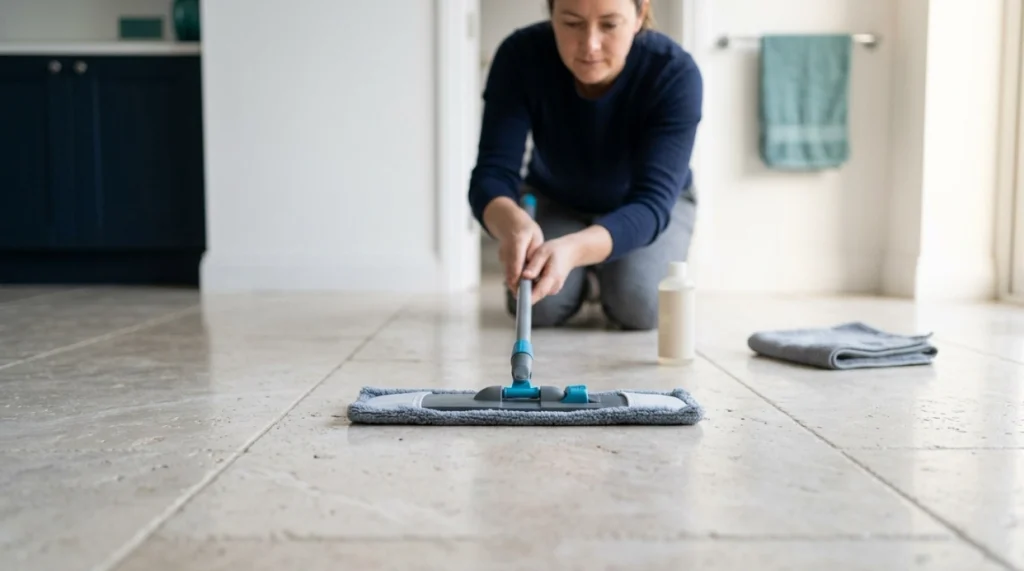
For marble, limestone, travertine, and other natural stone, use a soft microfiber mop with a stone-compatible neutral cleaner. Avoid assuming that a method safe for porcelain is automatically safe for stone.
The Natural Stone Institute’s care guidance recommends neutral cleaners or stone soap and warns that acidic products can damage acid-sensitive stones. That is why vinegar should not be your default stone-floor cleaner.
- Marble: Use soft microfiber and a non-acidic stone cleaner.
- Travertine: Keep moisture controlled and avoid aggressive acidic products.
- Limestone: Choose gentle stone-specific care.
- Granite tile: Follow the stone and sealer supplier’s cleaning directions.
I also remove grit before damp mopping natural stone. Small abrasive particles dragged beneath a mop can dull a polished surface over time.
Steam needs the same cautious approach. The tile may tolerate heat while the sealer, grout, repair material, or installation system has different limits.
Safety note: If you cannot identify the stone or sealer, ask the installer or stone supplier before trying acids, strong alkalines, bleach, or steam.
How Often Should Tile Floors Be Mopped?
For an average household, I would wet-mop tile about once a week and remove loose dirt more frequently. High-traffic kitchens, bathrooms, and entryways may need damp cleaning two or three times per week.
You do not need to mop the entire floor every time someone drops something. Spot cleaning keeps small messes from turning into a full-room job.
- Low-traffic rooms: Damp mop every one to two weeks as needed.
- Average kitchens: Mop about weekly and spot-clean spills immediately.
- Busy households: Clean high-traffic tile two or three times weekly when visibly dirty.
- Pet homes: Remove hair and grit frequently before damp mopping.
- Entryways: Dry-clean often because tracked grit can scratch glossy surfaces.
The condition of the floor matters more than following a rigid calendar. Visible soil, sticky spots, and tracked-in debris are better signals than mopping simply because another day has passed.
Frequently Asked Questions About the Best Mop for Tile Floors
Is a microfiber mop good for tile floors?
Yes. A washable microfiber flat mop is my preferred everyday option for most sealed ceramic and porcelain tile because it collects fine dirt while giving you strong control over moisture and cleaning solution.
Is a spin mop better than a flat mop for tile?
A spin mop is better for heavier wet cleaning and uneven tile because its flexible fibers reach more contours. A flat microfiber mop is easier to control and usually better for frequent light cleaning.
Can I use a steam mop on ceramic tile?
You may be able to use steam on sealed ceramic tile when the flooring manufacturer allows it. Check the grout, sealer, and installation condition first, and avoid holding the steam mop stationary over one area.
What mop works best on porcelain tile?
A microfiber flat mop works well on smooth porcelain, while a spin mop can help with textured porcelain. Both should be used with a cleaner compatible with the tile, grout, and any applied sealer.
Why does my tile floor feel sticky after mopping?
Sticky tile usually points to excess cleaner, dirty mop water, or residue left behind. Try a fresh microfiber pad with plain or manufacturer-approved rinse water, then reduce the cleaner concentration during future mopping.
Do I need to disinfect tile floors every time I mop?
No. Routine cleaning is sufficient in many households. Disinfection is more appropriate when someone is sick or there is a specific contamination concern, and the disinfectant must be suitable for the flooring surface.
What is the best mop for tile and grout together?
A spin mop is useful when you want one mop for both surfaces, but stubborn grout usually needs a separate nylon grout brush. I prefer treating grout directly and then using the mop to collect the loosened dirt.
Final takeaway: For most homes in 2026, start with a washable microfiber flat mop for routine tile cleaning. Add a spin mop for heavier messes, and treat steam as a specialized option for flooring that is specifically approved for it.
Match the mop, cleaner, and moisture level to your exact tile. That simple approach keeps the floor cleaner while reducing streaks, residue, and unnecessary wear.
