
What Liquid Should I Put in a Spray Mop?

Quick Answer
For most spray mops, use a ready-to-use floor cleaner made for your specific flooring or a properly diluted concentrate approved for spray mops. Plain water also works for light cleaning. On hardwood, laminate, vinyl, or stone, choose a low-residue, surface-safe formula and follow your flooring manufacturer’s instructions; floor-cleaner manufacturers such as Bona offer surface-specific options.
Best liquids for a spray mop
- Plain water: Good for light dust, footprints, and frequent maintenance on many sealed floors.
- pH-neutral cleaner: A dependable choice for many sealed hard floors because it minimizes harsh chemical exposure.
- Hardwood cleaner: Use a low-moisture formula specifically labeled for your wood finish.
- Laminate-safe cleaner: Choose a fast-drying product and spray lightly to keep moisture away from plank seams.
- Vinyl or LVP cleaner: Use a compatible residue-free formula rather than waxes or heavy soaps.
- Stone-safe cleaner: Natural stone usually needs a pH-neutral product designed for that stone and sealer.
What I would avoid
- Don’t automatically fill your spray mop with bleach, laundry detergent, dish soap, essential oils, wax, or concentrated cleaner. These can leave residue, harm flooring, clog the sprayer, or create unnecessary chemical exposure.
A spray mop makes floor cleaning easier because you control exactly how much liquid reaches the floor. I’ve found that choosing the right liquid matters just as much as choosing the mop itself.
The wrong floor cleaner can leave streaks, sticky residue, dullness, or excess moisture around seams. This guide explains what to use in a spray mop for hardwood, laminate, vinyl, tile, stone, and everyday floor cleaning.
In This Guide
- What is the best liquid to put in a spray mop?
- What spray mop liquid should you use for each floor type?
- Can you put just water in a spray mop?
- Can you use homemade cleaner in a spray mop?
- What should you not put in a spray mop?
- Why does spray mopping leave streaks or sticky floors?
- How should you use spray mop cleaner correctly?
- Frequently asked questions
What Is the Best Liquid to Put in a Spray Mop?
The safest default is a floor cleaner specifically approved for your floor type. A pH-neutral, low-residue cleaner is often a practical starting point for sealed hard floors.
A spray mop is a flat mop with a refillable or replaceable liquid reservoir. Pulling the trigger releases a controlled mist in front of a microfiber cleaning pad.
My first choice for everyday cleaning
For routine cleaning, I prefer the least complicated formula that does the job. More soap doesn’t automatically mean a cleaner floor.
- Light everyday dirt: Plain water may be sufficient on compatible sealed floors.
- General grime: Use a floor-specific, low-residue cleaner.
- Greasy kitchen soil: Choose a cleaner labeled for your floor and grease removal.
- Wood floors: Choose a hardwood-specific cleaner and use minimal moisture.
- Natural stone: Use a stone-safe pH-neutral formula.
One reason I favor ready-to-use products is consistency. You don’t have to guess whether you added twice as much concentrate as needed.
What does pH-neutral mean?
A pH-neutral cleaner is formulated near the middle of the pH scale rather than being strongly acidic or alkaline. That doesn’t make every neutral cleaner safe for every floor, but it reduces one common source of finish damage.
Always give the flooring manufacturer’s care guide the final say. A cleaner can be gentle yet still conflict with a particular coating, sealer, or warranty.
Safety note: Check both your floor-care instructions and the cleaner label before putting any chemical solution in your spray mop.
What Spray Mop Liquid Should You Use for Each Floor Type?
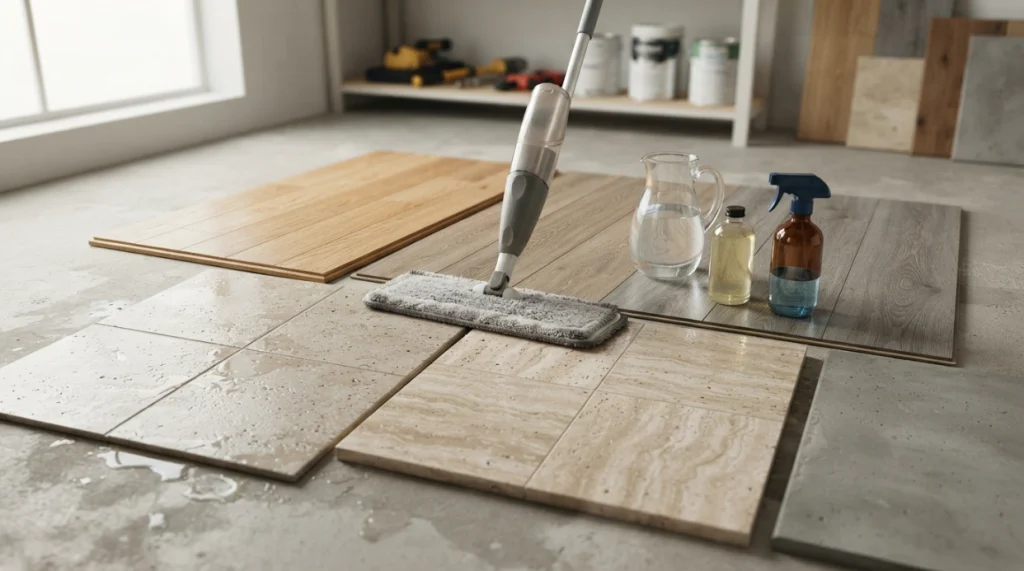
The liquid should match the flooring underneath your feet. Hardwood, laminate, vinyl, ceramic tile, and stone don’t respond to moisture and chemistry in the same way.
| Floor Type | Good Starting Choice | Moisture Level | Avoid Unless Approved |
|---|---|---|---|
| Hardwood | Wood-floor cleaner | Very light | Excess water, bleach, acidic DIY cleaners |
| Laminate | Laminate-safe cleaner | Very light | Pooling water, oily cleaners, heavy soap |
| Vinyl/LVP | Vinyl-safe pH-neutral cleaner | Light | Wax, harsh solvents, abrasive formulas |
| Ceramic/Porcelain Tile | Tile-safe cleaner | Moderate | Heavy residue-producing cleaners |
| Natural Stone | Stone-specific pH-neutral cleaner | Light | Vinegar, lemon, acidic cleaner |
| Sealed Concrete | Cleaner compatible with the sealer | Light to moderate | Chemicals that attack the coating |
Hardwood and engineered wood
Wood is where I become most conservative with spray quantity. I want the microfiber pad damp enough to clean without leaving visible wet trails behind.
Choose a cleaner intended for the specific wood finish. Bona, for example, markets pH-balanced wood-floor cleaners designed for finished wood surfaces.
Laminate flooring
Laminate responds well to controlled spray mopping because you can limit water. The vulnerable areas are usually the joints and edges.
Use a laminate-compatible formula and a clean microfiber pad. If droplets collect around plank seams, you’re spraying too much.
Vinyl and luxury vinyl plank
Vinyl and LVP are generally easier to damp clean than wood. Still, excessive cleaner can leave a film that makes attractive flooring look dull.
Choose a vinyl-safe cleaner without wax unless your flooring manufacturer specifically asks for a polishing product.
Tile and natural stone
Ceramic and porcelain tile tolerate routine damp cleaning well, although grout may need separate scrubbing. A spray mop is best for maintenance rather than deep grout restoration.
Natural stone needs more caution. Marble and other acid-sensitive materials can react badly with vinegar or acidic products.
Safety note: Flooring finishes and sealers vary. Verify cleaner compatibility before using a new formula across the entire floor.
Section Takeaway: Match the cleaner to the floor rather than searching for one aggressive mixture for the whole house. Use the least moisture needed, especially around wood and laminate seams.
Can You Put Just Water in a Spray Mop?
Yes. Plain water can work well in many spray mops when you’re removing light dust, footprints, and loose everyday soil from a compatible sealed surface.
I often start with water when a floor was properly cleaned recently. It avoids adding another layer of cleaner where none is needed.
When water works well
- Frequent maintenance: The floor has only light soil.
- Dusty rooms: You’re mainly collecting fine particles after vacuuming.
- Residue correction: You’re trying to remove leftover cleaner from an earlier mopping session.
- Sensitive households: You want to minimize unnecessary fragrance or cleaning chemicals.
Water isn’t a universal solution for grease, dried food, tracked grime, or oily residue. Those messes usually need a compatible cleaning agent.
Should you use hot water?
I wouldn’t automatically fill a spray mop with very hot water. Reservoir materials, seals, and internal parts may have temperature limits.
Follow the mop manufacturer’s instructions. Room-temperature or mildly warm water is usually simpler unless the manual specifies otherwise.
Can You Use Homemade Cleaner in a Spray Mop?
You can use a homemade mixture only when both the mop and flooring can safely handle its ingredients. A popular DIY recipe isn’t proof that it’s safe for your particular finish.
This is one area where I prefer caution. Floors cost far more to repair than a bottle of compatible cleaner costs to buy.
What about vinegar and water?
Vinegar is acidic. That makes it a poor universal recommendation because acidic solutions can affect some finishes, sealers, grout, and natural stone.
I don’t use vinegar as my automatic spray-mop formula. I first check the flooring manufacturer’s care guidance.
What about dish soap?
Dish soap is designed for items that can be thoroughly rinsed. Floors don’t get the same rinse treatment as plates in a sink.
Use too much and you’ll often trade dirt for a soapy film. That film can attract new soil and create streaks or slipperiness.
Can you add essential oils?
Essential oils aren’t necessary for cleaning performance. Oils can also leave residue, affect certain finishes, or build up inside a sprayer.
If fragrance is important to you, a cleaner already formulated and labeled for the floor is the more predictable option.
Safety note: Never mix cleaning chemicals unless the product labels specifically direct you to do so.
What Should You Not Put in a Spray Mop?
Avoid liquids that can damage the floor, leave residue, create unsafe chemical combinations, or harm the mop’s reservoir and spray mechanism.
The following are not good universal spray-mop fillers.
- Undiluted concentrate: More cleaner often means more residue, not more cleanliness.
- Laundry detergent: It’s formulated for fabric washing and can create a difficult-to-rinse floor film.
- Too much dish soap: It can leave sticky or streaky residue.
- Bleach as routine cleaner: It’s unnecessary for ordinary floor maintenance and can damage incompatible surfaces.
- Mixed cleaning chemicals: Combining products can create dangerous reactions or fumes.
- Wax or polish: It may clog components or create unwanted buildup on floors not designed for it.
- Essential-oil-heavy mixtures: Oils can leave a slippery film and residue inside the mop.
- Strong acidic cleaners: These can damage acid-sensitive stone and certain floor finishes.
Cleaning and disinfecting aren’t the same thing
The Centers for Disease Control and Prevention distinguishes routine cleaning from disinfecting. Cleaning removes dirt and many germs, while disinfection uses chemicals to kill remaining germs.
The CDC says regular household cleaning is sufficient in many situations. Disinfection becomes more relevant when someone is sick or at higher risk.
The U.S. Environmental Protection Agency also distinguishes cleaners, sanitizers, and disinfectants. A normal spray-mopping session doesn’t automatically require a disinfectant.
Never casually combine bleach with another cleaning product. Follow label directions whenever disinfectants are genuinely needed.
Safety note: Read disinfectant labels carefully and confirm that the product is suitable for both the flooring material and intended use.
Section Takeaway: Your spray mop doesn’t need a powerful chemical cocktail. For ordinary floor care, a compatible cleaner or plain water is usually the simpler choice.
Why Does Spray Mopping Leave Streaks or Sticky Floors?
Too much cleaner is one of the first things I check when a spray-mopped floor feels tacky. Residue remains behind when the pad can’t absorb the amount of product being applied.
In my own cleaning routine, cutting the spray volume often improves the result before I change products.
Common causes of streaks and stickiness
- Overdosing cleaner: Concentrated solution dries into a film.
- Dirty microfiber pad: A saturated pad redistributes grime instead of collecting it.
- Too much spray: Excess moisture pushes dirty liquid around the room.
- Skipping dry soil removal: Dust and hair mix with liquid and become muddy residue.
- Wrong product: Waxes, oils, soaps, or incompatible cleaners can leave a visible coating.
- Using one pad too long: Large rooms often need a fresh pad partway through cleaning.
How I fix cleaner residue
First, stop adding more product. Applying another coat rarely solves buildup caused by the previous one.
- Vacuum or dry mop loose debris.
- Install a clean microfiber pad.
- Use plain water only if your flooring permits it.
- Work in small sections with light spray.
- Change pads when they become visibly dirty.
- Allow the floor to dry completely before judging the result.
Persistent haze can indicate an incompatible product, polish buildup, or a damaged finish. At that point, check the flooring manufacturer’s instructions before trying stronger chemicals.
How Should You Use Spray Mop Cleaner Correctly?
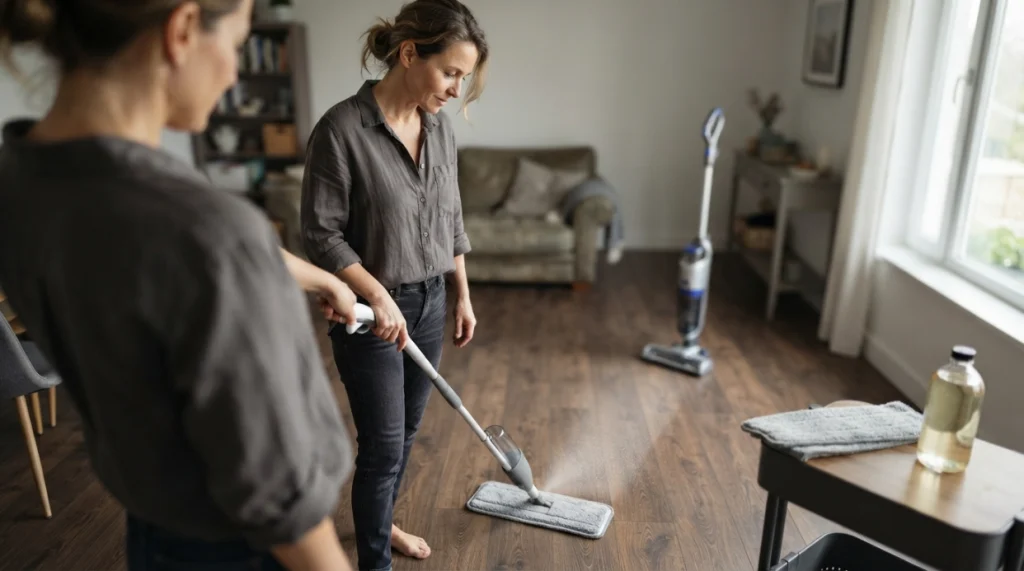
For a clean, fast-drying floor, remove dry debris first and then use a small amount of compatible liquid. The microfiber pad should collect soil rather than swim through cleaner.
My basic spray-mopping routine
- Vacuum first. Pick up grit, crumbs, pet hair, and dust before adding liquid.
- Check the floor. Look for damaged seams, worn finish, loose planks, or unsealed areas.
- Fill correctly. Add approved ready-to-use cleaner or dilute concentrate exactly as directed.
- Test a small area. Choose an inconspicuous spot when using a new cleaner.
- Spray lightly. One or two short trigger pulls can cover more area than you expect.
- Mop in sections. Work the microfiber pad over the damp area before spraying more.
- Watch the pad. Replace or rinse it once it becomes loaded with dirt.
- Let the floor dry. Keep foot traffic away until the surface is no longer damp or slippery.
How much cleaner should you spray?
There isn’t one trigger count for every mop because spray patterns differ. Use enough to lightly damp the cleaning path without leaving puddles or standing droplets.
On wood and laminate, I err on the dry side. If the floor stays visibly wet after you’ve passed the pad over it, reduce the amount.
Should you rinse after spray mopping?
A properly used no-rinse cleaner shouldn’t normally require a separate rinse. Follow its label rather than adding an unnecessary step.
If you accidentally overdosed the product, a second pass with a clean pad and compatible plain water can sometimes remove residue.
As of 2026, the basic rule hasn’t changed: the floor manufacturer’s care instructions and the cleaner label should outrank social-media cleaning recipes.
Safety note: Wet floors can be slippery. Keep children, pets, and other household members off the cleaned area until it dries.
Section Takeaway: Use less liquid than a traditional bucket mop, keep the microfiber pad clean, and let the flooring—not a viral recipe—determine which cleaner belongs in your spray mop.
Frequently Asked Questions
Can I put any floor cleaner in my spray mop?
No. The cleaner should be compatible with both the spray mop and your flooring. Some concentrated, oily, waxy, or high-foaming products can leave residue or affect the sprayer. Check the mop manual and floor-care instructions before filling the reservoir.
What is the safest homemade solution for a spray mop?
There isn’t one homemade recipe that’s safest for every floor. Plain water is the simplest option for light cleaning when the flooring manufacturer permits damp mopping. For deeper cleaning, a properly formulated floor-specific product is more predictable than experimenting with vinegar, soap, or oils.
Can I put Pine-Sol or another multipurpose cleaner in a spray mop?
Only if the product label, mop instructions, and flooring manufacturer all permit it. If the cleaner requires dilution, measure it exactly. A product being suitable for a hard surface doesn’t automatically mean it’s appropriate for every hardwood, laminate, vinyl, or stone finish.
Can I put disinfectant in a spray mop?
Only use a disinfectant when the product is labeled for the surface and you can follow its required directions, including contact time. Routine cleaning usually doesn’t require disinfecting every floor. Never mix disinfectants with other cleaning chemicals.
Can I use vinegar in my spray mop?
I don’t recommend vinegar as a universal spray-mop liquid. Its acidity makes it unsuitable for some finishes, sealers, and natural stone. Check your flooring manufacturer’s care guide before using any vinegar-based mixture.
Why does my spray mop leave the floor sticky?
Sticky floors usually point to excess cleaner, residue-producing formulas, a dirty microfiber pad, or insufficient removal of loose soil before mopping. Reduce the cleaner amount, use a fresh pad, and check whether your product is truly designed as a no-rinse floor cleaner.
Should I use distilled water in my spray mop?
Distilled water isn’t essential for most households, but it can be useful where tap water contains enough minerals to leave visible spots. Before switching, first check whether excess cleaner rather than water hardness is causing your streaks.
For most homes, the answer to “what liquid should I put in a spray mop?” is simple: use a floor-specific cleaner in the correct amount, or plain water when light cleaning is enough.
Keep the spray light, use clean microfiber pads, and avoid homemade chemical combinations. Your floors should dry clean—not sticky, cloudy, or soaked.