
Which Spray Mop Is Best for Cleaning Floors? 2026 Guide

Quick Answer
For most homes, the best spray mop is a reusable microfiber spray mop with a refillable cleaner tank and controlled mist. Models such as the O-Cedar ProMist MAX and Rubbermaid Reveal fit this approach well, while Bona spray mops are especially practical for compatible wood floors. For independent mop-testing information, you can also review Consumer Reports mop guidance.
What matters most
- Controlled spray: A fine mist helps prevent puddles and excessive moisture.
- Microfiber pad: Reusable microfiber lifts dust, hair, and everyday grime without aggressive scrubbing.
- Refillable bottle: This lets you use a cleaner approved for your specific flooring.
- Washable pads: Reusable pads cost less over time and reduce disposable waste.
- Floor compatibility: Your flooring manufacturer’s care instructions should always take priority.
My quick pick by situation
- Choose a refillable microfiber spray mop for the best all-around flexibility.
- Choose a floor-specific system such as Bona when protecting a compatible wood finish is your priority.
- Choose a disposable-pad system mainly when speed and convenience matter more than long-term cost.
After cleaning hardwood, laminate, vinyl, LVP, tile, and other hard floors with different mop styles, I keep coming back to spray mops for routine cleaning. They give me much better moisture control than a dripping traditional mop.
That doesn’t mean every spray mop is right for every floor. This guide explains what I look for, which designs work best, and when another mop makes more sense.
In This Guide
- Which spray mop is best for cleaning floors?
- What is a spray mop and how does it work?
- How do the main spray mop types compare?
- Which spray mop is safest for each floor type?
- What should you look for when choosing a spray mop?
- How do you use a spray mop without leaving streaks?
- Is a spray mop better than a steam, spin, or flat mop?
- Frequently asked questions
- Final takeaway
Which Spray Mop Is Best for Cleaning Floors?
The best choice for most households is a refillable microfiber spray mop. It combines controlled moisture, washable cleaning pads, and the freedom to select a floor-safe cleaner.
If I had to choose one spray-mop design for a mixed-floor home in 2026, that is the style I would buy first.
Best overall: refillable microfiber spray mop
A reusable spray mop works especially well for everyday footprints, kitchen splashes, dust, pet hair, and light grime. The trigger gives you control over exactly where the liquid lands.
That control matters on moisture-sensitive surfaces. I would rather add another small spray than flood a laminate seam or wood joint.
- Best for: Routine whole-home cleaning.
- Good surfaces: Compatible sealed hardwood, laminate, LVP, vinyl, and tile.
- Key feature: Fine, controllable spray rather than a heavy stream.
- Pad choice: Washable microfiber.
- Cleaner choice: A formula approved for the particular floor.
Best for hardwood: floor-specific microfiber spray system
For hardwood, I prefer a system designed around minimal liquid. Bona-style spray mops are a common example because the mop, microfiber pad, and cleaner are intended to work as a system.
The important point isn’t the logo on the handle. It’s avoiding excess water and using a cleaner compatible with the floor’s finish.
Best for quick convenience: disposable-pad spray mop
Swiffer-style systems make sense when you want a fast cleanup with almost no setup. They are useful for small kitchens, apartments, and frequent touch-ups.
The tradeoff is ongoing pad and cleaner cost. Disposable pads can also become saturated during larger cleaning jobs.
Best for stubborn grime: spray mop with washable scrubbing pad
Some spray mops include a slightly more textured microfiber surface. I like this design for dried food around dining areas or dirty entryways.
Avoid aggressive scrubbers on delicate finishes. More scrubbing power isn’t useful if it leaves visible marks.
What Is a Spray Mop and How Does It Work?
A spray mop is a flat floor-cleaning tool with an onboard liquid reservoir and a trigger-operated spray system. Pulling the trigger releases cleaner in front of the mop head.
You then pass a microfiber or disposable pad over the dampened area. Unlike a bucket mop, you don’t need to soak and wring the mop head repeatedly.
Why spray mops work well for everyday floor cleaning
The biggest advantage is moisture control. You can apply a small amount of cleaner exactly where it’s needed.
The flat head also slips under furniture easily. A swivel joint makes tables, chairs, cabinets, and tight bathroom spaces easier to reach.
- Faster setup: No bucket to fill.
- Less water: Helpful for moisture-sensitive flooring.
- Easy spot cleaning: Spray only the dirty area.
- Lightweight design: Easier to carry between rooms.
- Reusable microfiber options: Pads can often be machine washed.
Where a spray mop has limits
A spray mop isn’t a vacuum. Crumbs, grit, sand, and larger debris should be removed first.
It also isn’t automatically a disinfecting tool. According to the EPA’s explanation of cleaning, sanitizing, and disinfecting, cleaning removes dirt and organic matter, while disinfecting requires an appropriate registered product used according to its label.
How Do the Main Spray Mop Types Compare?
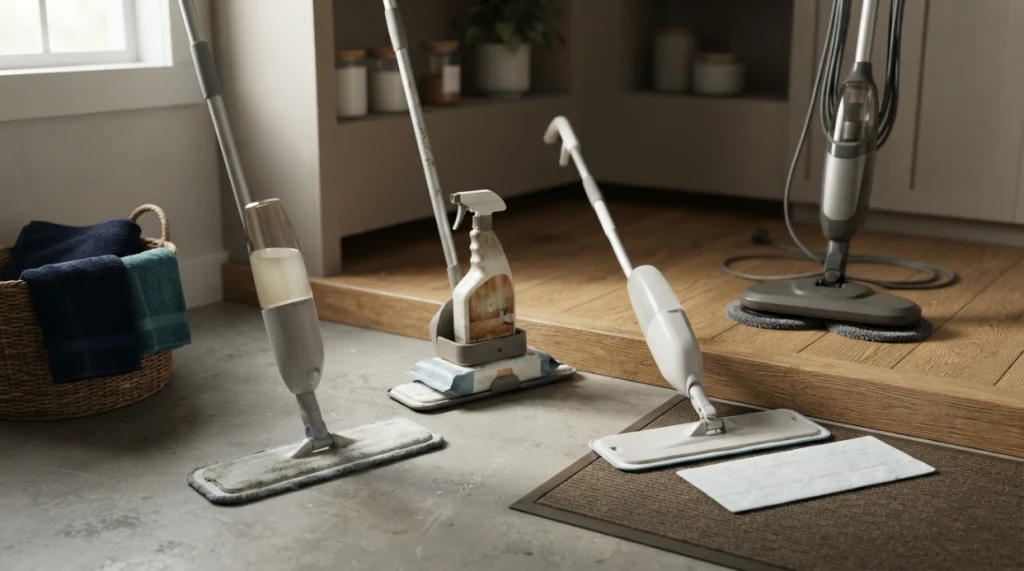
Spray mops look similar at first, but their cleaning systems can be quite different. The biggest differences involve pads, solution containers, and how much control you have over the cleaner.
| Spray Mop Type | Best Use | Moisture Control | Pad | Main Drawback |
|---|---|---|---|---|
| Refillable microfiber | Mixed hard floors | Excellent | Washable | Requires pad washing |
| Floor-specific spray system | Wood or other specified flooring | Excellent | Usually washable | Cleaner choices may be limited |
| Disposable-pad spray mop | Fast touch-ups | Good | Disposable | Ongoing consumable cost |
| Electric spray/spin mop | Sticky grime | Good | Reusable rotating pads | Heavier and more expensive |
For most readers, the first category offers the best balance. A refillable bottle also makes it easier to switch cleaners when your floor type changes.
Section Takeaway: A refillable microfiber spray mop gives most households the strongest combination of moisture control, reusable pads, and floor-cleaner flexibility.
Which Spray Mop Is Safest for Each Floor Type?
The best spray mop depends as much on the floor as the mop itself. A cleaning method that works beautifully on ceramic tile can be too wet or too harsh for wood.
Hardwood and engineered wood
Use a microfiber spray mop only when your floor manufacturer allows damp cleaning. Spray sparingly and wipe spills promptly.
The National Wood Flooring Association is a useful starting point for wood-floor care information, but your flooring manufacturer’s instructions should make the final decision.
Safety note: Check the flooring manufacturer’s care guide before using water, cleaner, polish, vinegar, or any new cleaning system on wood.
Laminate
Laminate benefits from a fine mist rather than a saturated mop. Pay special attention to edges and seams, where moisture can remain longer.
I usually work in small sections and use fewer sprays than I would on tile. If the surface still looks visibly wet after several passes, I’m using too much liquid.
Luxury vinyl plank and vinyl
A microfiber spray mop is one of my preferred choices for LVP because it keeps water use low. Use a mild cleaner that the flooring manufacturer approves.
Avoid assuming that waterproof flooring is compatible with every cleaning method. Heat, chemicals, seams, coatings, and installation systems can still matter.
Ceramic and porcelain tile
Tile is more forgiving of moisture than wood or laminate, making spray mops easy to use for routine maintenance. Textured tile may require several passes or occasional deeper scrubbing.
Grout can also hold grime below the reach of a flat microfiber pad. A small grout brush may still be useful for periodic detailed cleaning.
Natural stone
Choose a cleaner designed for the specific stone and finish. Marble, limestone, travertine, and other acid-sensitive stone should not be treated like ordinary ceramic tile.
Safety note: Avoid experimental DIY cleaner mixtures on stone. Confirm cleaner compatibility with the stone or sealer manufacturer first.
Section Takeaway: The safest spray mop is the one that lets you control moisture and use a cleaner approved for your exact floor surface.
What Should You Look for When Choosing a Spray Mop?
I focus on practical features before brand names. A good handle and reservoir matter more after six months of cleaning than flashy packaging does on purchase day.
1. A fine, even spray pattern
The nozzle should dampen a useful area without creating puddles. Uneven sprays can leave one section dry and another overly wet.
2. Reusable microfiber pads
Microfiber is made from extremely fine synthetic fibers that trap dust and soil against the pad. A removable washable pad is my preference for regular home cleaning.
Two or three pads are better than one. You can switch to a clean pad instead of spreading dirty solution into another room.
3. A refillable reservoir
A refillable bottle gives you more control over cleaning solution. That’s useful when your kitchen and living room have different floor materials.
A wide opening also makes the container easier to rinse. Complicated valves and tiny openings become annoying quickly.
4. A swivel head and low profile
Look for a head that turns around chair legs without fighting you. It should also slide under beds, cabinets, and furniture where dust collects.
5. Easy-to-find replacement parts
Check whether pads, bottles, and basic replacement pieces are readily available. A perfectly good mop becomes wasteful if one small broken component can’t be replaced.
6. A comfortable trigger
This detail is easy to overlook. During a whole-house cleaning session, a stiff trigger can become surprisingly tiring.
Test the handle position if possible. The mop should feel comfortable when you’re standing naturally rather than bending forward.
How Do You Use a Spray Mop Without Leaving Streaks?
Most spray-mop streaking isn’t caused by the mop itself. Dirty pads, excessive cleaner, leftover grit, and too much liquid are frequent causes.
- Remove loose debris first. Vacuum, sweep, or dust mop the floor before adding moisture.
- Attach a clean microfiber pad. Don’t start with yesterday’s dirty pad.
- Use the correct cleaner. Follow the floor and cleaner manufacturer’s instructions.
- Spray lightly. Start with less liquid than you think you need.
- Mop in overlapping passes. Work the damp area before spraying more.
- Change dirty pads. A loaded pad eventually starts redistributing grime.
- Let the floor dry fully. Keep people and pets off wet sections when possible.
Why too much cleaner causes problems
Extra cleaner doesn’t automatically create a cleaner floor. Too much product can leave film that catches light and creates streaks or dull patches.
If a floor becomes sticky after mopping, I first question the amount of cleaner. Using more product to fix residue usually makes the cycle worse.
When disinfecting is needed
Routine floor cleaning and disinfecting aren’t the same task. The CDC’s cleaning and disinfecting guidance says cleaning alone is sufficient in many normal household situations, while disinfection becomes more relevant in situations such as illness.
If you use a disinfectant, follow the product label exactly. Required surface compatibility, dilution, ventilation, and contact time can differ between products.
Safety note: Never mix cleaning or disinfecting chemicals unless the product directions specifically permit it. Check both the cleaner label and flooring manufacturer’s instructions.
Section Takeaway: For streak-free spray mopping, remove dry debris first, use a clean pad, spray lightly, and avoid overdosing the cleaner.
Is a Spray Mop Better Than a Steam, Spin, or Flat Mop?
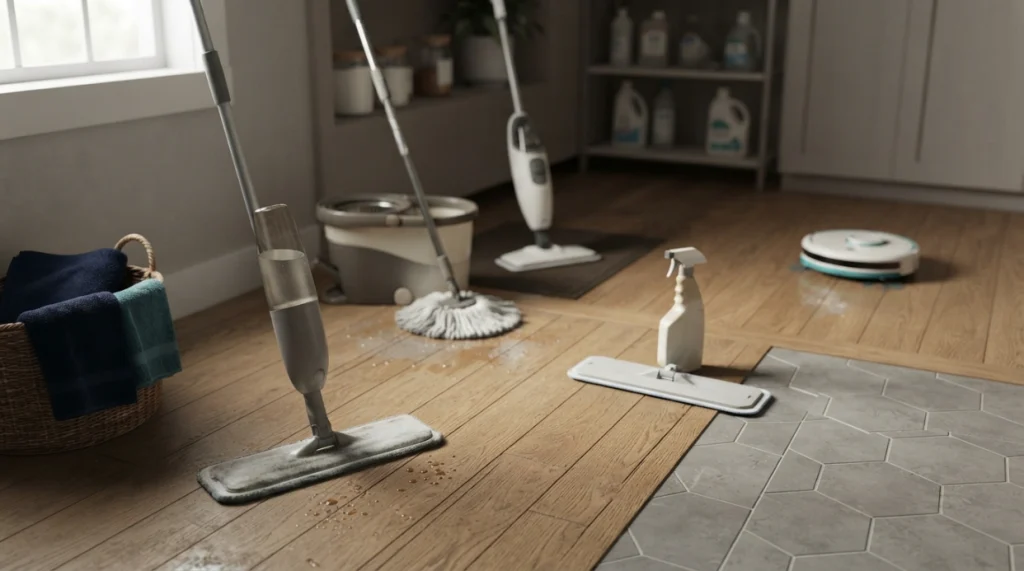
A spray mop is my first choice for quick routine cleaning, but it isn’t automatically the best tool for every mess. Different mop designs solve different problems.
Spray mop vs spin mop
A spray mop uses less water and takes less setup. It works well for frequent cleaning and small spills.
A spin mop is more useful when a floor can tolerate wetter cleaning and you’re tackling larger dirty areas. The bucket also lets you rinse the mop head during the job.
Spray mop vs steam mop
Steam uses heat and moisture to loosen soil on compatible surfaces. A spray mop relies on liquid cleaner and mechanical wiping.
I wouldn’t choose a steam mop simply because a floor is described as hard flooring. Hardwood, laminate, vinyl, LVP, stone, adhesives, and specialty finishes may have restrictions.
Spray mop vs basic flat microfiber mop
These two tools are closely related. A basic flat mop simply separates the cleaning-solution bottle from the mop itself.
A plain microfiber mop can be lighter and simpler. A spray mop wins on convenience because the solution is always within reach.
Spray mop vs robot mop
A robot mop is useful for automated maintenance. It can reduce how often you need to perform light cleaning yourself.
A manual spray mop still gives you better control around sticky spots, edges, furniture, and sudden spills. I see robots as maintenance tools rather than complete replacements.
- Choose a spray mop: For quick, controlled everyday cleaning.
- Choose a spin mop: For larger wet-cleaning jobs on compatible surfaces.
- Choose steam: Only when the specific flooring manufacturer permits steam.
- Choose a basic flat mop: For simplicity and maximum control over liquid application.
- Choose a robot mop: For automated maintenance between manual cleanings.
Section Takeaway: Spray mops are strongest at convenience and moisture control. Other mop styles can outperform them when deep scrubbing, rinsing, or automation is the priority.
Frequently Asked Questions
Are spray mops good for cleaning floors?
Yes. Spray mops are especially useful for routine cleaning because they apply a controlled amount of liquid and pair well with microfiber pads. Always match the cleaning solution and moisture level to the specific flooring.
What is the best spray mop for hardwood floors?
A microfiber spray mop that produces a fine mist is usually the most practical style for compatible sealed hardwood. Floor-specific systems such as Bona are common choices, but your wood-floor manufacturer’s cleaning instructions should take priority.
Can you use only water in a spray mop?
It depends on the mop and floor. Some refillable systems can use water, while others are designed for a particular cleaning formula. Follow both the mop manufacturer’s directions and your flooring care guide.
Can I put vinegar in a spray mop?
Only if both the mop manufacturer and flooring manufacturer allow it. Vinegar is acidic and isn’t appropriate for every finish or surface, especially acid-sensitive natural stone. A manufacturer-approved pH-neutral cleaner is the safer default when compatibility is uncertain.
Do spray mops leave streaks?
They can, but streaks usually come from too much cleaner, dirty pads, excessive moisture, or residue already on the floor. Use a clean microfiber pad, reduce the amount of solution, and remove dry debris before mopping.
Are reusable spray mops better than disposable ones?
Reusable spray mops are usually better for frequent cleaning because washable microfiber pads reduce recurring pad costs. Disposable systems can still be useful when speed, storage, and minimal cleanup are more important than long-term economy.
How often should I wash a reusable spray-mop pad?
Wash the pad after each substantial cleaning session or sooner if it becomes visibly dirty. During large jobs, switching to a fresh pad can prevent you from spreading grime from one room to another.
Which Spray Mop Should You Choose?
For most people asking which spray mop is best for cleaning floors, I recommend starting with a refillable microfiber spray mop. Look for a fine mist, washable pads, a comfortable trigger, and an easy-to-clean reservoir.
If you have hardwood or another sensitive floor, compatibility matters more than extra features. Use the least moisture needed and follow the flooring manufacturer’s care instructions.
For everyday cleaning, a simple spray mop often hits the sweet spot. It’s quick enough for small messes and practical enough to handle regular whole-home maintenance.
My final rule: choose the mop that gives you the best control over moisture, cleaner, and pad cleanliness—not simply the model with the longest feature list.