
Is a Spray Mop Better Than a Flat Mop?

Quick Answer
A spray mop is better than a flat mop when you want fast, low-moisture cleaning without carrying a bucket. A microfiber flat mop is better when you want more control over the amount of water and cleaning solution, plus greater flexibility in pad choice. For most homes, I’d choose a spray mop for quick daily cleaning and a flat mop for more deliberate whole-floor cleaning.
Which one should you choose?
- Choose spray: You want the fastest setup, controlled mist, and easy spot cleaning.
- Choose flat: You want interchangeable pads and complete control over your cleaning solution.
- For hardwood: Either can work when the floor manufacturer allows damp mopping and moisture stays minimal.
- For laminate: Both work well with a barely damp pad and careful moisture control.
- For tile: A flat microfiber mop generally gives more flexibility for routine cleaning and heavier soil.
- For small spaces: A spray mop usually wins because there is no bucket to fill, carry, or store.
When you’re comparing a spray mop with a flat mop, the difference can look small at first. Both usually have a flat cleaning head, both commonly use microfiber pads, and both are designed for hard-floor cleaning.
I’ve used both styles for quick kitchen messes, dusty living rooms, and moisture-sensitive floors. In this guide, I’ll break down where each mop wins, where it struggles, and which one makes more sense for your home.
In This Guide
- What Is the Difference Between a Spray Mop and Flat Mop?
- Which Mop Cleans Floors Better?
- Which Mop Controls Water and Drying Time Better?
- Which Mop Is Better for Hardwood, Laminate, Vinyl, and Tile?
- Is a Spray Mop Easier to Use Than a Flat Mop?
- Which Mop Is Easier to Maintain and Cheaper?
- Spray Mop vs Flat Mop: Side-by-Side Comparison
- How Do You Choose Between a Spray Mop and Flat Mop?
- Spray Mop vs Flat Mop FAQ
What Is the Difference Between a Spray Mop and Flat Mop?
A spray mop is a flat-style mop with a built-in reservoir and trigger that dispenses a small amount of liquid ahead of the mop head. A flat mop uses a removable pad, but you normally wet the pad separately or apply cleaner from another container.
The biggest difference isn’t the shape of the cleaning head. It’s how you control moisture and cleaning solution.
How does a spray mop work?
A spray mop stores water or an approved floor-cleaning solution in a small bottle. Pulling the trigger releases a controlled spray, and the microfiber pad immediately wipes the dampened area.
That makes the process simple: spray, mop, move on.
- No bucket: You don’t need to fill and carry a separate container.
- Targeted moisture: You can spray only where the floor needs attention.
- Fast setup: It’s ready almost immediately.
- Reusable pads: Many models use washable microfiber pads.
How does a flat mop work?
A flat mop uses a rectangular or similarly shaped head with a removable cleaning pad. You can wet the pad with water or cleaner before attaching it, depending on the mop design.
This gives you more freedom over the cleaning method.
For example, I can prepare several microfiber pads before cleaning a larger home. When one becomes dirty, I swap it instead of dragging the same loaded pad across another room.
Both designs are useful. The better choice depends on how you clean.
Section Takeaway: A spray mop is essentially a flat mop with built-in liquid delivery. A basic flat mop gives you more freedom over pads, moisture, and cleaning products.
Which Mop Cleans Floors Better?
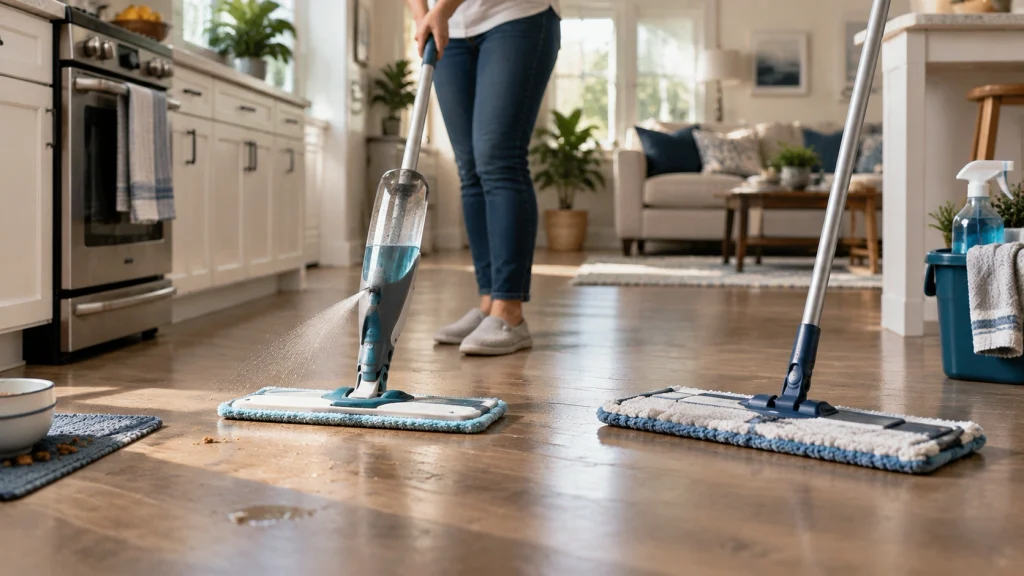
A flat mop can have a slight advantage for deeper routine cleaning because you can choose a larger or more absorbent microfiber pad and replace it as it becomes dirty. A spray mop is usually better for maintaining already-clean floors and dealing with fresh messes quickly.
When does a spray mop clean better?
Spray mops shine when the dirt is relatively light. Think fingerprints, food crumbs, muddy paw marks, dried droplets, and the film that develops after several days of normal household traffic.
The built-in spray also encourages frequent cleaning because there’s almost no preparation.
I’ve found this especially useful around kitchens. If something splashes beside the dishwasher, I don’t need to fill a bucket for a 30-second cleanup.
That convenience can matter more than maximum scrubbing power.
When does a flat mop clean better?
A flat microfiber mop becomes more useful when the floor needs several passes or when you’re cleaning a larger area. You can wet the pad more thoroughly, use different pads for different tasks, and change pads during the job.
A good microfiber pad can also collect dust and hair before you wet it.
Independent mop comparisons have found that spray and flat mops are both suited to everyday maintenance, while heavier soil may call for a mop with more scrubbing action. :contentReference[oaicite:0]{index=0}
What about dried or sticky spills?
Neither mop magically removes every dried spill in one pass. Sticky food residue often needs a little dwell time, gentle agitation, or pre-treatment before mopping.
For these jobs, I prefer a flat mop when I can attach a more suitable scrub pad. A spray mop still works, but its small spray output isn’t designed for soaking a stubborn spot.
Section Takeaway: Choose a spray mop for frequent maintenance and fresh messes. Choose a flat mop when you need more pad flexibility or repeated cleaning passes.
Which Mop Controls Water and Drying Time Better?
For moisture-sensitive flooring, both mop types can work well when used correctly. Spray mops make small amounts of liquid easy to dispense, while flat mops give you direct control over how wet the pad becomes.
Why does moisture control matter?
Too much water can leave slippery surfaces, streaks, residue, and longer drying times. On wood flooring, standing moisture can also create a serious care problem.
The National Wood Flooring Association recommends using a slightly moistened, well-wrung mop on wood floors and minimizing moisture left on the surface. :contentReference[oaicite:1]{index=1}
That’s one reason I don’t judge a mop simply by how wet it can make the floor.
More water isn’t automatically better cleaning.
Is a spray mop better for fast drying?
Usually, yes, when the spray mechanism delivers a light mist and the pad is used correctly. You can dampen a small area instead of distributing a bucketful of water across the room.
This can be particularly useful in humid conditions or busy households where people need to walk across the floor soon after cleaning.
Can a flat mop dry floors quickly?
Absolutely. A flat microfiber mop can leave very little moisture behind when the pad is properly dampened and wrung out.
The trick is not to saturate the pad. For hardwood and laminate, I prefer a pad that feels damp rather than wet.
Safety note: Always check your flooring manufacturer’s care guide before wet-mopping wood, laminate, engineered flooring, or any floor with exposed seams.
Section Takeaway: Spray mops make low-moisture cleaning effortless. A flat mop can match that performance when you prepare and wring the microfiber pad correctly.
Which Mop Is Better for Hardwood, Laminate, Vinyl, and Tile?
Neither mop is universally better for every floor. The flooring material, finish, manufacturer instructions, and amount of soil matter more than the mop label.
Hardwood floors
For sealed hardwood, I favor whichever mop leaves the least moisture while still removing the dirt. A spray mop makes that easy because you can dispense a small amount at a time.
A flat microfiber mop also works well when its pad is only slightly damp.
The NWFA recommends regular dry cleaning to remove grit and damp mopping with minimal moisture. :contentReference[oaicite:2]{index=2}
Laminate floors
Laminate generally benefits from controlled moisture and quick drying. A spray mop can be convenient here, particularly for small rooms and everyday maintenance.
A microfiber flat mop is equally useful if you keep the pad damp rather than wet. Pay close attention to seams and avoid leaving standing water.
Vinyl and LVP
Sealed vinyl and luxury vinyl plank flooring are often forgiving during routine damp cleaning, but the manufacturer’s instructions still come first. A flat mop offers excellent control when you’re cleaning a large vinyl floor.
A spray mop is convenient for daily touch-ups, especially around entryways and kitchens.
Tile and grout
Tile changes the equation because grout lines and textured surfaces can hold more soil. A flat microfiber mop can handle routine surface cleaning well, but heavily soiled grout may require separate agitation.
For a heavily trafficked tile floor, I’d rather use a mop with a pad suited to scrubbing than expect a fine spray to do all the work.
Natural stone
Natural stone requires more caution because different stones and finishes have different cleaning requirements. Avoid assuming that a homemade acidic cleaner is safe simply because it works on another floor.
Use a cleaner specifically approved for the stone and follow the flooring manufacturer’s guidance.
Safety note: Check the flooring manufacturer’s care guide and the cleaner label before using vinegar, disinfectants, acidic products, or other concentrated solutions on stone or finished floors.
Section Takeaway: Spray mops are excellent for low-moisture maintenance. Flat microfiber mops offer more flexibility when different floor surfaces need different pads or cleaning approaches.
Is a Spray Mop Easier to Use Than a Flat Mop?
For quick cleaning, a spray mop is usually easier because the cleaning liquid is built into the tool. You can grab it, spray, mop, and put it away without preparing a bucket.
Where spray mops save time
- Small spills: Clean them immediately without setting up a full mopping system.
- Kitchen floors: Target greasy-looking or sticky areas without soaking the room.
- Small apartments: Avoid storing a bulky bucket.
- Frequent touch-ups: Keep the mop ready for quick daily cleaning.
- Spot cleaning: Apply liquid only where it’s needed.
That convenience is one of the strongest reasons people prefer spray mops. It removes the psychological barrier of having to “do the whole floor.”
Where flat mops are easier
Flat mops become attractive when you’re cleaning several rooms at once. There is no spray trigger, bottle mechanism, or reservoir to maintain.
You can also prepare several pads and work through the house efficiently.
For homes with pets, I like this approach. One pad can handle the entryway, another can handle the kitchen, and a fresh pad can finish cleaner rooms.
It also means less dependence on a working spray mechanism.
What if the spray nozzle clogs?
Spray mechanisms can clog when residue builds up, especially if the wrong solution is used or the bottle isn’t cleaned regularly. A basic flat mop has fewer moving parts to troubleshoot.
If your spray mop stops producing a consistent mist, clean the bottle, nozzle, and surrounding parts according to the manufacturer’s instructions.
Section Takeaway: Spray mops win on grab-and-go convenience. Flat mops win when you value simplicity, interchangeable pads, and fewer mechanical components.
Which Mop Is Easier to Maintain and Cheaper?
A basic flat mop is often simpler to maintain because there is no built-in spray system. A spray mop adds a bottle, trigger, and nozzle that need occasional care.
Spray mop maintenance
- Wash pads: Launder reusable microfiber pads according to their care instructions.
- Clean the bottle: Prevent residue from building up inside the reservoir.
- Check the nozzle: Keep spray openings free of dried cleaner.
- Store it dry: Don’t leave a damp pad attached after cleaning.
The pad is just as important as the mop itself. A dirty microfiber pad can spread soil rather than remove it efficiently.
Flat mop maintenance
Flat mops have a simpler routine. Remove the pad, wash it properly, let it dry completely, and store the mop ready for its next use.
Keeping several pads on hand makes the system even better for larger homes.
Which has the lower long-term cost?
There isn’t a universal winner because prices vary widely by brand, pad design, and replacement parts. A cheap spray mop can become less economical if its proprietary bottle or pad system requires frequent replacement.
A flat mop using standard washable microfiber pads can be economical over many cleaning cycles.
Before buying either one, I check the price and availability of replacement pads. That’s an easy detail to overlook.
Section Takeaway: Flat mops usually have the simpler maintenance routine. Spray mops can still be economical when they use durable, washable pads and easy-to-replace components.
Spray Mop vs Flat Mop: Side-by-Side Comparison
The quickest way to decide is to compare the features that affect everyday cleaning. These ratings describe typical manual mop designs rather than one specific brand or model.
| Feature | Spray Mop | Flat Mop |
|---|---|---|
| Setup | Very fast | Fast |
| Bucket required | No | Usually no, but depends on the system |
| Moisture control | High | High when pad is properly prepared |
| Deep scrubbing | Low to moderate | Moderate, depending on pad |
| Spot cleaning | Excellent | Very good |
| Large-area cleaning | Good | Excellent |
| Pad flexibility | Good | Excellent |
| Moving parts | More | Fewer |
| Small-space storage | Excellent | Excellent |
| Best use | Daily maintenance and quick messes | Flexible routine whole-floor cleaning |
Current 2026 comparisons of manual mop types similarly place spray and flat mops in the everyday-maintenance category, with the main differences coming from liquid delivery, pad design, and convenience. :contentReference[oaicite:3]{index=3}
Section Takeaway: The spray mop wins the convenience contest. The flat mop wins the flexibility contest, especially when pad choice and cleaning method matter.
How Do You Choose Between a Spray Mop and Flat Mop?
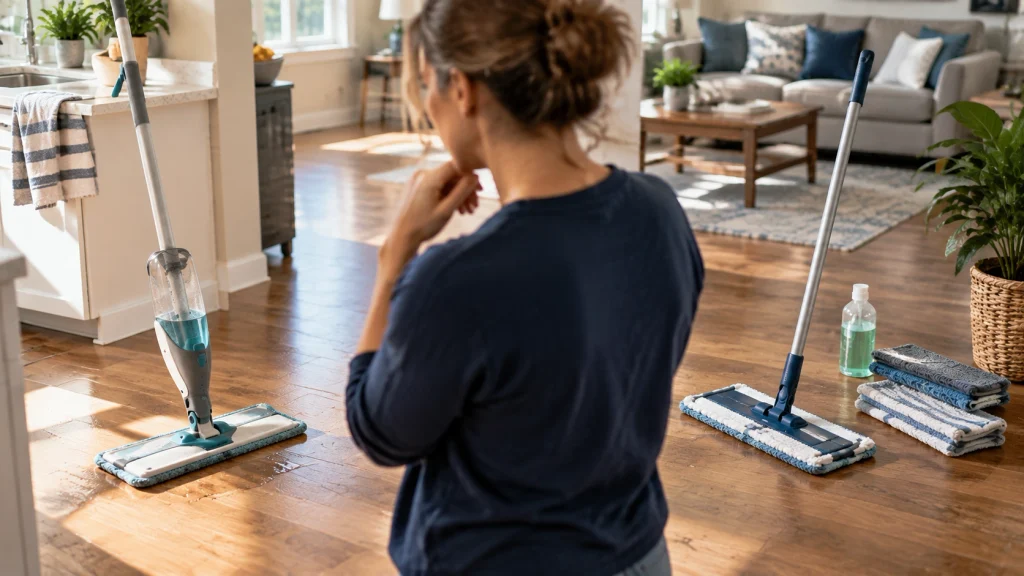
Start with your cleaning routine rather than the mop’s marketing claims. Ask how often you clean, how dirty your floors become, how much space you have, and whether any flooring requires special care.
Choose a spray mop if…
- You clean frequently: Short daily sessions make the quick setup valuable.
- You hate buckets: The built-in reservoir removes one of the most annoying parts of mopping.
- You have a small home: There’s less equipment to store.
- You clean spills immediately: The trigger lets you target the affected area.
- You need low moisture: Small spray amounts make moisture control straightforward.
Choose a flat mop if…
- You clean large areas: Larger or multiple pads can make whole-house cleaning easier.
- You want pad options: You can select microfiber or other compatible pad types.
- You prefer simplicity: There is no spray reservoir or nozzle to maintain.
- You use different cleaners: You can prepare the pad separately according to floor requirements.
- You want fewer replacement components: Standard washable pads can be simple to maintain.
What would I choose?
If I were buying one mop for a small apartment today, I’d lean toward a spray mop. The convenience makes it more likely that I’d clean small messes immediately instead of letting them accumulate.
For a larger home with several floor types, I’d lean toward a versatile microfiber flat mop. The ability to use different pads and control the cleaning process gives me more flexibility.
If your floors routinely have heavy mud, greasy buildup, or deeply soiled grout, neither should be your only tool. A spin mop or dedicated scrubber may make more sense for those jobs.
The same principle applies to steam mops. Steam can be useful on compatible floors, but heat isn’t appropriate for every flooring system, so it shouldn’t be treated as a universal upgrade.
Section Takeaway: Pick the spray mop when speed and convenience dominate. Pick the flat mop when flexibility and whole-floor control matter more.
Spray Mop vs Flat Mop FAQ
Is a spray mop better for everyday cleaning?
Yes, a spray mop is often better for everyday maintenance because it combines a microfiber pad with a built-in spray system. You can clean small areas quickly without preparing a bucket, making frequent touch-ups easier.
Can I use a flat mop on hardwood floors?
Yes, a flat microfiber mop can work well on compatible sealed hardwood floors when the pad is only slightly damp. Avoid standing water and follow the flooring manufacturer’s cleaning instructions.
Does a spray mop use less water than a flat mop?
Usually, a spray mop uses less liquid during routine cleaning because it dispenses small amounts directly onto the floor. A flat mop can also use very little moisture when its microfiber pad is properly dampened and wrung out.
Which is better for laminate floors, spray mop or flat mop?
Both can work well on laminate when the manufacturer’s care instructions permit damp cleaning. A spray mop offers convenient moisture control, while a flat mop gives you more freedom over pad selection and cleaning preparation.
Can a spray mop replace a flat mop?
For many homes, yes. A spray mop can handle routine dust, footprints, light spills, and general maintenance, but a flat mop may be more versatile for larger cleaning jobs and different pad requirements.
Which mop is better for sticky kitchen floors?
A flat mop may have the advantage when you need extra scrubbing or a different cleaning pad. A spray mop can still handle fresh sticky spots effectively, especially when you spray the approved cleaner and allow it a short dwell time before wiping.
Should I use vinegar in a spray mop?
Only if the mop manufacturer and flooring manufacturer both allow it. Vinegar is acidic and isn’t suitable for every floor, finish, stone surface, or spray system, so a compatible cleaner is the safer choice.
Safety note: Never mix cleaning chemicals or disinfectants. The CDC recommends cleaning surfaces first and following product labels when sanitizing or disinfecting. :contentReference[oaicite:4]{index=4}
Final Verdict: Is a Spray Mop Better Than a Flat Mop?
A spray mop isn’t automatically better than a flat mop. It is better when convenience, fast setup, targeted spraying, and low-moisture daily cleaning are your priorities.
A flat mop is the better choice when you want maximum flexibility. You can select different pads, prepare them for the job, and clean larger areas without depending on a built-in spray mechanism.
For most households, I’d make the decision based on cleaning frequency. If you prefer quick five-minute touch-ups, choose a spray mop; if you prefer a flexible whole-floor system, choose a flat microfiber mop.
Whichever you choose, the pad and technique matter as much as the handle. A clean microfiber pad, the correct floor cleaner, controlled moisture, and regular cleaning will usually produce a better floor than an expensive mop used incorrectly.
As of 2026, that’s still how I approach mop buying: choose the tool that makes the right cleaning habit easiest to repeat.
For general household cleaning, remember that cleaning and disinfecting are not the same thing. The CDC notes that routine cleaning removes dirt and many germs, while disinfection is a separate step used when it is appropriate. :contentReference[oaicite:5]{index=5}
If you’re unsure about a cleaner, start with the flooring manufacturer’s instructions rather than assuming a popular DIY solution is safe. That’s the simplest way to avoid turning a quick cleaning job into a floor-repair project.
