
Is a Spray Mop Better Than a Regular Mop?

Quick Answer
For most everyday floor cleaning, a spray mop is more convenient than a regular mop because it is lighter, uses less water, and eliminates the bucket. A regular mop still wins for large, heavily soiled floors because you can use more water, change the cleaning solution easily, and apply more scrubbing pressure. For floor-specific care, check guidance from the National Wood Flooring Association before wet-mopping wood floors.
When a spray mop is better
- Daily cleaning: It is quick to grab for crumbs, footprints, kitchen splashes, and light dirt.
- Less water: Controlled spraying helps prevent floors from becoming excessively wet.
- Small homes: You don’t need to store or carry a bucket.
- Fast drying: A lightly damp microfiber pad usually leaves less moisture behind.
- Easy handling: The lightweight design suits frequent touch-up cleaning.
When a regular mop is better
- Heavy dirt: A bucket system gives you more water and solution for stubborn grime.
- Large floors: A regular mop can be more practical when cleaning extensive areas.
- Deep cleaning: You can rinse and wring the mop repeatedly instead of relying on a small reservoir.
I’ve used plenty of mop styles over the years, and I’ve learned that “better” depends heavily on the mess and the floor underneath it. A spray mop can make routine floor cleaning almost effortless, while a regular mop still has an important place when the floor needs a deeper clean.
In this guide, I’ll compare the two by cleaning power, water use, floor type, maintenance, cost, and everyday convenience. I’ll also explain which option I’d choose for hardwood, laminate, vinyl, tile, stone, and concrete in 2026.
In This Guide
- What Is the Difference Between a Spray Mop and a Regular Mop?
- Which Mop Cleans Floors Better?
- Which Mop Is Better for Different Floor Types?
- What Are the Main Advantages of a Spray Mop?
- When Is a Regular Mop Better?
- Spray Mop vs Regular Mop: Side-by-Side Comparison
- How Should You Choose Between the Two?
- Frequently Asked Questions
- Final Takeaway
What Is the Difference Between a Spray Mop and a Regular Mop?
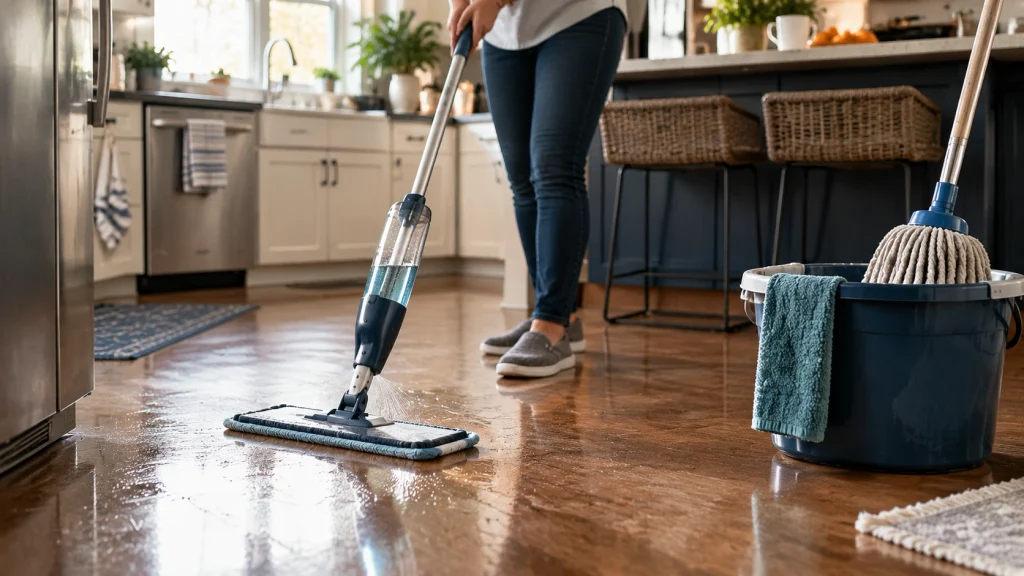
A spray mop combines a mop head, reusable pad, and small liquid reservoir in one tool. You squeeze a trigger or press a button to release a controlled amount of cleaning solution, then wipe the floor with the pad.
A regular mop usually relies on a separate bucket containing water and cleaning solution. You dip the mop, wring it out, clean a section, and repeat the process.
How does a spray mop work?
The spray mechanism puts moisture directly in front of the mop head. That means you can control how wet the floor becomes without carrying a bucket around the room.
Most spray mops use flat microfiber pads. Microfiber is a synthetic material made from extremely fine fibers that can pick up dust, hair, and loose soil while remaining relatively gentle on finished hard floors.
- Fill: Add the approved cleaning solution or water to the reservoir.
- Spray: Apply a small amount in front of the mop head.
- Wipe: Move the microfiber pad across the damp area.
- Wash: Launder the reusable pad after cleaning.
How does a regular mop work?
A traditional mop separates the water supply from the cleaning tool. This gives you more control over rinsing and allows you to refresh the mop solution repeatedly during a larger cleaning job.
That design can be especially useful when floors have visible mud, greasy residue, dried food, or other heavy soil. You have a larger supply of water available and can rinse the mop whenever the pad becomes dirty.
Section Takeaway: A spray mop prioritizes speed and convenience, while a regular mop gives you greater control during heavier cleaning.
Which Mop Cleans Floors Better?
Neither mop automatically cleans better in every situation. A spray mop is excellent for light-to-moderate daily soil, while a regular mop can have an advantage when you need repeated rinsing and more aggressive cleaning.
Is a spray mop good for everyday dirt?
Yes. I particularly like spray mops for the jobs that don’t justify dragging out a bucket. Kitchen footprints, breakfast spills, dusty hallways, and muddy marks near the door are exactly where they make sense.
The controlled spray also helps prevent the common mistake of soaking a floor unnecessarily. That matters on moisture-sensitive flooring where excess water can create problems.
Independent testing of manual mop types has found spray mops convenient for maintenance cleaning and small spills, with less water used during cleaning than some traditional mop approaches. :contentReference[oaicite:0]{index=0}
Is a regular mop better for stubborn dirt?
Often, yes. When I encounter dried food or a larger dirty area, I prefer having a bucket available because I can rinse the mop repeatedly.
That distinction matters because cleaning isn’t just about applying moisture. You also need to remove the soil rather than repeatedly moving a dirty pad across the floor.
For large areas, a two-bucket approach can provide even better control. One bucket holds cleaning solution while the second provides rinse water, a method also described in CDC environmental-cleaning guidance. :contentReference[oaicite:1]{index=1}
My practical test: If I can clean the floor with a few spray-and-wipe passes, I reach for the spray mop. If the pad would become dirty within minutes, I reach for the bucket mop.
Does more water mean a cleaner floor?
No. More water doesn’t automatically mean better cleaning, and excessive moisture can be harmful to some flooring materials.
The goal is enough moisture to loosen and remove soil without leaving standing water or a slow-drying surface. That’s why wringing and water control matter with any mop.
Section Takeaway: Cleaning performance depends more on matching the mop to the mess than choosing one mop style as universally superior.
Which Mop Is Better for Different Floor Types?
The floor itself should influence your decision. A mop that works beautifully on sealed tile may be a poor choice for an unsealed or moisture-sensitive wood floor.
Hardwood and engineered wood
For finished hardwood and engineered wood, I generally prefer a microfiber spray mop that leaves only a lightly damp surface. The important part is controlling moisture and following the flooring manufacturer’s care instructions.
The National Wood Flooring Association provides industry resources and standards for wood flooring care, making its guidance a useful reference when you’re unsure about cleaning methods. :contentReference[oaicite:2]{index=2}
Safety note: Always check your flooring manufacturer’s care guide before using water, vinegar, disinfectants, steam, or any new cleaning solution on wood floors.
Laminate floors
A spray mop can be convenient for laminate because it makes it easier to control the amount of moisture. I would avoid flooding the floor or allowing water to sit around seams.
For laminate, the cleaning pad should also stay reasonably clean. A saturated or dirty pad can leave residue behind instead of producing a streak-free finish.
Safety note: Follow the laminate manufacturer’s instructions for moisture, cleaner type, and cleaning frequency.
Vinyl and LVP
Vinyl and luxury vinyl plank are often easy to maintain with either mop style. A spray mop is especially convenient for routine cleaning because it can apply a thin layer of moisture across the surface.
A regular mop becomes useful when you need to rinse away heavier dirt. Either way, avoid leaving excess water around seams, edges, or damaged areas.
Safety note: Use only cleaners approved for your particular vinyl or LVP surface and finish.
Tile and natural stone
Tile is where a regular mop can start to make more sense, especially when grout lines collect dirt. You can rinse the mop more often and use more cleaning solution when needed.
Natural stone requires more care because different stones react differently to acids and harsh chemicals. I would never assume that a homemade vinegar solution is safe simply because it is common in household cleaning advice.
Safety note: Check the stone manufacturer’s or installer’s care instructions before using acidic, alkaline, abrasive, or disinfecting cleaners.
Concrete floors
Sealed concrete can generally tolerate a more substantial cleaning routine than moisture-sensitive wood. A regular mop may be useful for garages, utility rooms, and other areas where dirt is heavier.
For polished or specially finished concrete, however, I still follow the manufacturer’s recommendations rather than treating it like unfinished utility flooring.
| Floor type | My usual pick | Why |
|---|---|---|
| Finished hardwood | Spray mop | Easy moisture control |
| Engineered wood | Spray mop | Light damp cleaning |
| Laminate | Spray mop | Controlled moisture |
| Vinyl/LVP | Either | Both work for routine cleaning |
| Ceramic tile | Either | Choose based on soil level |
| Natural stone | Either | Cleaner compatibility matters most |
| Sealed concrete | Regular mop | Useful for heavier soil |
Section Takeaway: For sensitive floors, moisture control matters most. For rough or heavily soiled surfaces, rinsing capacity becomes more important.
What Are the Main Advantages of a Spray Mop?
The biggest advantage of a spray mop is convenience. It removes several small annoyances that make people put off routine floor cleaning.
Why is a spray mop faster?
There’s no bucket to fill, carry, rinse, empty, and store. You can simply grab the mop, spray a small area, and start wiping.
That makes a noticeable difference in a kitchen where you may need to clean the floor several times a week. The easier the tool is to grab, the less likely a small mess is to become a bigger chore.
Does a spray mop use less water?
Usually, yes. Spray mops are designed to dispense a controlled amount of liquid instead of soaking a mop head in a bucket.
Less moisture can also mean faster drying. Independent testing has found spray mops useful for maintenance cleaning because they apply relatively small amounts of water or cleaning solution. :contentReference[oaicite:3]{index=3}
Are spray mops easier to store?
For apartments and small homes, this can be a major advantage. A spray mop can usually hang in a closet while the reusable pads stack in a small laundry area.
There’s no bucket taking up floor space. That’s a small detail, but it matters when storage is limited.
Are spray mops better for quick spills?
Yes, especially when the spill hasn’t dried. A spray mop works well for coffee splashes, muddy footprints, food crumbs, and everyday kitchen marks.
For a sticky dried spill, I usually let the cleaner sit briefly if the floor-care instructions permit it, then make several controlled passes instead of soaking the whole area.
Section Takeaway: A spray mop earns its keep through convenience, low water use, compact storage, and fast everyday cleanup.
When Is a Regular Mop Better?
A regular mop remains useful because it gives you something a spray mop cannot: a larger reservoir of water and cleaning solution that you can repeatedly refresh.
Is a regular mop better for large homes?
It can be. If you’re cleaning several hundred square feet of tile or another durable surface, stopping to refill a small spray reservoir can become annoying.
A bucket also lets you rinse the mop head repeatedly. That can be valuable when the floor contains visible dirt rather than just a thin layer of dust.
Is a regular mop better for heavy dirt?
For muddy entryways, dirty utility rooms, and heavily soiled tile, I often prefer a regular mop. You can wring it thoroughly, rinse it, and repeat without depending on a small microfiber pad.
The key is to avoid turning the bucket into a container of dirty water that gets spread across the whole floor. Rinse or replace the solution when it becomes visibly dirty.
CDC cleaning guidance emphasizes systematic mopping, rinsing, changing cleaning materials as needed, and working from cleaner areas toward dirtier ones. :contentReference[oaicite:4]{index=4}
What are the disadvantages of a regular mop?
- More setup: You need water, a bucket, and a place to empty the dirty solution.
- More storage: The bucket takes up space when you’re not using it.
- More moisture: Poor wringing can leave floors excessively wet.
- More effort: Carrying a bucket becomes tiring during large cleaning jobs.
- More cleanup: The bucket itself needs to be emptied and washed afterward.
Wet floors can also create a slip hazard. OSHA’s housekeeping guidance specifically emphasizes keeping floors clean and dry to reduce slips, trips, and falls. :contentReference[oaicite:5]{index=5}
Section Takeaway: A regular mop is the stronger choice when you need repeated rinsing, more solution, or deeper cleaning across heavily soiled floors.
Spray Mop vs Regular Mop: Side-by-Side Comparison
If you’re still undecided, the comparison below shows where each design has the practical advantage.
| Feature | Spray mop | Regular mop |
|---|---|---|
| Setup | Very quick | Requires bucket setup |
| Water control | Excellent | Depends on wringing |
| Small spills | Excellent | Good, but more setup |
| Heavy dirt | Good | Very good |
| Large areas | Good | Very good |
| Storage | Compact | Requires bucket space |
| Drying speed | Usually fast | Depends on wringing |
| Rinsing control | Limited | Excellent |
| Best use | Routine maintenance | Deep or heavy cleaning |
Which is cheaper?
A basic regular mop and bucket can have a low upfront cost. Spray mops may cost more because you’re buying a built-in reservoir, spray mechanism, and specialized reusable pad system.
However, purchase price isn’t the entire cost. Consider replacement pads, cleaning solution, bucket storage, and how often you expect to use the mop.
Which is easier to maintain?
Both are simple if you clean them after every use. The most important habit is washing reusable pads regularly rather than putting a dirty pad back on the mop and storing it damp.
For a spray mop, rinse the reservoir according to its instructions and keep the spray nozzle free of dried cleaner. For a regular mop, empty and rinse the bucket after each session.
Section Takeaway: Spray mops win on convenience, while regular mops win on rinsing capacity and heavy-duty flexibility.
How Should You Choose Between the Two?
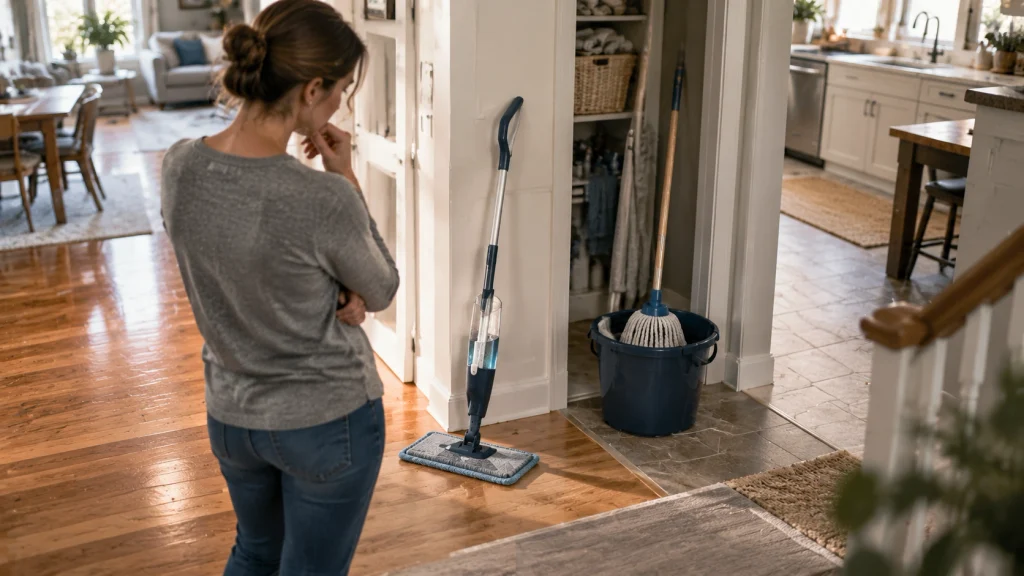
The best choice comes down to four questions: what floor you have, how dirty it gets, how much space you have, and how often you clean.
Choose a spray mop if you:
- Clean hard floors several times a week.
- Deal mostly with dust, footprints, crumbs, and light spills.
- Live in an apartment or have limited storage.
- Prefer a lightweight mop that is ready immediately.
- Need tight control over moisture.
- Want washable microfiber pads rather than disposable sheets.
Choose a regular mop if you:
- Clean large areas of tile, concrete, or other durable flooring.
- Deal with mud, heavy soil, or sticky buildup.
- Want to rinse the mop frequently.
- Need a large supply of cleaning solution.
- Already own a good bucket and mop.
- Prefer a simple tool with fewer moving parts.
What if you clean several types of floors?
If your home has hardwood bedrooms, LVP in the living room, and tile in the kitchen, I’d lean toward a quality microfiber spray mop for routine maintenance.
I’d still keep a regular mop available for the occasional deep clean. Having both doesn’t mean using both every time.
A simple buying rule
- Mostly light dirt: Buy a spray mop.
- Mostly heavy dirt: Buy a regular mop.
- Mixed cleaning: Use a spray mop for daily care and keep a regular mop for deep cleaning.
- Moisture-sensitive floors: Choose the tool that gives you the safest moisture control for that flooring.
When choosing cleaning solutions, I also pay attention to the product rather than assuming “natural” automatically means safer. The EPA’s Safer Choice program evaluates cleaning-product ingredients against health and environmental criteria and identifies qualifying products through its label. :contentReference[oaicite:6]{index=6}
Safety note: Never mix bleach with other cleaners or disinfectants. Follow the product label and your flooring manufacturer’s instructions whenever you use a chemical cleaner.
The CDC notes that routine cleaning is often enough in ordinary home situations, while disinfection has a more specific role when someone is sick or when circumstances call for it. :contentReference[oaicite:7]{index=7}
Section Takeaway: Don’t buy the mop with the most features. Buy the one that matches your floor, cleaning frequency, soil level, and available storage.
Frequently Asked Questions
Is a spray mop better than a regular mop for everyday cleaning?
For everyday maintenance, a spray mop is often the more convenient choice. It is quick to use, controls moisture well, and doesn’t require a bucket. A regular mop remains useful when everyday dirt becomes heavy enough to require repeated rinsing.
Can a spray mop replace a regular mop?
Yes, for many homes it can replace a regular mop for routine floor cleaning. However, keeping a regular mop can be worthwhile if you have large tiled areas, frequent muddy messes, or floors that require more intensive rinsing.
Do spray mops clean better than bucket mops?
Not universally. Spray mops are excellent for light and moderate soil, while bucket mops provide more water and rinsing capacity. Cleaning results depend on the pad, cleaner, floor material, technique, and how dirty the surface is.
Are spray mops safe for hardwood floors?
A spray mop can be appropriate for some finished hardwood floors when it applies only a small amount of moisture. Always follow the flooring manufacturer’s instructions because wood floors can vary by finish, construction, and installation.
Which is better for laminate floors, a spray mop or regular mop?
A spray mop is often convenient for laminate because it provides controlled moisture. A regular mop can also work if it is thoroughly wrung out. The important point is to avoid excessive water and standing moisture around laminate seams.
Do you need floor cleaner with a spray mop?
Not necessarily. Some spray mops can be used with plain water, while others are designed for specific cleaning solutions. Check the mop instructions and your floor manufacturer’s recommendations before adding a cleaner to the reservoir.
Is a spray mop worth buying?
A spray mop is worth buying if you value quick, frequent cleaning and want to avoid carrying a bucket. It is especially useful for apartments, kitchens, and homes where most floor messes are light or moderate rather than heavily soiled.
Final Takeaway
So, is a spray mop better than a regular mop? For most routine household cleaning, I’d give the spray mop the edge because it’s faster, lighter, easier to store, and better at controlling moisture.
But I wouldn’t throw away the regular mop. When a floor is heavily soiled, covers a large area, or needs frequent rinsing, the bucket system still has a clear advantage.
My preferred setup is simple: use a microfiber spray mop for everyday maintenance and keep a regular mop available for the jobs that need more water, rinsing, or scrubbing.
Most importantly, let the flooring decide how wet you should get it. A good mop is only part of the equation; the right technique, clean pad, suitable cleaner, and correct amount of moisture matter just as much.
