
Can You Mop the Floor With Bleach? Safe Ratio, Steps and Floors to Avoid

Quick answer: Yes, you can mop the floor with bleach if you dilute it and use it only on hard, non-porous floors such as glazed ceramic or porcelain tile, sealed concrete and some sheet vinyl. Mix about 1/3 cup (5 tablespoons) of regular household bleach into 1 gallon of cool water, open a window, keep the floor wet for the time on the label, then rinse with clean water. Never use bleach on hardwood, laminate or natural stone, and never mix it with anything except water.
Bleach is a disinfectant, not a general cleaner. It kills germs well, but it does not lift grease and dirt the way a regular floor cleaner does. That is why the order matters: clean first, then disinfect. Used the wrong way, bleach can discolor floors, irritate your lungs and leave a slippery film.
Is It Safe to Mop Floors With Bleach?
It is safe when three things are true: the floor can handle it, the solution is diluted correctly, and the room has fresh air. Household bleach contains sodium hypochlorite, usually around 5% to 9%. That is strong enough to kill most bacteria and viruses on a clean surface, and strong enough to damage the wrong floor.
When bleach makes sense
Use bleach when you need to disinfect, not for every weekly mop. Good examples are a bathroom floor after a stomach bug, a kitchen floor after raw meat spills, or a garage floor with mold spots. For routine cleaning, warm water and a pH-neutral cleaner are enough. See what to mop floors with to disinfect for gentler options.
Clean before you disinfect
Bleach loses strength when it meets dirt, grease and food residue. Sweep or vacuum, and wash very dirty areas with a regular cleaner first. Then mop with the bleach solution.
Which Floors Can You Mop With Bleach?
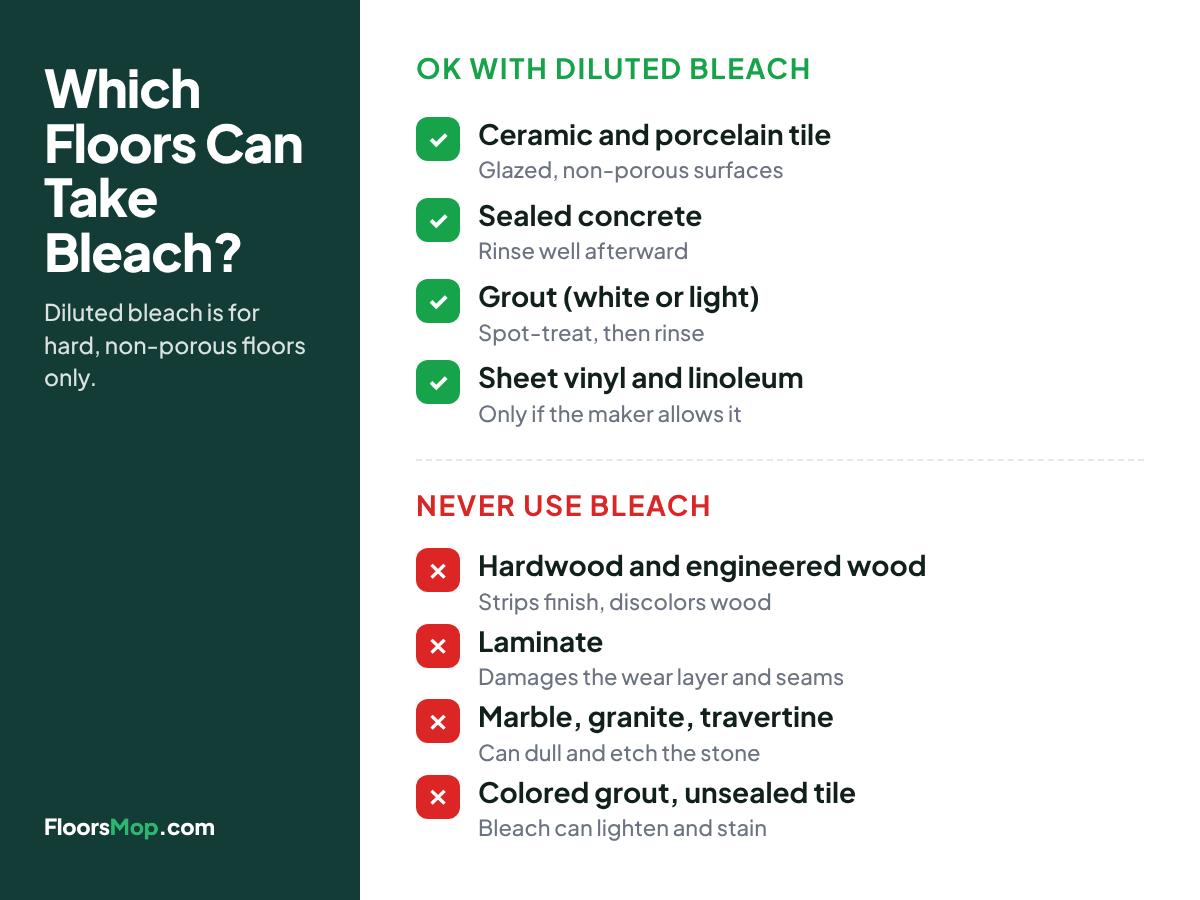
| Floor type | Bleach OK? | Notes |
|---|---|---|
| Glazed ceramic and porcelain tile | Yes | Non-porous; rinse after |
| Sealed concrete | Yes | Rinse well; test colored or stained concrete first |
| Grout | Yes, for light grout | Can lighten colored grout |
| Sheet vinyl and linoleum | Sometimes | Only diluted, only if the maker allows; frequent use can dull the finish |
| Luxury vinyl plank (LVP) | Check the maker | Many brands advise against bleach; use a neutral cleaner |
| Hardwood and engineered wood | No | Strips the finish and discolors wood |
| Laminate | No | Damages the wear layer; moisture swells seams |
| Marble, granite, travertine, slate | No | Can dull the surface and harm the sealer |
| Unsealed or porous tile | No | Absorbs bleach and can stain |
When you are not sure, check the floor maker’s care guide. If it says nothing about bleach, test the solution on a small hidden area first and wait a day before doing the whole room.
How to Mop With Bleach Step by Step
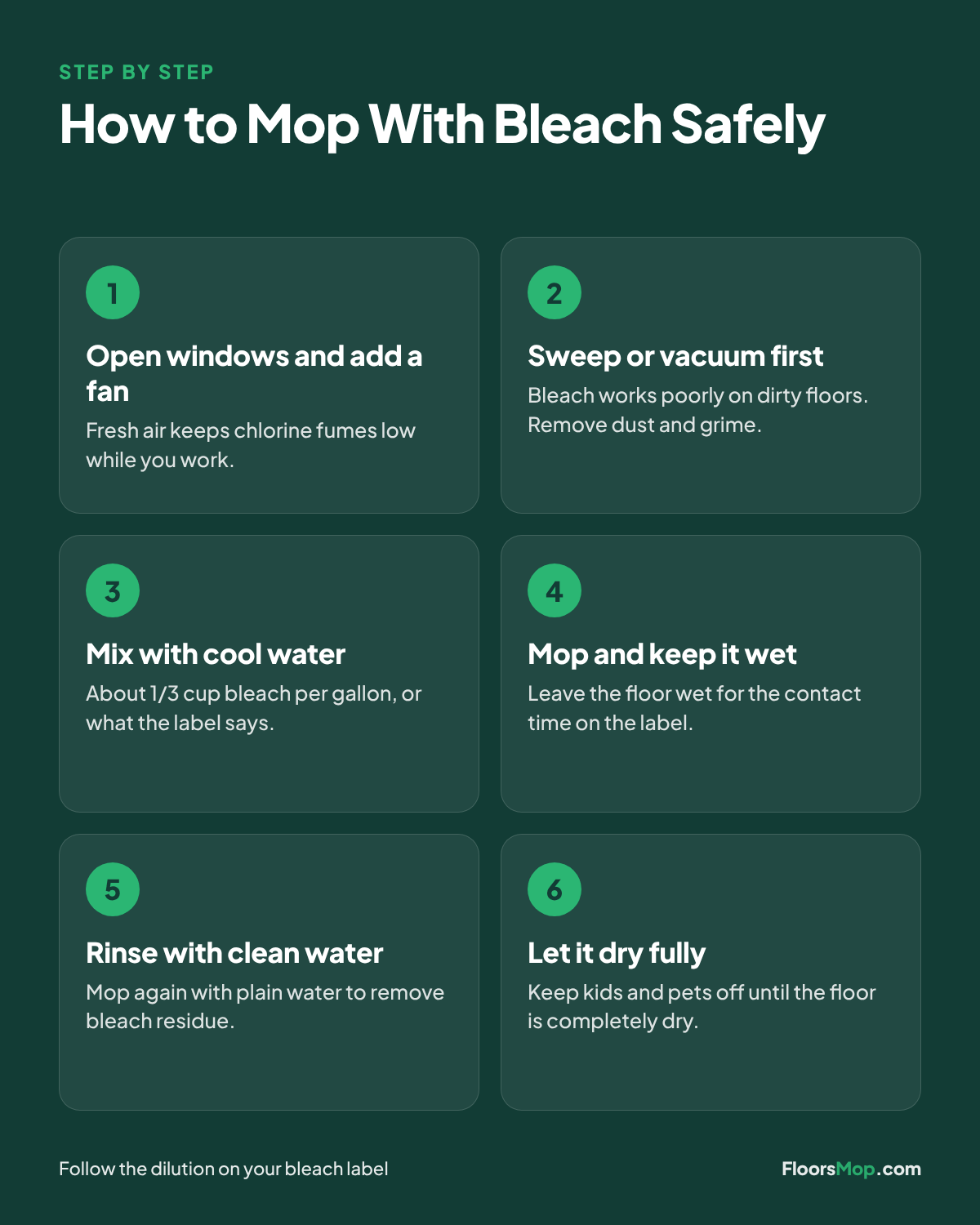
- Ventilate the room. Open windows and doors. In a bathroom with no window, run the exhaust fan or set a fan in the doorway.
- Sweep or vacuum. Remove dust, hair and grit. Pre-clean sticky or greasy spots with a regular cleaner.
- Put on gloves. Wear rubber gloves and old clothes. Eye protection helps if you are mixing a large batch.
- Mix the solution. Add about 1/3 cup (5 tablespoons) of regular unscented bleach to 1 gallon of cool or room-temperature water. Always add bleach to water, not water to bleach. If your bottle gives a different floor ratio, follow the label.
- Mop and let it sit. Wring the mop well and wipe the floor. Keep the surface wet for the contact time listed on the label so it can disinfect. The CDC advises leaving bleach solution on for at least 1 minute; many bleach labels list longer times.
- Rinse with clean water. Empty the bucket, refill with plain water, and mop again to remove residue.
- Let it air-dry. Keep children and pets off the floor until it is completely dry.
Bleach to water ratio for mopping
| Amount of water | Bleach to add |
|---|---|
| 1 gallon | 1/3 cup (5 tablespoons) |
| Half gallon | About 2.5 tablespoons |
| 1 quart | 4 teaspoons |
These amounts match the CDC’s household bleach guidance for regular-strength bleach. Make a fresh batch each time, because diluted bleach weakens within about a day. Do not use hot water; it makes the bleach break down faster and increases fumes.
Safety Rules for Mopping With Bleach
Never mix bleach with other cleaners
This is the most important rule. Bleach mixed with ammonia (found in some glass and floor cleaners) makes toxic chloramine gas. Bleach mixed with vinegar or other acids releases chlorine gas. Both can cause coughing, chest pain and breathing problems. Use bleach with plain water only, and rinse the floor and bucket before switching to another product. Read how to mop floors with vinegar if you prefer vinegar, but never on the same day without a full water rinse in between.
Ventilate and protect your skin
Bleach fumes irritate the eyes, nose and throat, especially for people with asthma. Open windows, take breaks and leave the room if your eyes or chest sting. Gloves stop skin irritation.
Keep kids and pets away
Wet bleach solution can irritate paws and skin, and pets may lick the floor. Keep them out of the room until it is rinsed and dry. Birds are very sensitive to fumes, so move bird cages to another room with fresh air.
Use regular bleach, not scented or splash-less
Scented and splash-less bleach often have lower strength, and some are not labeled for disinfecting. For disinfecting, use a regular unscented bleach whose label lists disinfecting directions.
Do You Need to Rinse After Mopping With Bleach?
Yes, for indoor floors. Bleach left on the floor can leave a white haze, feel slippery, irritate skin and keep releasing a chlorine smell. A quick mop with clean water after the contact time removes it. If your floor looks cloudy afterward, our guide on cloudy floors after mopping explains how to fix it.
Bleach Alternatives for Floors That Cannot Take It
- Hardwood and laminate: a pH-neutral wood or laminate cleaner and a lightly damp microfiber mop.
- Natural stone: a stone-safe neutral cleaner made for marble or granite.
- Sealed tile and vinyl: a hydrogen peroxide or EPA-registered disinfectant that lists your floor type.
- Steam: on floors that allow it, steam cleans without chemicals. See does a steam mop kill bacteria.
Frequently Asked Questions
Can you use bleach on hardwood floors?
No. Even on sealed hardwood, bleach can strip the finish, discolor the wood and cause damage when it seeps into seams. Use a cleaner made for wood floors instead.
What can you mix with bleach to mop floors?
Only water. Never mix bleach with ammonia, vinegar, other acids or other cleaning products, because the mixtures release toxic gases.
How much bleach do you put in a mop bucket?
About 1/3 cup (5 tablespoons) of regular household bleach per gallon of cool water, which is the CDC household ratio. If your bleach label lists a different ratio for floors, follow the label.
Does mopping with bleach disinfect the floor?
Yes, if the floor is cleaned first and the solution stays wet for the contact time on the label. Bleach on a dirty floor or wiped off right away does not disinfect well.
Can you mop with bleach and hot water?
No. Use cool or room-temperature water. Hot water makes bleach break down faster and increases fumes.
How often should you mop with bleach?
Only when you need to disinfect, such as after illness or a raw-meat spill. For regular cleaning, use a mild floor cleaner. See how often you should mop for a routine.
The Bottom Line
You can mop with bleach, but only on hard, non-porous floors like glazed tile, sealed concrete and some vinyl. Clean first, dilute about 1/3 cup per gallon of cool water, ventilate, let it sit for the label’s contact time, then rinse. Keep it away from wood, laminate and stone, and never mix it with anything but water. For everyday cleaning, a mild cleaner is safer and works better.