
How Often Should You Mop? A Room-by-Room and Floor-by-Floor Guide

Disclosure: FloorsMop is reader-supported. As an Amazon Associate, we earn from qualifying purchases. If you buy through a link on this page, we may earn a small commission at no extra cost to you. Learn more.
Quick answer: Most homes should mop high-traffic hard floors once a week. Mop kitchens and entryways one to three times a week, bathrooms weekly, and low-traffic rooms every two weeks. Vacuum or sweep more often, ideally daily in busy areas, because removing grit protects the floor between mops.
How Often to Mop Each Room
| Room | How often to mop | Notes |
|---|---|---|
| Kitchen | 1 to 3 times a week | Spot-clean spills daily |
| Entryway and mudroom | 1 to 3 times a week | Daily in wet or muddy seasons |
| Bathroom | Weekly | Wipe around the toilet more often |
| Living and dining rooms | Weekly | Every 2 weeks if lightly used |
| Bedrooms and guest rooms | Every 2 weeks | Vacuum or dust-mop weekly |
| Homes with pets or crawling babies | 2 to 3 times a week in main areas | Spot-clean accidents right away |
How Often to Mop Each Floor Type
| Floor | Wet mop | Dry clean |
|---|---|---|
| Sealed hardwood | Every 1 to 2 weeks, barely damp | Daily or every other day |
| Laminate | Every 1 to 2 weeks, barely damp | Several times a week |
| Vinyl and LVP | Weekly | Several times a week |
| Ceramic and porcelain tile | Weekly; kitchens more | Several times a week |
| Natural stone | Weekly with stone-safe cleaner | Daily in busy areas |
For more detail on wood, see how often to mop hardwood floors. For steam mops, see how often to steam mop.
Weekly Mopping Checklist
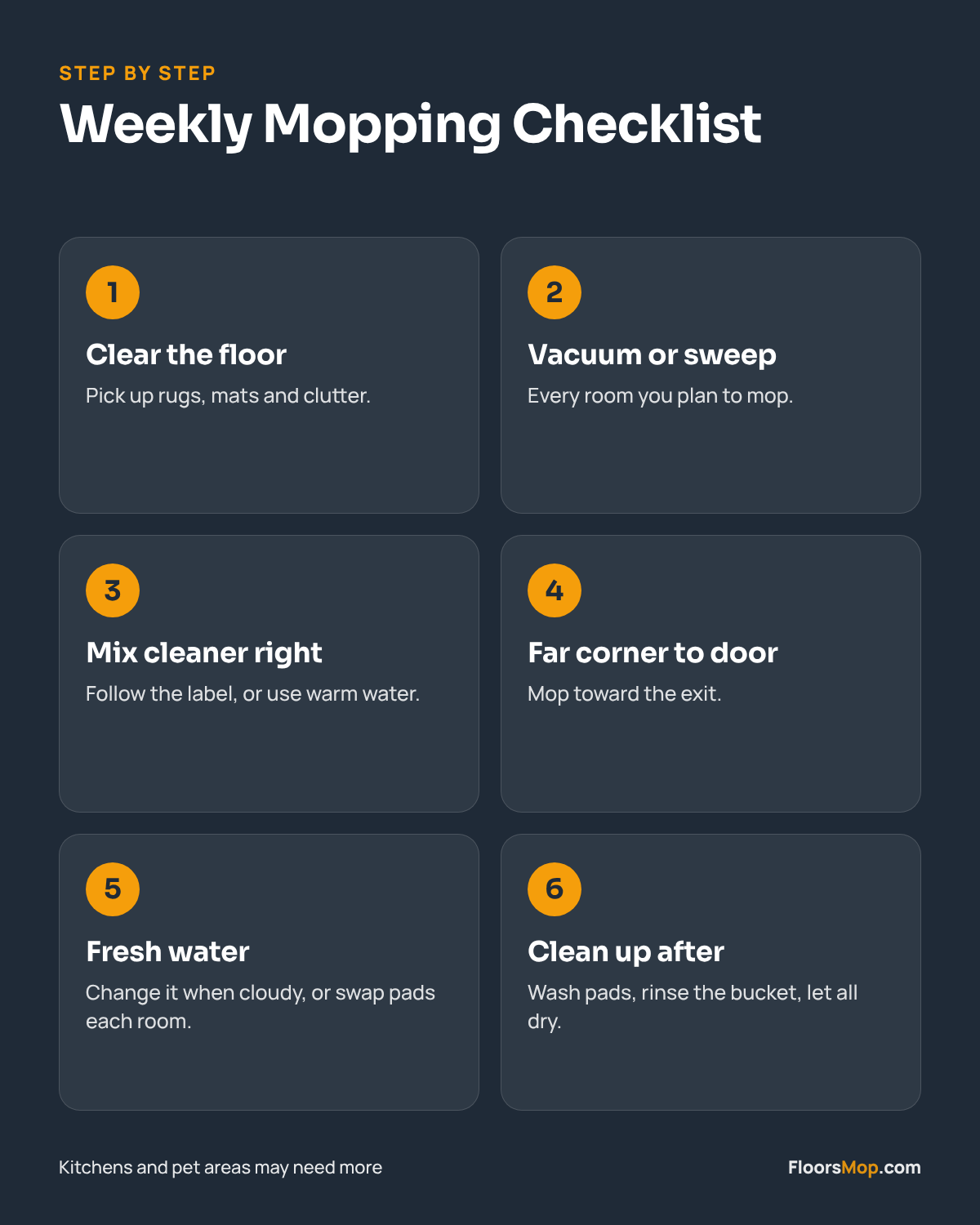
- Pick up rugs, mats, and clutter.
- Vacuum or sweep every room you plan to mop.
- Mix cleaner exactly as the label says, or use warm water.
- Start in the room farthest from the door and mop toward the exit.
- Change the water when it turns cloudy, or swap pads each room.
- Dry glossy or dark floors with microfiber to avoid streaks.
- Wash mop heads and pads, rinse the bucket, and let everything dry.
Signs You Should Mop More Often
- Floors feel gritty or sticky within a few days.
- Mop water turns dark after one room.
- You see dull traffic lanes forming.
- Someone in the home has allergies, or you have shedding pets.
Signs You Are Mopping Too Often
- Hardwood or laminate boards start to cup or swell at seams.
- The finish looks dull from repeated cleaner use.
- Floors are never fully dry before you mop again.
Choosing the Right Mop
- Microfiber flat or spray mop: safest everyday choice for wood, laminate, and LVP. See how to use a microfiber mop.
- Spin mop: great for tile and vinyl in larger homes. See what a spin mop is.
- Steam mop: fast for sealed tile, not for wood or laminate. See what steam mops are.
Popular picks include the O-Cedar EasyWring Spin Mop for tile and vinyl and the Bona Premium Spray Mop for wood. Not sure which type suits you? Read the different types of mops.
FAQs
Is it OK to mop once a week?
Yes, for most rooms. Add extra mopping in kitchens and entryways if they get dirty quickly.
Should you mop or vacuum first?
Always vacuum or sweep first. Mopping over grit spreads dirt and can scratch the floor.
How often should you change mop water?
When it looks cloudy, and at least between rooms. Dirty water is the top cause of sticky and streaky floors. See why floors are sticky after mopping.
How often should you replace a mop head?
Every two to three months for cotton heads in regular use; microfiber lasts longer if washed properly.