
How Much Floor Cleaner per Gallon of Water? (Easy Dilution Chart)

Disclosure: FloorsMop is reader-supported. As an Amazon Associate, we earn from qualifying purchases. If you buy through a link on this page, we may earn a small commission at no extra cost to you. Learn more.
Quick answer: Most liquid floor cleaner concentrates call for about 1/4 cup (2 fluid ounces) per gallon of warm water, but always follow the label on your bottle. Ready-to-use sprays need no water at all. Using more than the label says does not clean better. It leaves sticky, streaky residue that attracts dirt faster.
Eyeballing a “glug” of cleaner into the bucket is how most sticky floors start. A measured dose cleans better, costs less and dries clean. If you are just learning the routine, our step-by-step guide on how to use Bona floor cleaner with a regular mop is a good companion to this chart.
Start with the Label
Every concentrate is formulated differently, so there is no single universal ratio. The label will usually give one of three formats:
- A measured amount, such as “1/4 cup per gallon of water.”
- A ratio, such as “1:64” (1 part cleaner to 64 parts water).
- Ounces per gallon, common on commercial and janitorial products.
If you are not sure whether a product is a concentrate, look for the words “dilute,” “concentrated,” or a dilution chart. If it says “ready to use” or “no rinse, spray and wipe,” do not add water.
Typical Amounts per Gallon by Cleaner Type
| Cleaner type | Typical amount per gallon | Rinse needed? |
|---|---|---|
| — | — | — |
| All-purpose floor concentrate | About 1/4 cup (2 oz) | Usually not at label strength |
| Pine cleaner (e.g. Pine-Sol) | About 1/4 cup for general cleaning | Check label; rinse food-contact areas |
| Oil soap for wood | About 1/4 cup | No, but use a barely damp mop |
| pH-neutral concentrate | Varies widely; often 1 to 2 oz | No |
| White vinegar (DIY) | 1/2 to 1 cup | Optional on tile and vinyl |
| Mild dish soap (DIY) | A few drops to 1 teaspoon | Yes |
| Borax (DIY) | 1/4 to 1/2 cup | Yes |
| Bleach, for disinfecting | Follow the bleach label | Follow label; ventilate |
The “typical” column is a starting point. Brands change their formulas, so check your bottle. For pine cleaner specifics, see how to mop with Pine-Sol. For the vinegar ranges by floor type, see our vinegar mopping guide.
Ratio Conversion Chart
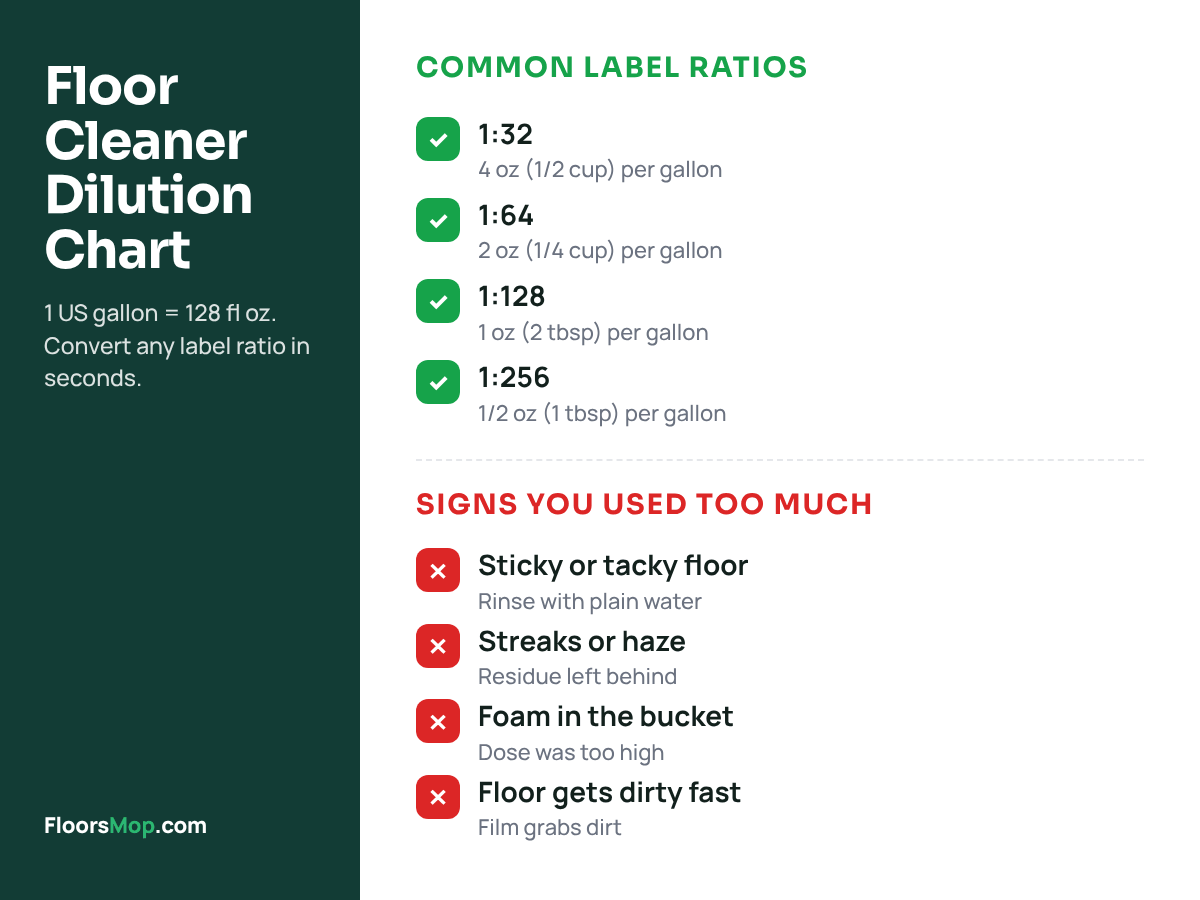
A US gallon is 128 fluid ounces. That makes ratio math easy:
| Label ratio | Per gallon of water | Per half gallon | Per liter |
|---|---|---|---|
| — | — | — | — |
| 1:32 | 4 oz (1/2 cup) | 2 oz | about 30 ml |
| 1:64 | 2 oz (1/4 cup) | 1 oz | about 15 ml |
| 1:128 | 1 oz (2 tbsp) | 1/2 oz (1 tbsp) | about 8 ml |
| 1:256 | 1/2 oz (1 tbsp) | 1/4 oz (1 1/2 tsp) | about 4 ml |
Handy kitchen conversions: 1 fluid ounce = 2 tablespoons. 1/4 cup = 2 fluid ounces = 4 tablespoons. 1 cup = 8 fluid ounces.
How to Measure the Right Amount
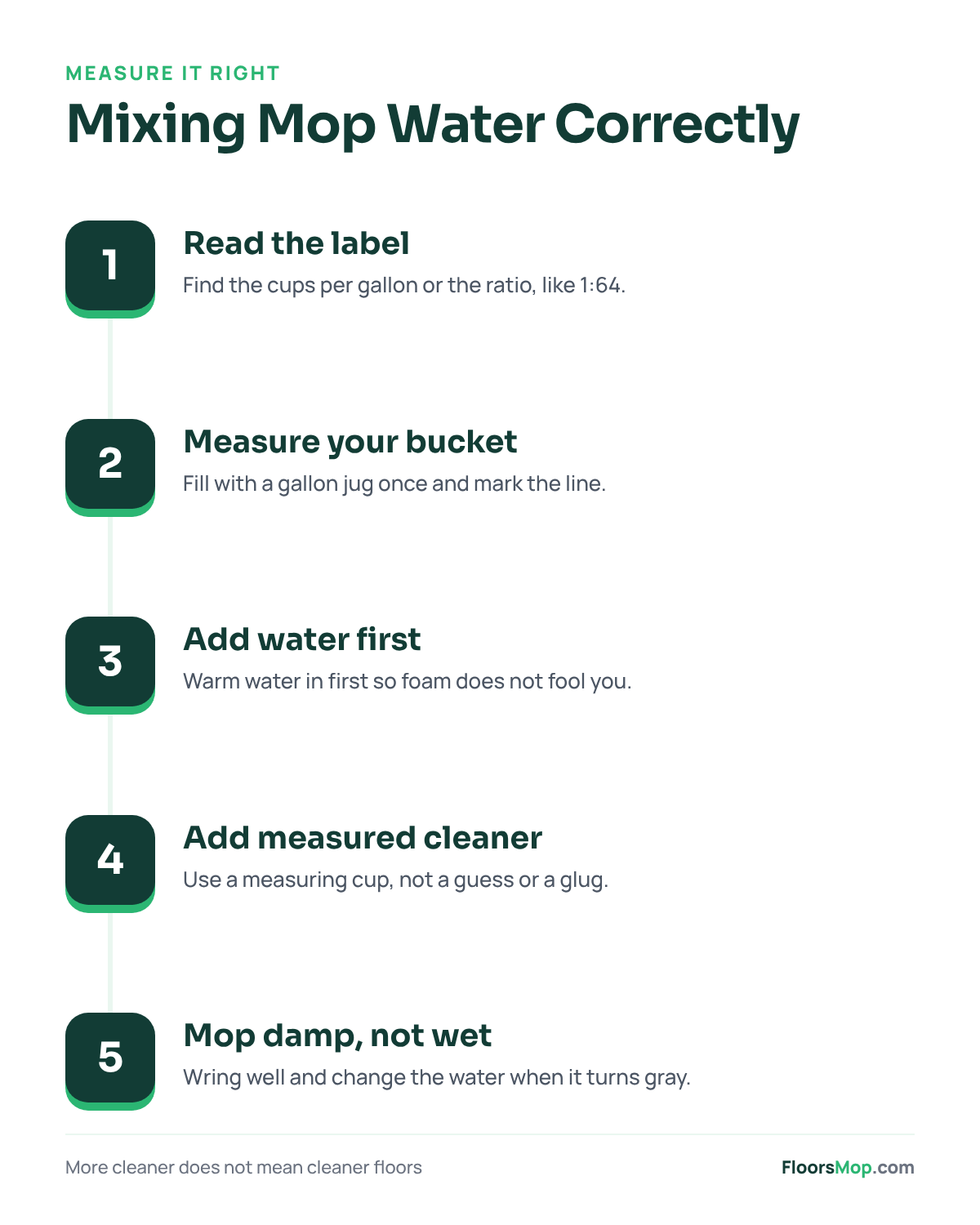
Step 1: Read the dilution on your bottle
Find the amount per gallon or the ratio. Note whether it gives a different strength for light cleaning and heavy soil.
Step 2: Find out how much your bucket holds
Most people do not know. Fill your bucket with a measured gallon jug once and mark the line with a permanent marker. Spin mop buckets often have a fill line; check how much water that line really is.
Step 3: Add water first
Pour the warm water in before the cleaner. Adding cleaner first makes foam and makes it harder to judge the level.
Step 4: Add the measured cleaner
Use a measuring cup or the bottle cap if the label tells you how many caps equal a dose. Stir gently.
Step 5: Mop with a damp, not wet, mop
The right dilution only helps if you wring the mop well. Change the water when it turns gray. For where to dump it, see where mop water should be disposed.
Scaling for Your Bucket
| Bucket water | At 1/4 cup per gallon | At 2 tbsp per gallon |
|---|---|---|
| — | — | — |
| 1/2 gallon | 2 tbsp | 1 tbsp |
| 1 gallon | 1/4 cup | 2 tbsp |
| 1.5 gallons | 6 tbsp | 3 tbsp |
| 2 gallons | 1/2 cup | 1/4 cup |
| 3 gallons | 3/4 cup | 6 tbsp |
Does the Floor Type Change the Amount?
The dose comes from the cleaner, not the floor. What changes by floor is how much of that mixed water you put down, and which cleaner you pick in the first place.
| Floor | Cleaner choice | How wet the mop should be |
|---|---|---|
| — | — | — |
| Ceramic and porcelain tile | Most all-purpose concentrates | Damp; tile tolerates more water |
| Vinyl and LVP | pH-neutral or vinyl-safe cleaner | Damp, no puddles at the seams |
| Laminate | Laminate-safe, low-residue cleaner | Barely damp |
| Sealed hardwood | Wood floor cleaner only | Barely damp, dry within a minute |
| Marble and stone | pH-neutral stone cleaner | Damp; never acidic cleaners |
On wood and laminate, a spray mop with a ready-to-use cleaner is often easier than a bucket, because it puts down a thin, even layer without any measuring.
Signs You Are Using Too Much Cleaner
- The floor feels sticky or tacky after it dries.
- Socks or bare feet pick up dirt quickly.
- You can see streaks or a cloudy haze in the light.
- The water foams up in the bucket.
- The floor gets dirty again faster than before.
If this sounds familiar, mop once with plain warm water to rinse off the extra, then go back to a measured dose. Our guide on why your floor is sticky after mopping explains more causes.
Dilution Mistakes
- “A little extra for dirty floors.” Use the label’s heavy-duty strength if it has one, not your own.
- Mixing two cleaners in one bucket. Some combinations are dangerous. Never mix bleach with vinegar or ammonia.
- Using hot water with bleach. Bleach labels usually call for room-temperature water. See can you mop the floor with bleach.
- Filling a spray mop with concentrate. Spray mop tanks need a ready-to-use or properly diluted cleaner.
- Guessing the bucket size. A 3-gallon bucket filled halfway is not one gallon.
Helpful Tools
- Measuring cup: an OXO Good Grips angled measuring cup lets you read ounces from above while you pour.
- Bucket with a fill line: the Libman Tornado spin mop bucket is easy to measure once and mark.
- Concentrate: Pine-Sol Multi-Surface Cleaner has dilution directions printed on the label.
FAQs
How much Pine-Sol do I use per gallon of water?
Check your bottle, but general cleaning directions for Pine-Sol usually call for about 1/4 cup per gallon of warm water.
Can I use less cleaner than the label says?
Yes, for light weekly cleaning a slightly weaker mix is fine on most floors. Avoid going stronger than the label.
How many ounces are in a gallon?
A US gallon is 128 fluid ounces, or 16 cups.
Do I need to rinse after mopping with floor cleaner?
Many modern concentrates are no-rinse at label strength. If the floor feels sticky or a label calls for rinsing, go over it with plain water.
Is hot or cold water better for mixing?
Warm water is best for most cleaners. Bleach is the exception; mix it with room-temperature water as the label directs.
Related Guides
- How to Use Bona Floor Cleaner with a Regular Mop
- How to Mop with Pine-Sol
- Where Should Mop Water Be Disposed?
- How to Mop Floors with Vinegar
- Is It Better to Mop with Hot or Cold Water?