
What Is a pH-Neutral Floor Cleaner (and Why It Matters)?

Disclosure: FloorsMop is reader-supported. As an Amazon Associate, we earn from qualifying purchases. If you buy through a link on this page, we may earn a small commission at no extra cost to you. Learn more.
Quick answer: A pH-neutral floor cleaner has a pH close to 7, the same as pure water, so it is neither acidic nor alkaline. That makes it safe for floors that acids or strong alkalis can damage, like marble, travertine, sealed hardwood, laminate and waxed or sealed surfaces. It cleans everyday dirt without etching, dulling or stripping finishes.
You will see “pH-neutral” or “pH-balanced” on a lot of floor cleaner labels. It is not just a marketing phrase. For some floors it is the difference between a clean surface and a dull, damaged one. If you already use Bona, our guide on how to use Bona floor cleaner with a regular mop shows a practical routine.
The pH Scale in Plain English
The pH scale runs from 0 to 14. Seven is neutral. Lower numbers are acidic, and higher numbers are alkaline (also called basic). The further a cleaner is from 7, the stronger its chemical action on both dirt and the surface underneath.
| Cleaner | Approximate pH | Type |
|---|---|---|
| — | — | — |
| White vinegar | about 2 to 3 | Acidic |
| Lemon juice | about 2 | Acidic |
| Pure water | 7 | Neutral |
| pH-neutral floor cleaner | about 7 (roughly 6 to 8) | Neutral |
| Baking soda in water | about 8 to 9 | Mildly alkaline |
| Borax in water | about 9 | Alkaline |
| Household ammonia | about 11 to 12 | Strongly alkaline |
| Chlorine bleach | about 11 to 13 | Strongly alkaline |
These are typical ranges for common household products. Exact values depend on the brand and how much you dilute it.
Why pH Matters for Floors
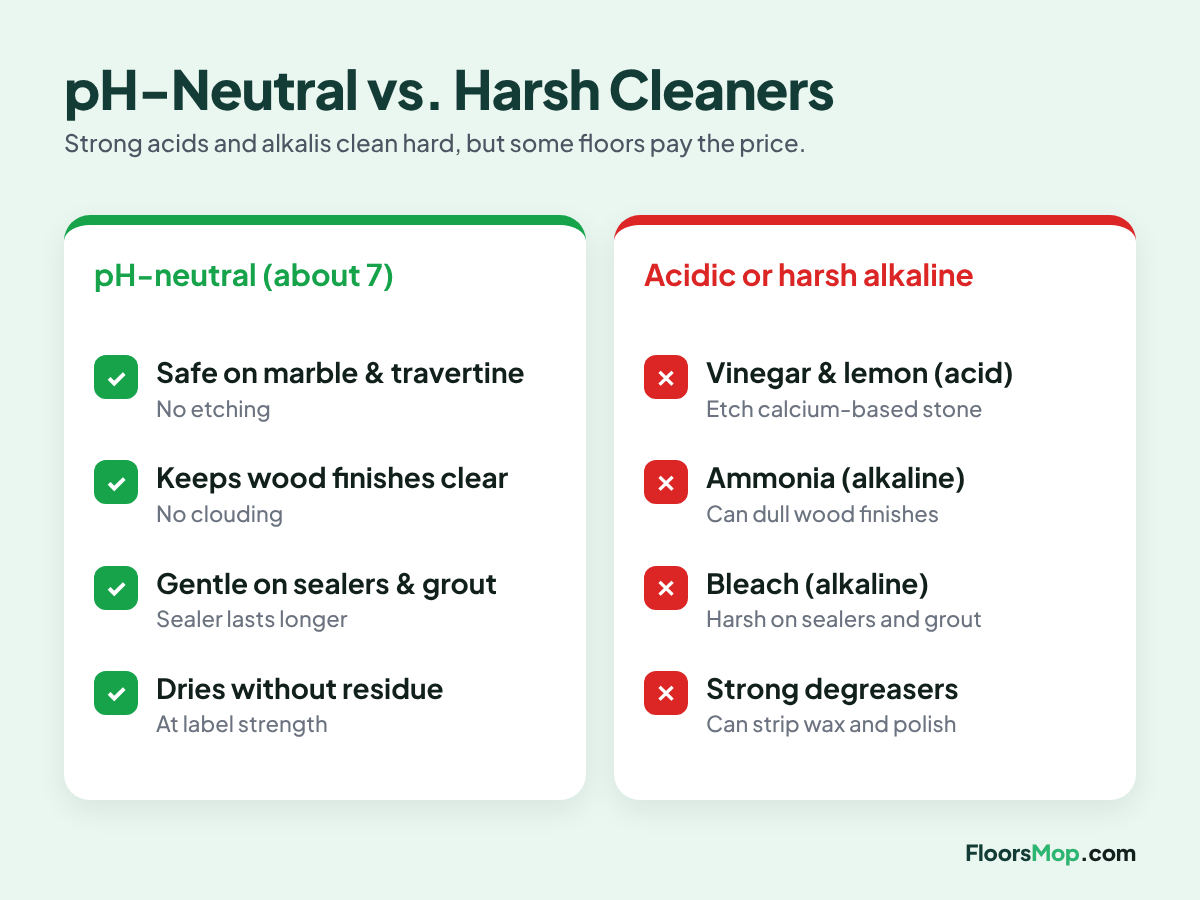
Acids and alkalis are good at breaking down certain types of soil. Acids dissolve mineral deposits and hard water spots. Alkalis cut grease and oily grime. The problem is that some floors are made of, or coated with, materials those same chemicals attack.
- Marble, travertine and limestone are calcium-based. Acids react with them and leave dull, rough “etch” marks.
- Hardwood finishes like polyurethane can cloud or wear faster with strong alkaline cleaners such as ammonia.
- Wax and some sealers can be softened or stripped by alkaline products.
- Grout sealers wear down faster with harsh cleaners, letting stains soak in.
A neutral cleaner avoids those reactions. It relies on mild surfactants to lift dirt instead of chemical force. That is also why these products tend to dry without residue when used at the right strength.
Which Floors Need a pH-Neutral Cleaner?
| Floor | Needs pH-neutral? | Why |
|---|---|---|
| — | — | — |
| Marble, travertine, limestone | ✅ Yes, always | Acids etch; alkalis can wear sealers |
| Granite and slate | ✅ Best choice | Protects the sealer and avoids haze |
| Sealed hardwood and engineered wood | ✅ Yes | Keeps the finish clear and intact |
| Laminate | ✅ Recommended | Dries clean with minimal moisture |
| LVP and sheet vinyl | 👍 Ideal for routine cleaning | Most makers recommend it for daily care |
| Porcelain and ceramic tile | 👍 Good for routine | Tile handles stronger cleaners, but sealed grout benefits |
| Sealed concrete | 👍 Good for routine | Keeps the sealer intact longer |
For a stone-specific routine, see how to mop travertine floors. If you are thinking about steam on stone, read are steam mops good for marble floors first.
When a Neutral Cleaner Is Not Enough
pH-neutral cleaners are for routine cleaning. They are not designed to remove everything:
- Heavy grease in a restaurant-style kitchen may need an alkaline degreaser (on floors that can take it).
- Hard water scale and soap scum on tile may need a mild acid (never on stone).
- Old wax or polish buildup needs a stripper made for your floor type.
- Germs need a product labeled as a disinfectant. Neutral cleaners clean, but most do not disinfect.
Think of a neutral cleaner as the everyday product and stronger cleaners as occasional specialists.
How to Tell If a Cleaner Is pH-Neutral
- Read the label. Look for “pH-neutral,” “pH-balanced,” or “safe for natural stone.”
- Check the floor maker’s list. Many flooring brands name approved cleaners in their care guide.
- Look at the warnings. Products with strong-smelling ammonia, bleach or citrus acids are usually not neutral.
- Test it if you are unsure. Inexpensive pH test strips give you a rough reading of the diluted solution.
How to Use a pH-Neutral Floor Cleaner
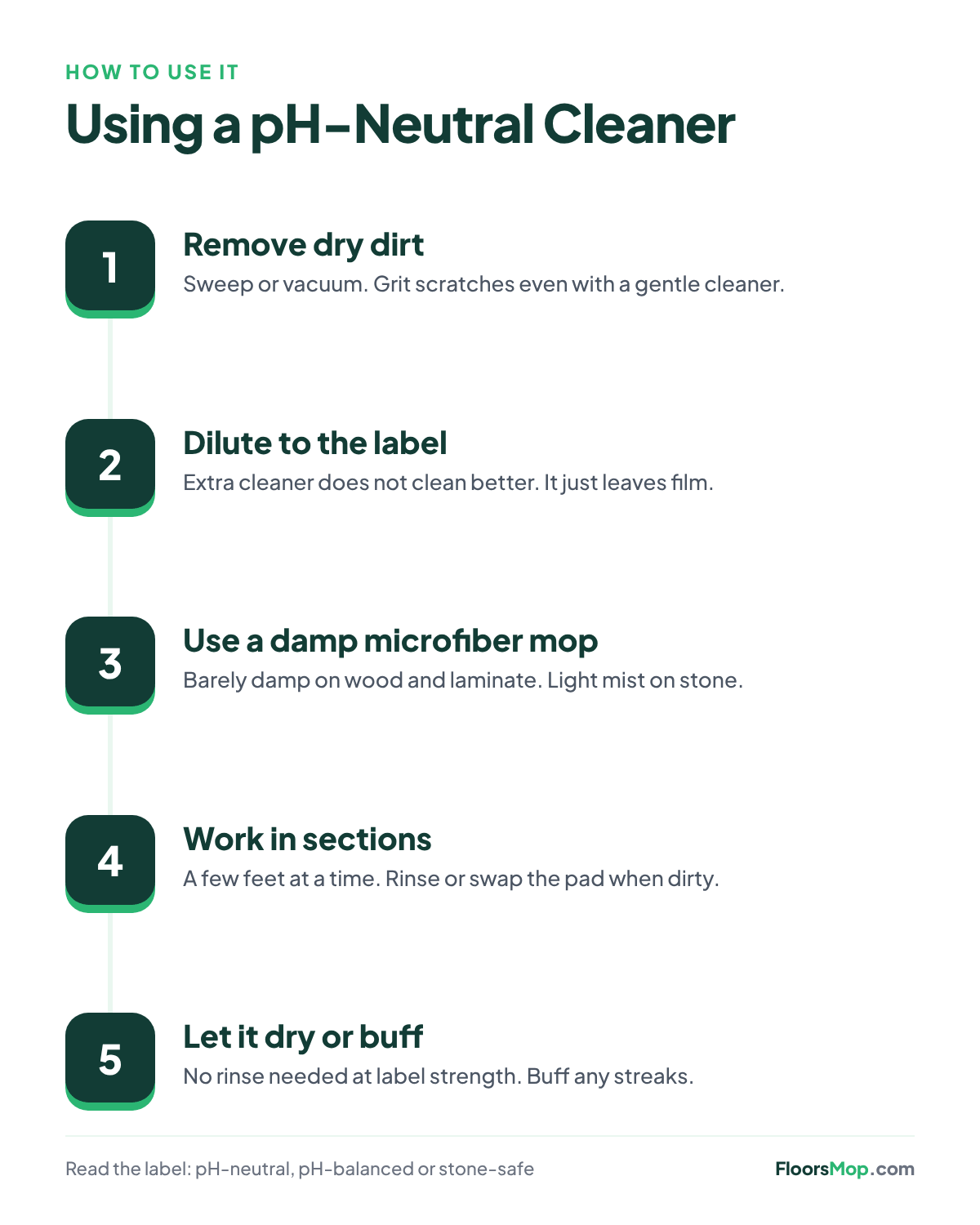
Step 1: Remove dry dirt
Sweep, dust mop or vacuum. Grit scratches stone and wood finishes no matter how gentle the cleaner is.
Step 2: Dilute it exactly as the label says
Concentrates need measuring. Ready-to-use sprays do not. Adding extra does not make it stronger, it just leaves more to dry on the floor.
Step 3: Use a damp microfiber mop
Microfiber grabs fine dirt well and uses little liquid. For wood and laminate, the pad should be barely damp.
Step 4: Work in sections
Mop a few feet at a time and swap or rinse the pad when it gets dirty.
Step 5: Let it dry, or buff
Most neutral cleaners do not need a rinse at label strength. If you see streaks, buff with a dry pad.
Want a homemade version? A few drops of mild, dye-free dish soap in a gallon of warm water is close to neutral and works for light cleaning, but rinse it, because soap can leave a film. Our page on making your own spray mop cleaner has more recipes, and what liquid to put in a spray mop covers safe tank fillers.
Myths and Mistakes About pH
- Assuming “natural” means neutral. Vinegar and lemon are natural and very acidic.
- Using vinegar on stone “because it’s diluted.” Diluted acid still etches marble.
- Overdosing a neutral cleaner. Residue builds up and attracts dirt.
- Skipping the floor warranty. Some makers require specific products to keep coverage.
- Expecting it to disinfect. Check the label for a disinfectant claim before relying on it for germs.
Good pH-Neutral Cleaners to Consider
- Multi-floor: Bona Hard-Surface Floor Cleaner. Labeled for stone, tile, vinyl and laminate.
- Hardwood: Bona Hardwood Floor Cleaner. Made for polyurethane-finished wood.
- Concentrate for big areas: Zep Neutral pH Floor Cleaner. Diluted in a bucket, it covers a lot of floor for the price.
FAQs
Is vinegar a pH-neutral cleaner?
No. Vinegar is acidic, usually around pH 2 to 3. It is useful on some tile and vinyl, but it should not be used on marble, travertine or limestone.
Is Bona pH-neutral?
Bona markets its hard-surface and hardwood floor cleaners as pH-neutral. Check the label on your specific bottle, since product lines vary.
Is dish soap pH-neutral?
Many mild dish soaps are close to neutral, but formulas vary and some lean alkaline. A few drops in a gallon of water is fine for light cleaning if you rinse well.
Can I use a pH-neutral cleaner in a steam mop?
No. Most steam mops are made for water only. Add cleaners only if your steam mop’s manual says it is allowed.
Do pH-neutral cleaners kill germs?
Most do not. They clean and remove soil, which removes many germs physically, but they are not disinfectants unless the label says so.
What pH is safe for marble floors?
Stay close to neutral, about 7. Avoid acids like vinegar and lemon and strong alkalis like ammonia and bleach.
Related Guides
- How to Use Bona Floor Cleaner with a Regular Mop
- Can I Make My Own Spray Mop Cleaner?
- How to Mop Floors with Vinegar
- How to Mop Travertine Floors