
Sponge Mop vs String Mop: Which Is Better for Your Floors?

Disclosure: FloorsMop is reader-supported. As an Amazon Associate, we earn from qualifying purchases. If you buy through a link on this page, we may earn a small commission at no extra cost to you. Learn more.
Quick answer: A sponge mop is better for smooth floors like vinyl, linoleum and sealed tile in small areas. It wrings with a lever, scrubs spots well, and is easy to store. A string mop is better for large, textured or very dirty floors, such as garages, mudrooms and commercial kitchens, because its strands hold more water and reach into grout. Neither is ideal for wood or laminate, where a flat microfiber mop is safer.
Sponge and string mops are the two classic wet mops. They still sell well because they are cheap and simple. For a wider view of every style, see our guide to the different types of mops. Here is how these two compare head to head.
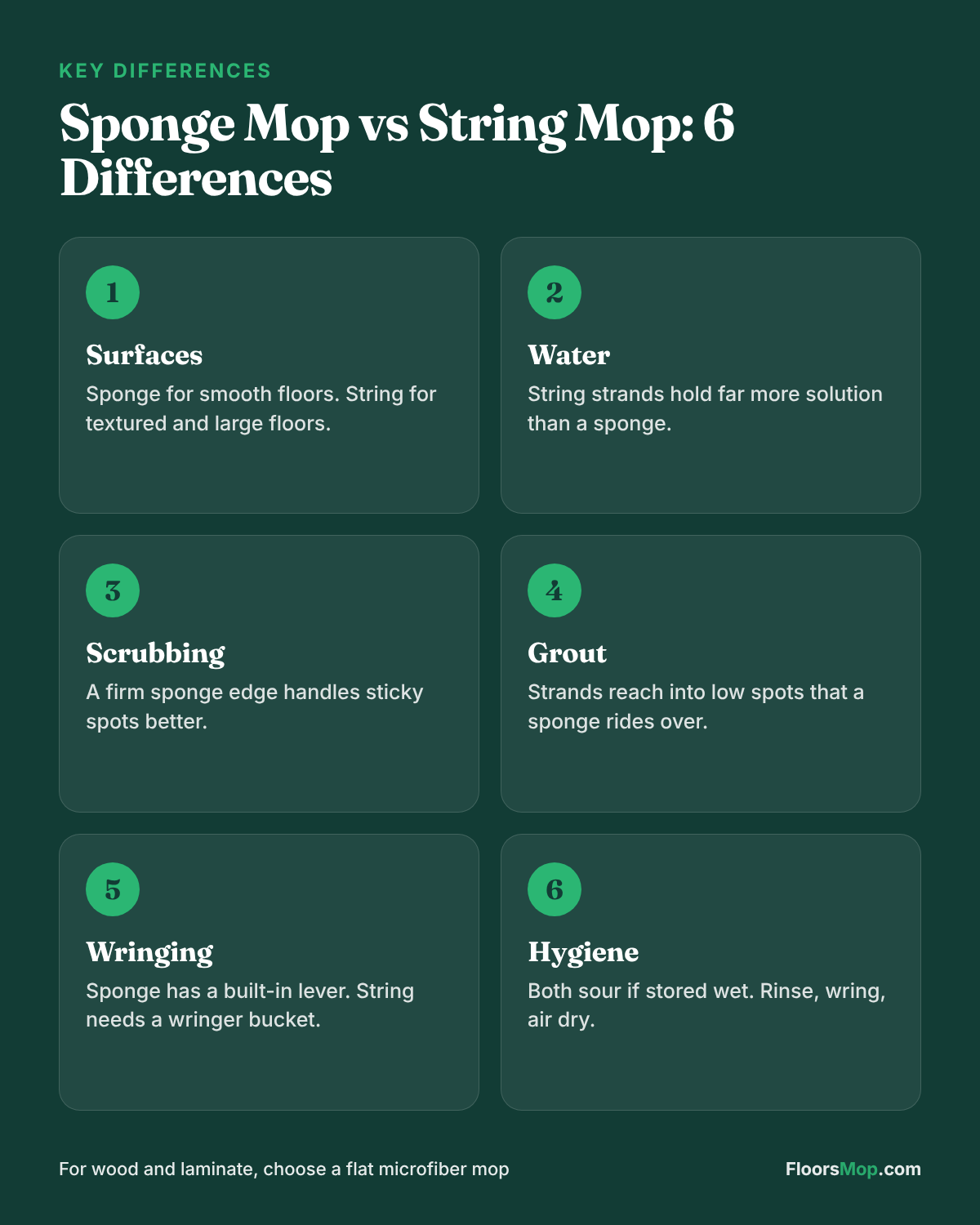
Sponge Mop vs String Mop at a Glance
| Feature | Sponge mop | String mop | Edge |
|---|---|---|---|
| Best surfaces | Smooth vinyl, linoleum, sealed tile | Textured tile, concrete, large areas | Depends |
| Water it holds | Moderate | A lot | String (big jobs) |
| Spot scrubbing | Firm edge, many have a scrub strip | Soft, spreads pressure | Sponge |
| Grout lines and uneven floors | Rides over low spots | Strands reach in | String |
| Wringing | Built-in lever or roller | Needs a wringer bucket or hand wringing | Sponge |
| Drying and odors | Can stay damp inside and smell | Dries faster if hung, but can sour if left wet | Tie |
| Wood and laminate | Not recommended | Not recommended | Neither |
| Cost of refills | Low | Low | Tie |
Key Differences
Cleaning performance
A sponge mop presses a flat, firm surface against the floor. That pressure is good for scuffs and dried drips on smooth floors, and many models add a scrubbing strip along the front edge for stubborn spots. The trade-off: sponge can push dirty water around instead of trapping it, and it does not reach into recessed grout.
A string mop (often called a wet mop or deck mop) has dozens of cotton, rayon, or microfiber strands. They hold a lot of solution, flop into low spots, and spread water over a large area quickly. This is why janitors use them on big floors. On a small kitchen, though, that much water can be more than you need.
Ease of use
Sponge mops win for convenience. You dunk the head and pull a lever, and a roller or hinged plate squeezes the sponge without your hands touching dirty water. String mops are heavier when wet and need a wringer bucket or some hand twisting. If you do not own a wringer bucket, expect to leave more water on the floor.
Hygiene and smell
Both can get smelly when stored wet. Sponge heads are dense, so the inside can stay damp for a long time. String mops dry faster if you hang them strands-down in airflow, but bunched-up wet strands sour quickly. Rinse either one well in clean water after use and let it dry fully. Our guide on how to clean a mop head covers sanitizing both types.
Floors and surfaces
Use a sponge mop on smooth vinyl, linoleum and glazed tile in kitchens, bathrooms and laundry rooms. Use a string mop on textured tile, quarry tile, sealed concrete, and any large floor. Keep both off hardwood, laminate, and luxury vinyl plank with exposed seams, unless you wring very hard and dry the floor right away. These floors do best with a damp microfiber pad.
Refills and running cost
Replacement sponge heads are brand-specific and should be replaced when the sponge cracks, crumbles or smells. String mop heads are cheap and often universal for standard clamp handles. Cotton strings need a break-in wash to remove lint before first use; microfiber strings do not.
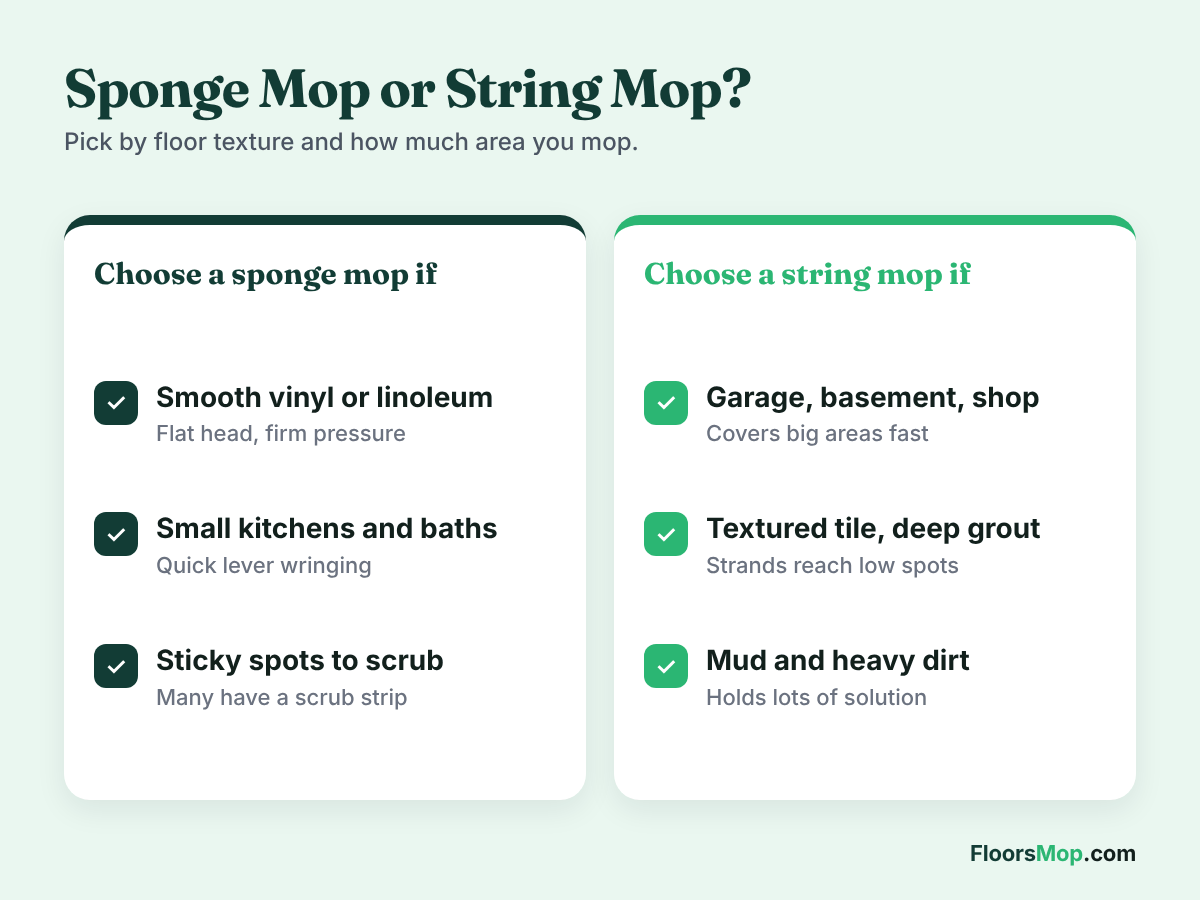
Choose a Sponge Mop If…
- Your floors are smooth vinyl, linoleum or glazed tile.
- You clean small rooms like a kitchen, bath or laundry room.
- You want a built-in wringer and no extra bucket gear.
- You often need to scrub small sticky spots.
Popular choices include the Libman Nitty Gritty Roller Mop and Quickie sponge mops with lever wringers.
Choose a String Mop If…
- You clean large floors, a garage, a basement, or a shop.
- Your tile is textured or has deep grout lines.
- You deal with heavy dirt like mud or grease.
- You own (or will buy) a bucket with a wringer.
Look for a heavy-duty microfiber string mop for home use or a mop bucket with a wringer if you mop large areas.
How to Get Better Results With Either Mop
- Sweep or vacuum first. Wet grit scratches and turns into mud.
- Use two buckets (or a divided bucket): one for cleaning solution, one for rinsing the dirty mop. This stops you from spreading dirty water.
- Use the right amount of cleaner. Extra soap leaves a sticky film that attracts dirt. See how to mop a floor properly.
- Mop in a figure-eight with a string mop, and in straight overlapping rows with a sponge mop.
- Rinse and dry the head after every use, and replace it at the first sign of a sour smell.
If you want to disinfect after an illness or a pet accident, the mop type matters less than the product and contact time. Our guide on what to mop floors with to disinfect lists safe options by floor type.
Consider Instead: A Spin Mop or Flat Microfiber Mop
For most modern homes, a spin mop or a flat microfiber mop beats both classics. Spin mops wring much drier, which makes them safe on more floors. Flat microfiber mops use the least water of all and have machine-washable pads. Read spray mop vs regular mop if you are weighing a switch.
FAQs
Is a sponge mop or string mop more hygienic?
Neither is clearly more hygienic. Both can hold bacteria if stored wet. Rinse well, wring hard, dry in open air, and replace the head regularly.
Can you use a sponge mop on tile?
Yes, on smooth glazed tile. It works less well on textured tile or deep grout, where the flat sponge skips the low spots.
Why does my sponge mop smell?
Moisture trapped inside the sponge lets bacteria grow. Rinse it with clean water after each use, squeeze it as dry as possible, and store it head-up where air can reach it.
Are cotton or microfiber string mops better?
Cotton holds more water and suits heavy-duty jobs. Microfiber picks up finer dirt, is lighter, and dries faster, which suits home use better.
Which mop is best for hardwood?
Neither. Use a flat microfiber mop that is barely damp, or a spray mop with a wood-safe cleaner.
Verdict
Choose a sponge mop for small, smooth floors where you want quick, easy wringing and some scrubbing power. Choose a string mop for large, textured or heavy-duty floors, ideally with a wringer bucket. For wood, laminate, and most everyday home mopping, a spin mop or flat microfiber mop is the better upgrade.
Related Guides
- Different Types of Mops
- How to Mop a Floor Properly
- How to Clean a Mop Head
- Reusable vs Disposable Mop Heads