
Twist Mop vs Spin Mop: Which Wrings Better and Cleans Faster?

Disclosure: FloorsMop is reader-supported. As an Amazon Associate, we earn from qualifying purchases. If you buy through a link on this page, we may earn a small commission at no extra cost to you. Learn more.
Quick answer: A spin mop wrings the head drier and with less effort, because a foot pedal or pump spins the head in a basket. That makes it better for wood, laminate and anyone with weak wrists. A twist mop wrings by twisting a built-in collar or handle, needs no special bucket, and stores in a narrow closet. Choose a twist mop for small spaces and quick jobs, and a spin mop for regular whole-home mopping.
Both are “hands-free” in the sense that you never touch the dirty head. The difference is how the water comes out. If you want the mechanics in detail, read how a spin mop works. Below is a side-by-side look so you can decide quickly.
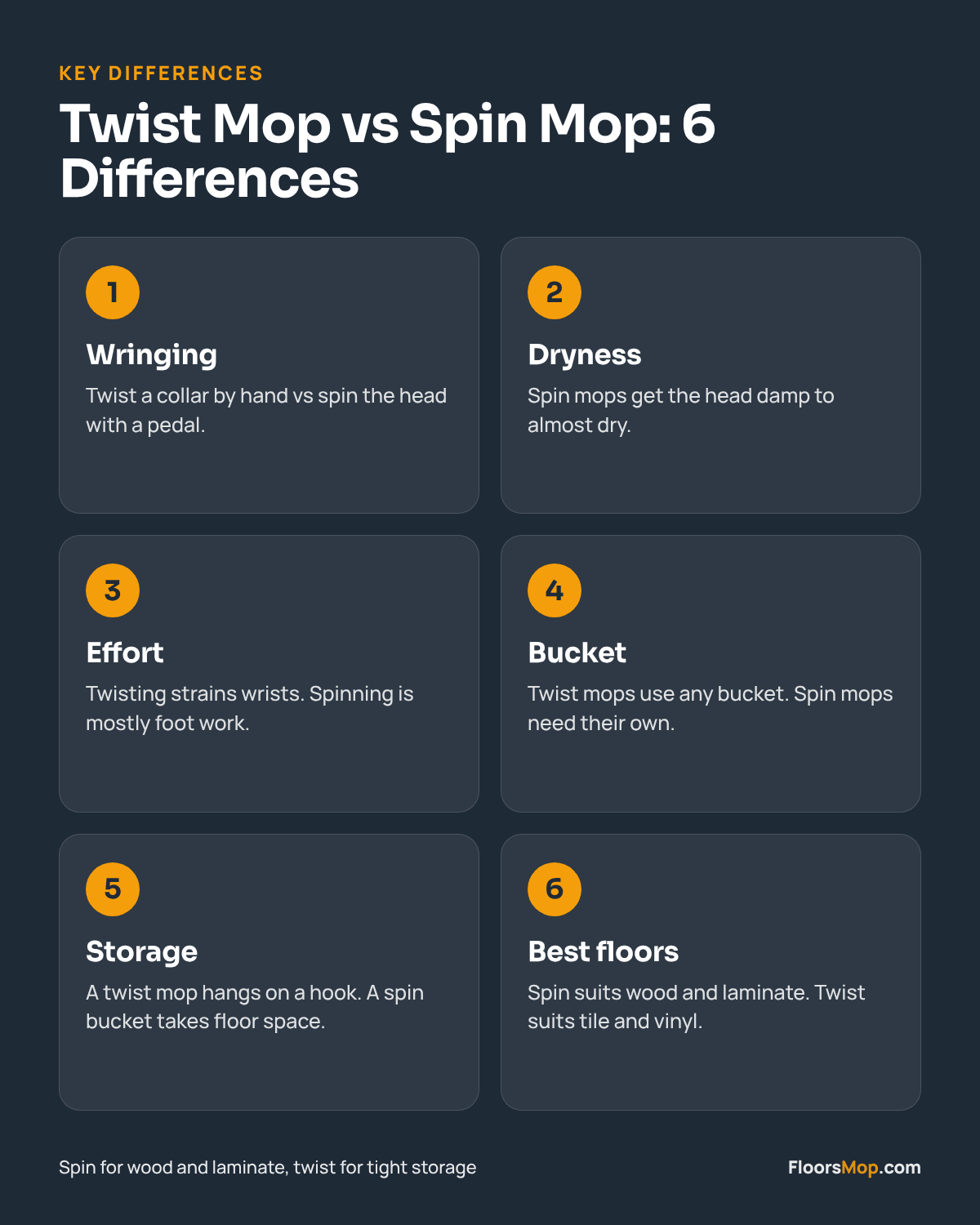
Twist Mop vs Spin Mop at a Glance
| Feature | Twist mop | Spin mop | Edge |
|---|---|---|---|
| How it wrings | Twist a collar or the handle to squeeze the strands | Pedal or pump spins the head in a basket | Spin |
| How dry the head gets | Damp to fairly wet; depends on your grip | Damp to nearly dry; you control by spins | Spin |
| Wrist and hand effort | Moderate, repeated twisting | Low, mostly foot work | Spin |
| Bucket needed | Any bucket or sink | Its own spin bucket | Twist |
| Storage | Just a handle, hangs on a hook | Bucket takes floor space | Twist |
| Head shape | Long strands (microfiber or cotton) | Round or triangular microfiber head | Tie |
| Best floors | Tile, vinyl, sealed concrete | All sealed floors, including wood and laminate | Spin |
| Upfront cost | Low | Low to mid | Twist |
Key Differences
Wringing and water control
This is the core difference. A twist mop has a sleeve or collar on the handle. You slide it down over the strands and turn it a few times, which squeezes water out like wringing a towel. The Libman Wonder Mop, for example, has a built-in wringer, and its directions say to push the sleeve down and twist about four times. How dry the head gets depends on your strength and patience.
A spin mop uses centrifugal force. You set the head in the bucket’s spin basket and press a pedal (or pump the handle) so the head whirls and flings water out. Five or six pumps give a damp head for tile. Ten or more get it close to dry for hardwood and laminate. That level of control is the main reason spin mops took over from twist mops in many homes.
Ease of use
Owners of twist mops often like how simple they are, but a common complaint is that the head turns with the collar instead of wringing, especially once the parts wear. Twisting also adds strain for people with arthritis or wrist pain. Spin mops are easier on the hands, but you carry a bucket around, and cheaper buckets can have pedals that crack or baskets that stop spinning.
Cleaning performance
Long twist mop strands reach into grout lines and around chair legs well and hold plenty of solution, which helps on sticky kitchen tile and textured floors. Spin mop heads are rounder and denser. They pick up dust and hair well, and because you can get them drier, they leave less water behind and floors dry faster.
Floors and surfaces
For sealed hardwood, laminate and engineered wood, less water is always safer, so the spin mop wins. On ceramic tile, vinyl, and sealed concrete, either works. If you mop rough tile or a garage floor, a twist mop’s strands can be a better fit than a spin mop’s soft round head.
Refills and running cost
Both use machine-washable replacement heads. Twist mop refills are usually brand-specific because the head locks into the collar. Spin mop refills are also brand-specific, though some generic heads fit popular buckets. Plan on replacing either head every few months with regular use. Our guide to types of spin mop heads explains the shapes and fits.
Storage
A twist mop is just a handle with a head, so it hangs on a hook or slides into a narrow closet. A spin mop needs its bucket, which takes up a square of floor space in a closet or laundry room. In a small apartment, that difference matters more than you might expect.
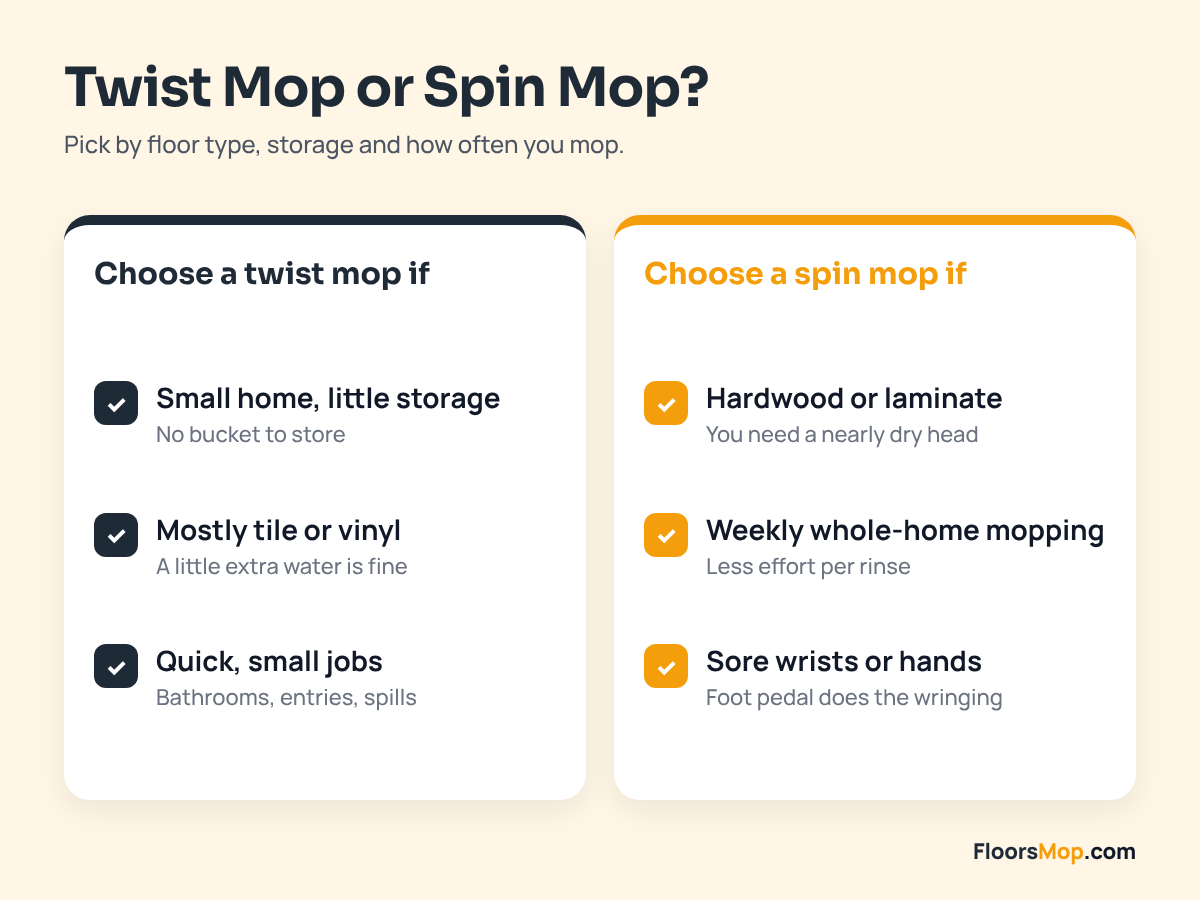
Choose a Twist Mop If…
- You have limited storage and do not want a bulky bucket.
- Your floors are mostly tile or vinyl, where a slightly wetter mop is fine.
- You mop small areas, like a bathroom or entry, and want something quick.
- You want the lowest upfront cost.
Look at the Libman Wonder Mop or other self-wringing twist mops. If you like the idea but want even less wrist work, see our list of the best self-wringing mops.
Choose a Spin Mop If…
- You have hardwood, laminate or engineered floors and need a nearly dry head.
- You mop the whole home every week or more.
- Twisting hurts your hands or wrists.
- You have room for a bucket in a closet or laundry room.
The O-Cedar EasyWring is the best-known pedal model, and its RinseClean version keeps clean and dirty water apart. Read our EasyWring review for details.
What About “Twist” Spin Mops?
Some brands, such as Leifheit with its Clean Twist line, use the word “twist” for a spin mop where pushing the handle down makes the head rotate in the basket. These are spin mops, not classic twist mops, even though the name suggests otherwise. You can read more in our Leifheit Clean Twist review and the Clean Twist M Ergo review. When shopping, look at how the wringer works rather than the product name.
Consider Instead: A Flat Microfiber Mop
If you mostly need a light weekly clean on wood or laminate, a flat microfiber mop or spray mop may beat both. It uses very little water, the pads go in the washer, and it slides under furniture easily. It is weaker on sticky tile and deep grout, though, where strands or a spin head do more.
FAQs
Is a twist mop the same as a spin mop?
No. A twist mop squeezes water out when you twist a collar or handle. A spin mop spins the head in a basket to fling water out. Some spin mops use “twist” in their name, so check how they wring.
Which mop gets the head driest?
A spin mop, in most cases. More pedal presses mean a drier head, which is why spin mops are preferred for wood and laminate.
Are twist mops good for hardwood floors?
They can be if you wring very thoroughly and mop in small sections. Many people find it hard to get a twist mop dry enough, so a spin or flat microfiber mop is safer for wood.
How long do twist and spin mop heads last?
Most makers suggest replacing heads every two to three months with weekly use, or sooner if they smell, shed or stop absorbing well.
Can you put a twist mop head in the washing machine?
Many microfiber twist mop heads are machine washable. Check the label, skip fabric softener, and let the head air dry fully before storing it.
Verdict
For most homes, the spin mop is the better buy. It wrings drier with less effort and is safer on wood and laminate. The twist mop still makes sense if storage is tight, your floors are mostly tile, or you only mop small areas and want the simplest tool.
Related Guides
- How Does a Spin Mop Work?
- Types of Spin Mop Wringers
- Foot Pedal vs Handle Spin Mop
- How to Get a Spin Mop Head Drier