
Steam Mop vs Robot Mop: Which One Should You Buy?

Disclosure: FloorsMop is reader-supported. As an Amazon Associate, we earn from qualifying purchases. If you buy through a link on this page, we may earn a small commission at no extra cost to you. Learn more.
Quick answer: A steam mop is better for deep cleaning sealed tile, stone and sealed vinyl. It uses heat to loosen sticky, greasy grime, but you have to push it. A robot mop is better for keeping floors tidy every day with no effort, including on hardwood and laminate where steam is risky. Many homes do best with a robot for daily upkeep and a steam mop for a monthly deep clean.
These two tools solve different problems. One is a hands-on deep cleaner; the other is an automatic maintenance cleaner. If you are new to steam, start with our explainer on what steam mops are and where to use them. Below we compare the two side by side so you can pick the one that fits your floors and your week.
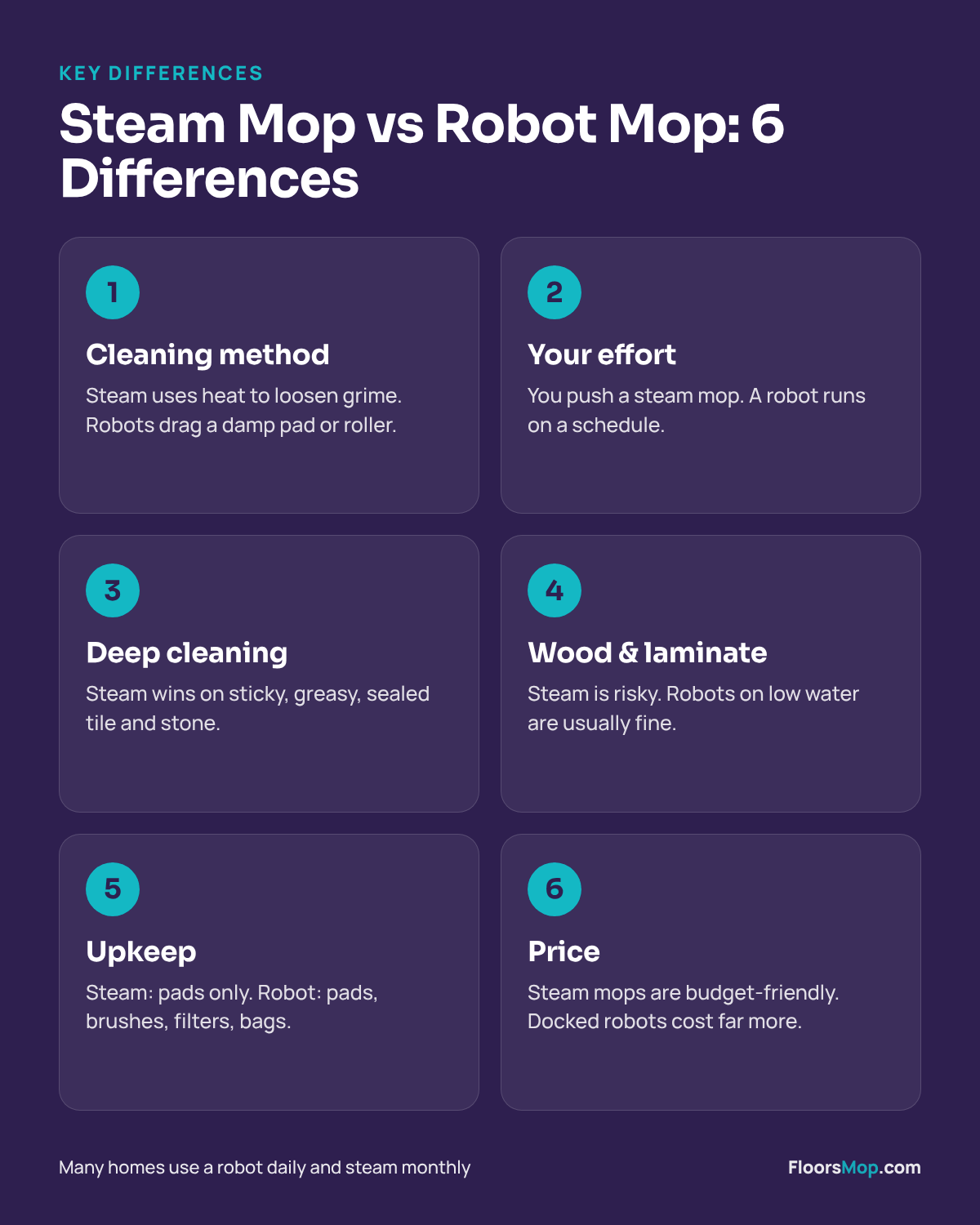
Steam Mop vs Robot Mop at a Glance
| Feature | Steam mop | Robot mop | Edge |
|---|---|---|---|
| How it cleans | Hot steam through a microfiber pad | Damp pad (or spinning pads/roller) dragged by a robot | Steam for stuck-on grime |
| Your effort | You push it, room by room | Runs on a schedule while you are out | Robot |
| Deep cleaning power | High on sealed hard floors | Light to moderate; best for daily film and dust | Steam |
| Hardwood and laminate | Risky; many makers say no steam | Usually fine with low water settings | Robot |
| Corners and edges | Good, you steer it | Varies; some models extend a pad, others miss edges | Steam |
| Chemicals needed | Water only (many models want distilled) | Water, sometimes a brand-approved solution | Tie |
| Upfront cost | Budget to mid-range | Mid-range to premium | Steam |
| Ongoing cost | Pads, sometimes a filter | Pads, filters, brushes, bags, base station solution | Steam |
| Storage | Slim, hangs in a closet | Needs a dock (large if self-washing) | Steam |
Key Differences
Cleaning performance
A steam mop heats water in a small boiler and pushes steam into a microfiber pad. Heat softens sticky spills, dried juice, kitchen grease and the dull film that builds up on tile. Because you move it slowly and can hold it over a spot, it gets more done on tough messes in a single pass than almost any robot.
A robot mop cleans with a damp pad and gentle pressure. Higher-end models add vibrating pads, twin spinning pads, or a roller that is rinsed as it goes, which helps with light dirt and footprints. Even so, most owners say robots are best at keeping floors clean, not rescuing very dirty ones. A dried coffee spill may need several passes or a quick hand scrub.
Ease of use
This is where robots win clearly. Once the map is set up, you choose rooms in an app and the robot handles it. Models with a self-washing base also clean and dry their own pads. A steam mop asks you to fill the tank, wait for it to heat (usually under a minute), and push it around. It is not hard work, but it is work, and you need to keep the cord or tank level in mind.
Floors and surfaces
Steam is great on sealed ceramic and porcelain tile, sealed stone, and many sealed vinyl floors. It is the wrong tool for unsealed wood, waxed floors, and most laminate, because heat and moisture can push into seams. Read our guide on whether steam mops are safe for hardwood before you try it on wood.
Robot mops use small amounts of room-temperature water, so they suit more floor types, including sealed hardwood and laminate when you choose a low water setting. Most also lift their pads or avoid rugs so carpets stay dry. The catch: robots need clear floors. Cords, socks and pet toys get in the way.
Hygiene and odors
Heat helps break down grime and residue, which is why many people like steam in kitchens and bathrooms. Do not expect a steam mop to sanitize a floor like a lab tool, though: the steam cools fast once it leaves the head, and results depend on how long you hold it in one place. Robots do not use heat on the floor. Some bases wash pads with warm or hot water and then dry them, which helps prevent the sour smell that damp pads can develop.
Running costs and upkeep
A steam mop has very few parts that wear out: pads you can machine wash, and on some models a scale filter. Many makers recommend distilled water to slow mineral buildup. If your mop stops steaming, our Shark steam mop troubleshooting guide covers the common causes.
A robot has more consumables: mop pads or rollers, side brushes, main brushes, filters, dust bags for self-emptying docks, and sometimes a cleaning solution. None of these is expensive on its own, but they add up over a year. Batteries also wear down after a few years of daily use.
Price and value
Steam mops are among the cheapest powered floor cleaners you can buy. Robot mops start higher, and models with a self-emptying, self-washing dock sit at the premium end. Value depends on how often you will actually use it. A robot that runs five times a week can be worth more than a steam mop that sits in the closet, and the opposite is true if you only clean on weekends.
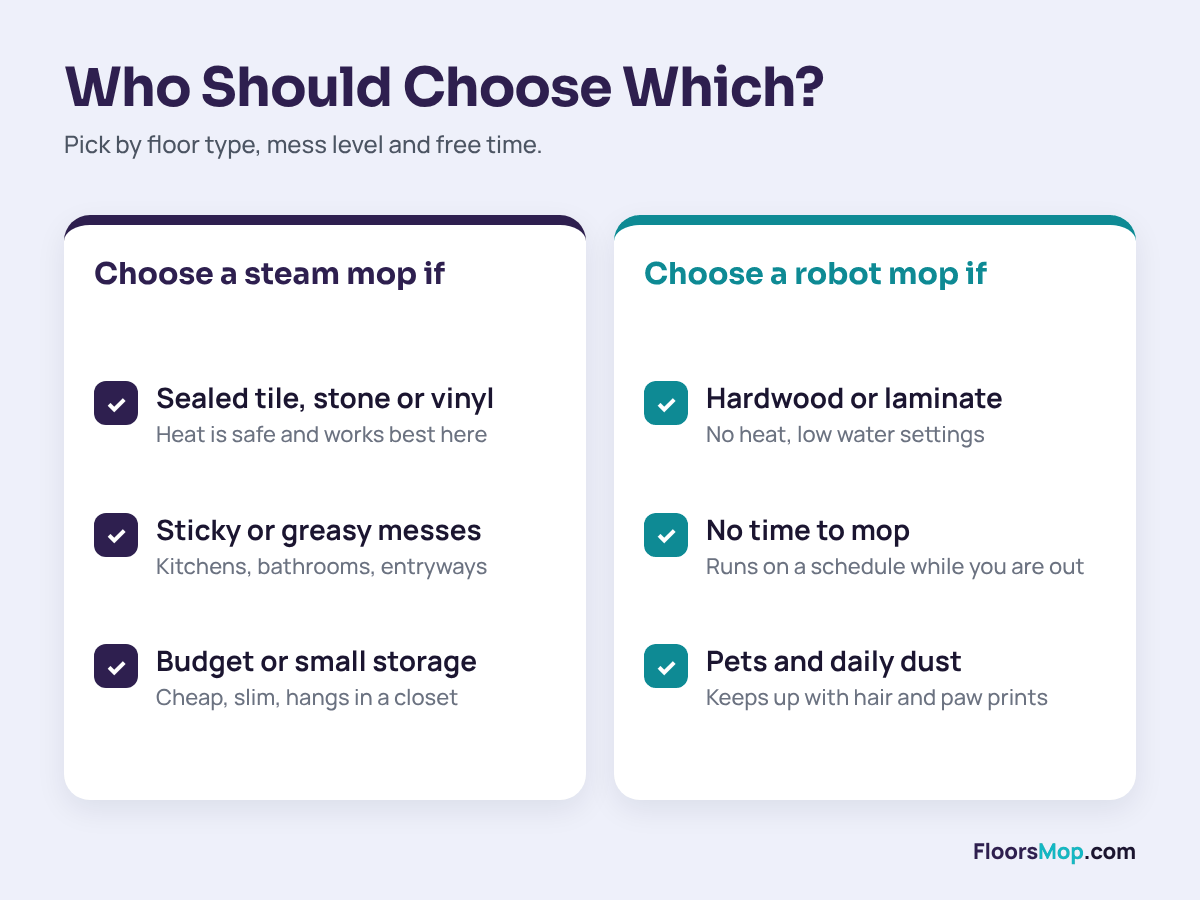
Choose a Steam Mop If…
- Most of your hard floors are sealed tile, stone, or sealed vinyl.
- You deal with sticky kitchen spills, greasy film, or bathroom grime.
- You want a chemical-free deep clean using just water.
- You have a smaller budget or limited storage space.
- You do not mind 15 to 30 minutes of hands-on cleaning a week.
Popular choices include the Bissell PowerFresh steam mop and the Shark Steam & Scrub, which adds rotating pads for extra scrubbing. For more picks, see our list of the best steam mops for tile floors.
Choose a Robot Mop If…
- You have sealed hardwood or laminate that should not be steamed.
- You want floors kept clean daily without thinking about it.
- You have pets or kids that leave a steady trail of dust and paw prints.
- Your floor plan is fairly open and you can keep clutter off the floor.
- You are willing to pay more upfront and keep up with parts.
Most buyers now pick a vacuum-and-mop combo with a dock, such as the Roborock Q Revo or the Eufy X10 Pro Omni, both of which wash their own mop pads. Not sure the category is for you? Read is a robot mop worth it for the honest pros and cons.
Can You Use Both?
Yes, and for many homes it is the best answer. Let the robot handle daily dust, crumbs and light film. Then once every week or two, steam the kitchen and bathroom tile where grime builds up. This keeps the hands-on job short because the robot has already done most of the work. Just keep the steam mop off any floor the robot cleans because it is wood or laminate.
| Your home | Best setup |
|---|---|
| Mostly tile, small apartment | Steam mop only |
| Mostly hardwood or laminate | Robot mop (or a flat microfiber mop) |
| Mixed floors, busy household | Robot for daily upkeep + steam mop for tile |
| Large home, little free time | Robot with a self-washing dock |
| Tight budget | Steam mop or a manual spray mop |
Consider Instead: A Wet-Dry Vacuum Mop
If you want more cleaning power than a robot without the heat of steam, look at a cordless wet-dry vacuum mop such as the Tineco Floor One S5 or Bissell CrossWave Cordless. These scrub with a wet roller and suck the dirty water back up, so they handle spills and sticky spots well. You still push them, but they vacuum and mop in one pass.
FAQs
Is a robot mop as good as a steam mop?
Not for deep cleaning. A steam mop removes stuck-on grime faster on sealed hard floors. A robot mop is better for frequent, effortless maintenance, and it is safer on hardwood and laminate.
Can a robot mop replace regular mopping?
For many homes it can handle most routine mopping. Expect to spot-clean dried spills by hand and to do an occasional deeper clean in kitchens and bathrooms.
Do any robot mops use steam?
Mainstream robot mops do not steam the floor. Some docks wash pads with hot water or dry them with warm air, but the mopping itself uses room-temperature water.
Which is better for pet owners?
A robot combo is usually better day to day because it picks up hair and paw prints constantly. A steam mop is useful for occasional accidents on sealed tile after you have removed the mess.
Which uses less water?
Both use far less water than a bucket and string mop. Steam mops turn a small tank into vapor; robots release water slowly onto a pad. Either one leaves floors dry in minutes.
Verdict
Pick a steam mop if you have sealed tile or stone and want a cheap, powerful deep clean. Pick a robot mop if you want daily clean floors with no effort, or if your home is mostly wood or laminate. If you can afford both, use the robot for upkeep and the steam mop for a periodic deep clean.
Related Guides
- What Floors Can You Use Steam Mops On?
- Do Steam Mops Need Distilled Water?
- Are Steam Mops Good for Tile Floors?
- Is a Robot Mop Worth It?