Are Steam Mops Good for Bamboo Floors?

Quick Answer
No, steam mops are not good for bamboo floors, and most bamboo manufacturers explicitly warn against them. Bamboo is a grass that swells and warps when it absorbs moisture, and the heat and vapor from a steam mop can force water past the finish and into the seams. If you’re set on a wet-cleaning method, a steam mop on wood floors carries the same risk, so a barely-damp microfiber mop is the safer route.
Why Steam Mops Are Risky on Bamboo
- It’s a grass, not a hardwood: bamboo’s cell structure absorbs and releases moisture faster than oak or maple.
- Heat opens the seams: hot vapor can work its way between planks even on a well-sealed floor.
- Damage isn’t reversible: cupped or warped boards usually need to be replaced, not repaired.
- Warranties often exclude it: many bamboo manufacturers void coverage if a steam mop caused the damage.
- Strand-woven is sturdier, not immune: it resists moisture better than solid bamboo, but it can still be damaged.
What to Use Instead
- A microfiber flat mop wrung out until it’s just damp, paired with a pH-neutral bamboo or hardwood cleaner.
I’ve refinished, repaired, and mopped a lot of bamboo over the years, and it’s one of the floors I get asked about most. Bamboo looks like hardwood, gets marketed like hardwood, but behaves more like a grass mat once water gets involved. That difference is exactly why steam mops trip people up.
In this guide, I’m covering why steam is risky, how solid, engineered, and strand-woven bamboo react differently, what to use instead, and how to catch damage early if it’s already happened.
In This Guide
- What Is Bamboo Flooring, and Why Does It React to Water?
- Are Steam Mops Safe for Bamboo Floors?
- Why Steam Can Damage Bamboo Flooring
- Solid vs. Engineered vs. Strand-Woven: Does the Type of Bamboo Matter?
- Steam Mop vs. Other Mop Types for Bamboo Floors
- How to Clean Bamboo Floors Without a Steam Mop
- If You Still Want to Try a Steam Mop, Read This First
- Signs Your Bamboo Floor Has Moisture or Heat Damage
- How Often Should You Clean Bamboo Floors?
What Is Bamboo Flooring, and Why Does It React to Water?
A bamboo floor is made from bamboo stalks that are sliced, boiled or carbonized, and pressed into planks. It’s often sold alongside hardwood, but botanically, bamboo is a grass.
That distinction matters for cleaning. Grass fibers are more porous and less dense than the ring-structured cells in oak, maple, or hickory.
A steam mop is a floor-cleaning appliance that heats water into vapor and releases it through a mop head, usually with light scrubbing action. On sealed tile or stone, that vapor evaporates quickly and does no harm.
On a floor built from compressed plant fiber, the same vapor behaves differently. It can be drawn into any gap, crack, or worn spot in the finish before it has a chance to evaporate.
Section takeaway: Bamboo is grass, not hardwood, and its fiber structure absorbs moisture faster than the wood species steam mops are sometimes (cautiously) used on.
Are Steam Mops Safe for Bamboo Floors?
No. This is one of the few areas where manufacturers, flooring associations, and cleaning experts largely agree.
The National Wood Flooring Association’s installation guidelines call for keeping interior relative humidity between 35% and 55% for most wood flooring, and steam pushes moisture levels far past that in a very localized, concentrated way. One bamboo manufacturer’s own care guide tells owners never to use a steam mop or wet-mop, since standing water can cause permanent damage, dull the finish, or lead to cupped boards.
I’ve seen this play out in a rental property I helped a friend clean up. She’d used a steam mop weekly for about four months on strand-woven bamboo in her kitchen, and the boards nearest the sink started cupping at the edges.
That’s the pattern I see most: damage doesn’t show up after one pass. It builds slowly, then shows up all at once.
- First use: may look fine, no visible change.
- Weeks 2-8: finish may start looking slightly duller in high-steam zones.
- Months 2-6: edge cupping, gapping, or a slightly spongy feel underfoot near seams.
- 6+ months of regular steam use: visible warping, discoloration, or delamination in engineered planks.
Section takeaway: Steam mops aren’t safe for bamboo, and the damage they cause is usually gradual, which is why so many people don’t connect the two until months later.
Why Steam Can Damage Bamboo Flooring
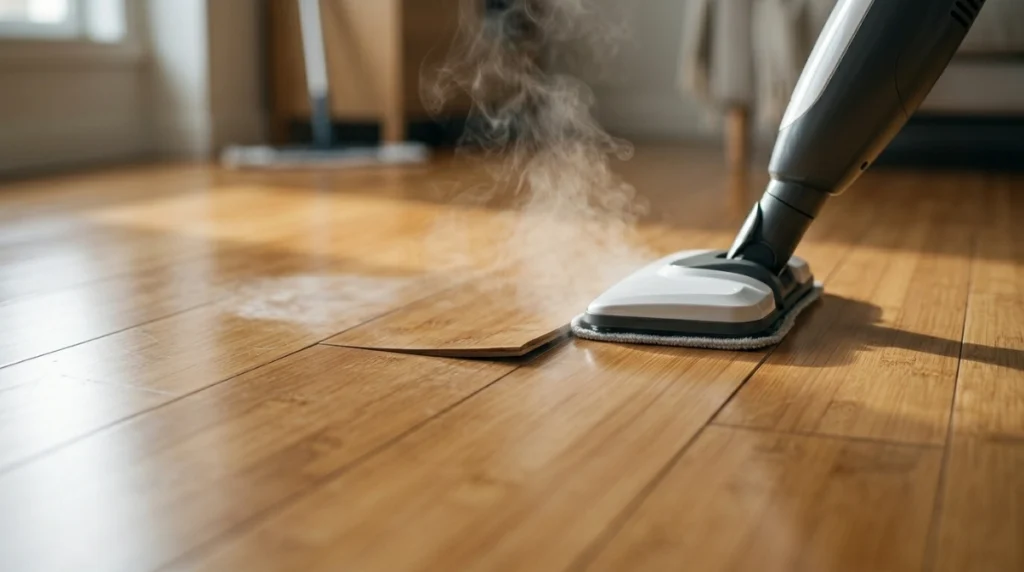
Two things make steam risky on bamboo: heat and moisture, working together instead of separately.
Moisture Absorption
Bamboo fiber swells when it takes on moisture, then shrinks again as it dries out. Do that cycle repeatedly and the wood cells lose their ability to hold a tight, even shape.
That’s what produces cupping, where the edges of a plank sit higher than the center. It’s also what causes gapping, where boards pull apart at the seams as they dry unevenly.
Heat and the Finish
Steam mops typically run at 200°F to 250°F at the nozzle. That heat softens the polyurethane or oil finish on top of the bamboo just enough to let vapor slip through hairline cracks invisible to the eye.
Safety note: even a factory finish rated for moderate humidity isn’t rated for direct, repeated steam contact — check your specific product’s care sheet before assuming it’s the exception.
Subfloor and Core Damage
Moisture that gets past the finish doesn’t stop at the surface. It travels down into the plank core and, in glued-down installations, into the subfloor underneath.
Manufacturers generally want the moisture differential between the subfloor and the bamboo planks to stay within about 3% to 4%. A single steam mopping session can push that number well out of range in the treated area, even if the rest of the room stays fine.
Section takeaway: Steam damages bamboo through two separate mechanisms at once — moisture swelling the fiber and heat compromising the finish — which is why the damage is often worse than a simple wet mop would cause.
Solid vs. Engineered vs. Strand-Woven: Does the Type of Bamboo Matter?
Not all bamboo flooring is built the same way, and that changes how fast moisture damage shows up.
| Bamboo Type | Construction | Moisture Sensitivity | Steam Mop Safe? |
|---|---|---|---|
| Solid horizontal/vertical grain | Bamboo strips glued in layers, minimal compression | Highest — absorbs humidity readily | No |
| Strand-woven | Shredded fiber compressed under extreme pressure | Roughly 30% more dimensionally stable than solid bamboo, but still reactive | No |
| Engineered bamboo | Thin bamboo veneer over a plywood or composite core | Moderate on the surface, high risk at seams and edges | No |
| Rigid-core / hybrid bamboo | Bamboo layer over a rigid waterproof core | Lower at the core, but the bamboo veneer itself is not waterproof | Still not recommended |
Strand-woven bamboo is the toughest of the group because the manufacturing process compresses the fiber so tightly. Even so, tough is relative — it’s more resistant to humidity swings, not waterproof.
Section takeaway: Strand-woven bamboo handles moisture better than solid bamboo, but “more resistant” is not the same as “steam safe,” and no bamboo type on this list gets a green light.
Steam Mop vs. Other Mop Types for Bamboo Floors
If steam is off the table, it helps to see how the alternatives actually compare.
| Mop Type | Water Exposure | Bamboo-Safe? | Best For |
|---|---|---|---|
| Steam mop | High (hot vapor) | No | Sealed tile, stone, vinyl |
| Spin mop | Medium-high unless wrung well | Only if nearly dry | Tile, sealed laminate |
| Microfiber flat mop | Low, fully adjustable | Yes | Bamboo, hardwood, laminate |
| Dust mop / dry mop | None | Yes | Daily maintenance, all floors |
| Cordless electric mop | Low to medium, depends on setting | Yes, on lowest water setting | Bamboo, hardwood, LVP |
I compare steam mops against spin mops in more detail elsewhere on the site, and the water-control issue shows up there too.
The pattern across every safe option is the same: control over how much water touches the floor, and how long it sits there.
Section takeaway: A microfiber flat mop or a low-setting cordless electric mop gives you the cleaning power of a steam mop’s alternatives without saturating bamboo’s fiber.
How to Clean Bamboo Floors Without a Steam Mop
Here’s the routine I use on bamboo, start to finish.
- Dry-sweep or vacuum with a hard-floor setting to remove grit before it scratches the finish.
- Fill a bucket with cool water and a small amount of pH-neutral bamboo or hardwood cleaner.
- Dip a microfiber flat mop pad, then wring it until it’s damp, not dripping.
- Mop in the direction of the plank seams, working in small sections.
- Go over any visibly wet spot with a dry microfiber cloth within a minute or two.
- Let the floor air-dry for 10 to 15 minutes before walking on it in socks or bare feet.
A pH-neutral cleaner made for wood or bamboo finishes tends to work best, and matching the cleaner to your floor’s specific finish matters more than the brand name on the bottle. Vinegar-and-water mixes work in a pinch, but frequent use can dull the finish over time because of the acidity, so I keep that one for occasional spot cleaning rather than a weekly routine.
Safety note: skip ammonia, bleach, and oil soaps on bamboo — they can strip the finish or leave a residue that dulls the surface.
For deeper monthly cleaning, the same damp-mop method works, just with a slightly higher concentration of cleaner and a second dry pass to make sure nothing lingers.
Section takeaway: A damp — never wet — microfiber mop with a pH-neutral cleaner, followed by a quick dry pass, gets bamboo just as clean as a steam mop without the moisture risk.
If You Still Want to Try a Steam Mop, Read This First
I get why people ask this. Steam mops feel fast, chemical-free, and satisfying to use.
If you own a steam mop already and you’re weighing whether to risk it, here’s what I’d want you to know before you do.
- Check your warranty first: most bamboo manufacturers list steam mopping as a specific exclusion.
- New, flawless finish only: any worn spot, hairline crack, or old scratch becomes an entry point for vapor.
- Lowest steam setting, constant motion: never let the mop head pause in one spot.
- Test an inconspicuous area first: a closet corner or under a rug, checked again 48 hours later.
- Accept the risk is real: even with every precaution, you’re working against the floor’s basic material properties.
Honestly, I don’t do this on my own bamboo floors, and I wouldn’t recommend it to a reader. The margin for error is too thin for a cleaning method that has a genuinely safe substitute.
Section takeaway: There’s no version of steam-mopping bamboo that’s fully safe, only versions that lower the odds of damage while leaving the underlying risk in place.
Signs Your Bamboo Floor Has Moisture or Heat Damage
Catching damage early matters, because bamboo doesn’t self-correct once it’s absorbed excess moisture.
- Cupping: plank edges sit noticeably higher than the center.
- Gapping: visible spaces open up between boards, often worse in dry seasons.
- Dull or cloudy patches: the finish loses its sheen in the areas you steam most.
- Soft or spongy spots: the plank flexes slightly underfoot near seams.
- Discoloration: darker patches that don’t match the surrounding wood tone.
- Musty smell: a sign moisture has reached the subfloor or plank core.
Once moisture damage has set into bamboo flooring, there’s very little that can actually be done to fix it in place — the usual resolution is pulling up the affected planks, drying the subfloor, and replacing them. That’s a big part of why prevention matters more here than with tile or vinyl.
Section takeaway: Cupping, gapping, and dull patches are the earliest warning signs, and catching them early can save you from a full plank replacement later.
How Often Should You Clean Bamboo Floors?
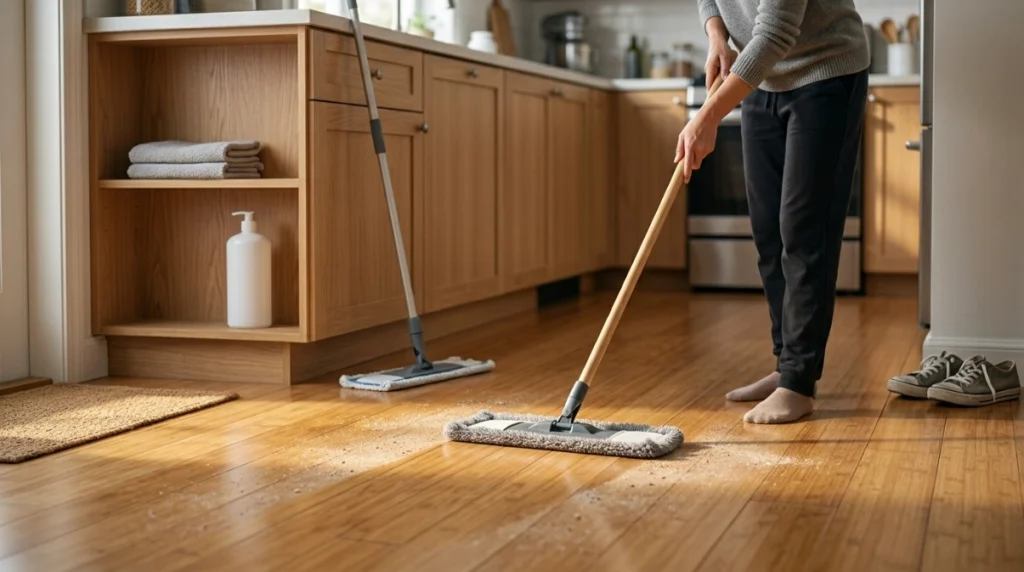
Bamboo floors do best with daily dry maintenance and a damp mop once or twice a week, adjusted for foot traffic. Kitchens and entryways usually need more frequent attention than bedrooms or hallways.
- Daily: quick sweep or vacuum in high-traffic zones.
- 1-2 times per week: damp microfiber mop with pH-neutral cleaner.
- Monthly: slightly deeper clean, same damp-mop method, extra dry pass.
- 1-2 times per year: a specialty bamboo deep-cleaning product, used sparingly since these formulas are stronger.
I keep a small stack of dry microfiber cloths near the kitchen specifically for wiping up spills the moment they happen. That single habit prevents more bamboo damage than any cleaner I’ve tried.
Section takeaway: A light daily routine plus one or two damp-mop sessions a week keeps bamboo clean without ever needing to reach for a steam mop.
Frequently Asked Questions
Can you use a steam mop on strand-woven bamboo?
No. Strand-woven bamboo resists moisture better than solid bamboo, but it’s still made from compressed plant fiber that can swell, cup, or delaminate with repeated steam exposure.
What happens if I accidentally steam mop my bamboo floor once?
A single accidental pass usually won’t ruin the floor, especially with a well-sealed finish. Dry the area immediately with a towel and watch it over the next week for dullness, cupping, or a musty smell.
Is a wet Swiffer safe for bamboo floors?
A Swiffer WetJet or similar spray mop is generally safer than steam because you control the amount of liquid, but it should still be used sparingly and wiped dry afterward.
Can I use a robot mop on bamboo floors?
Some robot mops work on bamboo if you set them to a low water flow and avoid leaving the robot running unattended near rugs or baseboards where water can pool.
Does bamboo flooring scratch easily?
Bamboo is comparable in hardness to many hardwoods, but strand-woven bamboo tends to resist scratches better than solid bamboo. Felt pads on furniture legs and regular grit removal go a long way either type.
Why does my bamboo floor smell musty after mopping?
A musty smell after mopping usually means moisture has reached the plank core or subfloor rather than just the surface. It’s worth checking nearby boards for gapping or softness and cutting back on how wet your mop is.
Is vinegar safe to use on bamboo floors regularly?
Occasional vinegar-and-water solutions are fine for spot cleaning, but frequent use can dull the finish over time due to its acidity. A pH-neutral bamboo or hardwood cleaner is the better everyday choice.
The Bottom Line on Steam Mops and Bamboo
Steam mops and bamboo floors don’t mix, no matter how tempting the convenience is. The good news is that a damp microfiber mop and a pH-neutral cleaner get bamboo just as clean, minus the risk of cupping, gapping, or a warranty claim you can’t file.
If you’re still deciding what to buy for your home, my guide on which floors are actually safe for steam mops breaks down every common surface so you know exactly where a steam mop belongs — and where it doesn’t.